
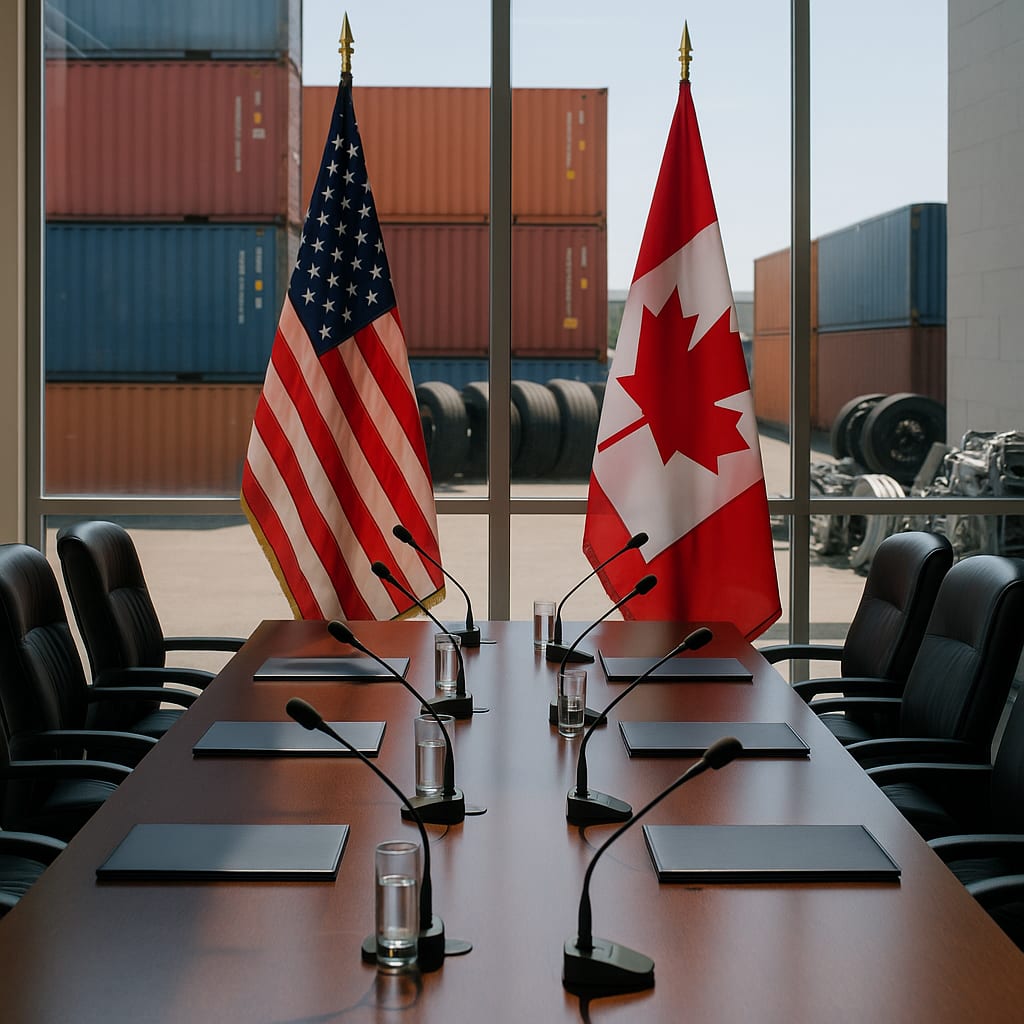
Carney conditions restart of U.S.–Canada trade talks on end to taunts as both sides escalate tariffs
Narrative Snapshot
Across outlets, there is broad agreement that Ottawa’s pause in negotiations and the latest tariff salvos are intertwined with political signaling. Multiple sources carry Prime Minister Mark Carney’s demand that Washington “stop doing memes” and “start being serious” before talks can resume, while noting Canada’s planned retaliation to U.S. duties (Fox News, The Guardian, CGTN, South China Morning Post). Reports also converge on the unusually personal nature of the dispute, from the executive order renaming Lake Ontario to “Lake America” to senior U.S. officials’ social media mockery of Canada (Fox News, CGTN).
Where they diverge is on cause and consequence. Deutsche Welle links new U.S. penalties to Ottawa’s refusal to mirror Washington’s China tariffs, framing the standoff as a sovereignty test. The Hindu attributes the breakdown to “unacceptable last-minute demands” from the U.S., while the Toronto Star highlights competing domestic narratives: Conservatives pressing Carney to explain the collapsed deal versus commentary portraying a public “hunger for independence.” The New York Times underscores that Liberals won three special elections and that polling shows strong support for Carney’s stance.
Coverage also splits on the legal and structural footing of the U.S. moves. Argentina’s Clarín questions the legality and effectiveness of invoking a 1930 statute to impose 50% tariffs. RT emphasizes maximalist U.S. demands, including urging Canadian firms to relocate south and announcing additional 50% auto and steel tariffs due January 1. On economic stakes, BBC notes cross-border impacts; Al Jazeera flags recession risks and potential job losses in Canada; CGTN warns that energy could become a next battleground, and SCMP and CGTN echo Carney’s warning that proposed U.S. terms could “wipe out” Canadian industries.
What Happened
After the U.S. imposed 50% tariffs on a range of Canadian goods in late July, with duties taking effect earlier in August (Fox News), President Donald Trump announced additional 50% tariffs on Canadian cars, parts, and steel to begin January 1 (RT). Canada responded with duties of up to 50% on U.S. products, targeting sectors such as dairy, seafood, appliances, and construction materials (CGTN). Ottawa had suspended talks on August 21, citing unacceptable last-minute U.S. demands to avert further tariffs (The Hindu). As tensions escalated, Trump signed an order renaming Lake Ontario “Lake America,” and senior U.S. officials mocked Canada online (Fox News, CGTN). Carney said negotiations could resume if Washington ended public taunts and presented serious terms, warning U.S. proposals threatened key Canadian industries (Fox News, The Guardian, SCMP, CGTN). Deutsche Welle links added penalties to Ottawa’s refusal to match U.S. China tariffs, while Clarín questions the legal basis under a 1930 law. Domestically, Canada’s Liberals won three special elections and polling showed support for Carney’s retaliatory tariffs (New York Times).
Why It Matters
This episode tests the resilience and scope of North American trade governance. Analysts warn the current tariff regime could cost Canada significant jobs and raises recession risks if institutional backstops fray further (Al Jazeera). Deutsche Welle frames the dispute as a sovereignty clash over whether U.S. security- and China-focused tariff strategies set continental rules. Clarín’s reporting that Washington invoked Section 338 of 1930 with contested legality highlights how older unilateral tools are being repurposed, with potential precedent for future executive action. The asymmetry—Canada’s heavier export dependence on the U.S. than vice versa—features prominently in accounts of structural leverage (Telesur). Inside Washington, the fight is now a campaign flashpoint as House Republicans engage the U.S. Trade Representative (Fox News), while in Ottawa the policy line has electoral salience amid special-election wins and polling support for retaliatory tariffs (New York Times). For decision-makers, the mix of legal uncertainty, domestic politics, and supply-chain exposure now shapes negotiation space as much as tariff math.
Diverging Narratives
Competing explanations for the rupture run through the coverage. The Hindu reports Canada walked away after last-minute U.S. demands; Deutsche Welle ties new penalties to Ottawa’s refusal to align with Washington’s China tariffs, casting the dispute as a test of “economic sovereignty.” Carney’s own framing—insisting insults end and warning U.S. terms could “wipe out” Canadian industries—anchors much international coverage (SCMP, CGTN, The Guardian). On the U.S. side, Trump’s posts labeling Canada an abuser and deriding Canadian products, coupled with an executive order renaming Lake Ontario, project a maximalist posture (RT, Fox News).
Assessments of legality and efficacy diverge as well. Clarín notes legal doubts over using a 1930 statute to levy 50% tariffs, suggesting potential challenges and limited effectiveness. By contrast, RT amplifies the administration’s leverage claims and relocation push. Outlets also weight impacts differently: BBC emphasizes pain on both sides of the border; Al Jazeera cites recession and job-loss risks in Canada; CGTN flags rising costs for U.S. firms and the prospect that energy becomes a next battleground. In Canada’s domestic arena, the Toronto Star presents a split view—Conservatives pressing Carney for an accounting of the failed deal even as commentary describes a public energized by a more independent line—while the New York Times points to immediate political payoff for the governing Liberals.
What Happens Next
Whether talks restart hinges on tone and terms: Carney has conditioned reengagement on an end to public taunts and a shift to “serious” negotiations (Fox News, The Guardian, CGTN, SCMP). Analysts should watch for changes in White House and Cabinet messaging, and for concrete outreach from the U.S. Trade Representative, who is already in discussions with House Republicans amid intraparty scrutiny (Fox News).
On trade measures, key indicators include whether the announced 50% auto, parts, and steel tariffs take effect on January 1 as stated (RT) and how Canada calibrates its retaliatory list, including any movement toward energy, which some analysts flag as a potential next front (CGTN). The legal trajectory bears monitoring: Clarín reports doubts about the 1930 statute underpinning U.S. tariffs, implying possible challenges. Domestically, Canadian polling and recent special-election outcomes (New York Times) and opposition demands for clarity on the collapsed deal (Toronto Star) will shape Ottawa’s latitude, just as congressional Republicans’ engagement will shape Washington’s. Economic indicators—cross-border costs and sectoral stress—will signal how much pressure both sides face to adjust course (BBC, Al Jazeera).