
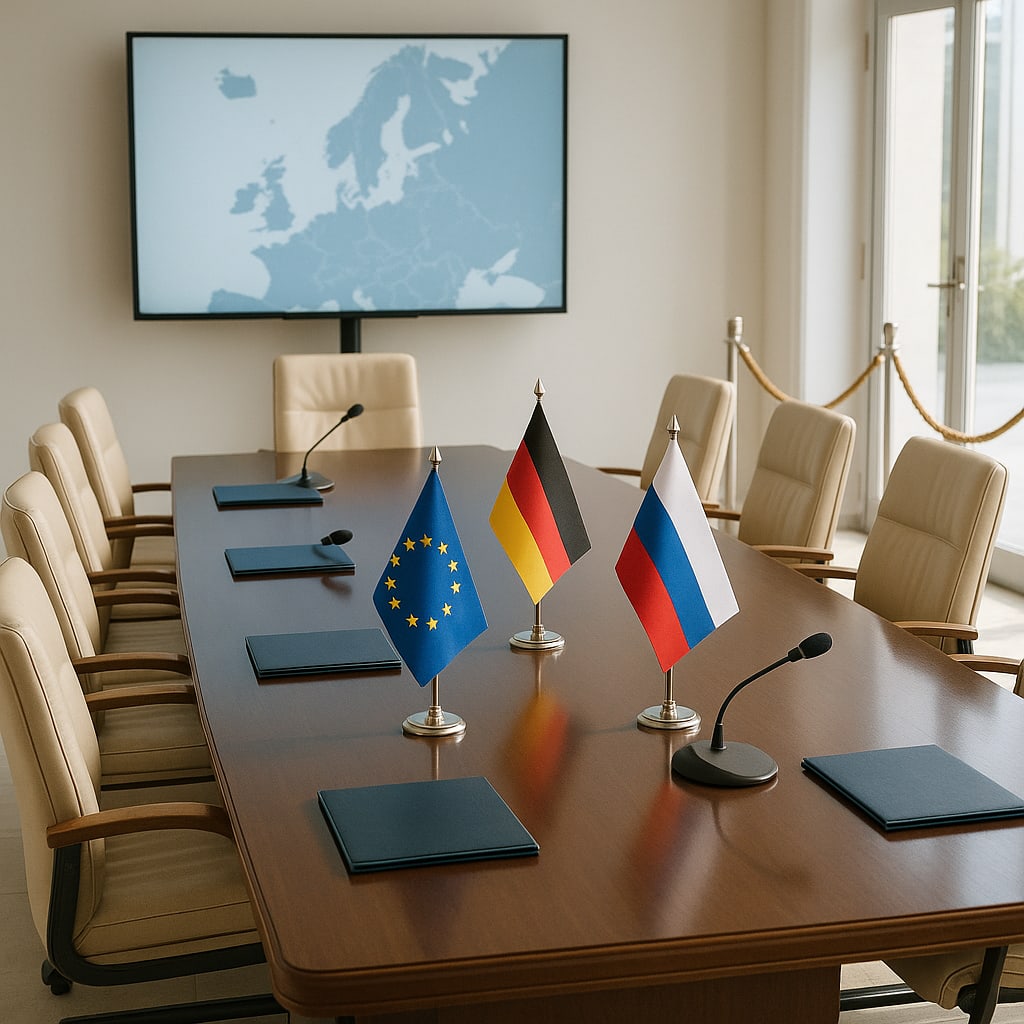
Germany closes Russian institutions over Leipzig drone case; Moscow responds by shuttering Goethe-Institut branches
Narrative Snapshot
Across European and global outlets, there is broad alignment on the sequence: Berlin publicly attributed the foiled Leipzig/Halle airport incident to Russia and announced closures of the Russian Consulate General in Bonn and the Russian House in Berlin; Moscow then said it would shut branches of Germany’s Goethe-Institut in Russia. France24, Al Jazeera English, Deutsche Welle, Bangkok Post, The Hindu, Toronto Star, and Corriere della Sera report the reciprocal closures and the rapid spillover from a security case into the cultural-diplomatic realm.
Framing diverges most sharply between Ukrainian, Italian, and Western reporting on one side and Russian state media on the other. Ukrinform and La Repubblica emphasize Germany’s institutional closures as overdue in light of Russia’s invasion and depict the Russian House as a suspected intelligence node, a characterization also echoed by France24. By contrast, RT and TASS portray Berlin’s steps as grounded in a “far‑fetched” or “false pretext,” asserting Germany has presented no public evidence and criticizing German political and media narratives as escalatory.
What is most at stake is the collapse of cultural channels that had persisted even amid broader confrontation. Lavrov’s remarks, reported by The Hindu and Kyiv Independent, that Germany’s move “means the end of their cultural presence in Russia,” crystallize how a counterintelligence case is being translated into the withdrawal of soft-power infrastructure. In parallel, Brussels’ posture—EU envoys summoning Russian diplomats and leaders signaling potential sanctions, as reported by Bangkok Post and Al Jazeera—positions the episode within the EU’s collective response to alleged Russian hybrid operations.
What Happened
German authorities linked a failed August 4 explosive‑laden drone operation at Leipzig/Halle Airport—discovered near a Ukrainian Antonov cargo aircraft—to Russia, and announced closures of Russia’s consulate in Bonn and the Russian House cultural center in Berlin (France24; Fox News; Ukrinform; La Repubblica). Interior Minister Alexander Dobrindt cited forensic and intelligence findings; officials also said a second drone collided with a nearby cargo aircraft and that the explosive failed due to a faulty detonator (Fox News). The European Union expressed solidarity, with member states summoning Russian envoys and considering additional sanctions (France24; Bangkok Post; Al Jazeera English). Moscow denied involvement, with Maria Zakharova calling Berlin’s claims “far‑fetched” and unsupported by evidence (RT), and TASS labeling the German decisions a “false pretext.” In response, Foreign Minister Sergey Lavrov announced Russia would close Goethe‑Institut branches, including in Moscow, St. Petersburg, and Yekaterinburg (Deutsche Welle; The Hindu; Toronto Star; Al Jazeera English; Bangkok Post). Putin called Berlin’s sanctions move a “mistake” (Japan Times).
Why It Matters
Germany’s framing of the Leipzig case as part of a “well‑established pattern of Russian hybrid operations in Europe” (Fox News) moves another sensitive file from criminal investigation into interstate retaliation and collective security politics. EU institutions quickly signaled alignment—solidarity statements, summoning envoys, and exploration of sanctions (France24; Bangkok Post; Al Jazeera English)—reinforcing the bloc’s coordination on Russia policy after previous packages. NATO’s assurance that it would defend members (France24) underscores how even non‑Article 5 hybrid incidents can catalyze alliance messaging.
The episode also extends the attrition of cultural and people‑to‑people ties. Germany’s move against the Russian House and Moscow’s announced closures of Goethe‑Institut branches elevate cultural diplomacy to an instrument and target of coercive signaling. Lavrov’s statement that this “means the end of [Germany’s] cultural presence in Russia” (The Hindu; Kyiv Independent) points to a structural retreat of soft power channels that had survived earlier phases of the conflict, with implications for civil society contact, language education, and the operating environment for non‑political exchange.
Diverging Narratives
German officials assert a link between the Leipzig/Halle devices and Russian activity, citing forensic and intelligence findings and situating the incident near Ukrainian cargo aircraft (Fox News). Allied political signaling—EU solidarity and consideration of sanctions, plus UK, Estonian, and Polish backing reported by France24—aligns with Berlin’s attribution and response. Italian and Ukrainian outlets further foreground the security rationale by describing the Russian House as a suspected spy hub and noting the delayed timing since the 2022 invasion (La Repubblica; France24; Ukrinform).
Russian state narratives reject both the attribution and the proportionality of the response. RT calls Berlin’s case “fabricated” and “reckless,” emphasizing the absence of publicly presented evidence and criticizing domestic German media dynamics. TASS characterizes the closures as based on a “false pretext” that the drone was Russian. Putin’s description of sanctions as a “mistake” (Japan Times) and Lavrov’s framing that any milder response would lack “self‑respect” (The Hindu) invert the escalation logic by portraying Moscow’s cultural closures as compelled reciprocity. A core unresolved point across this coverage is the evidentiary threshold: Western outlets relay official conclusions and allied support, while Russian outlets highlight that detailed proof has not been disclosed publicly.
What Happens Next
EU deliberation over sanctions is the pivotal policy hinge. Aligned statements from EU officials and member states’ summons of Russian envoys (Bangkok Post; Al Jazeera English) set up a decision on whether, and how broadly, to expand measures; Germany’s intent to draw up a new list of individuals and act against a “shadow fleet” was reported by RT, so analysts should watch whether Berlin formalizes these elements at national or EU level. On the cultural track, Lavrov named closures in Moscow, St. Petersburg, and Yekaterinburg (The Hindu), with multiple branches referenced more generally (Bangkok Post); monitoring official decrees will clarify scope and timing.
In Germany, the announced shutdown of the Bonn consulate and termination of the Russian House lease (France24; Fox News) will proceed on set timelines; additional steps flagged in RT’s account—such as tighter border controls for Russian nationals—bear watching for formal adoption. A key evidentiary indicator will be whether German authorities release further details substantiating attribution beyond current statements, a gap highlighted by RT and TASS.