
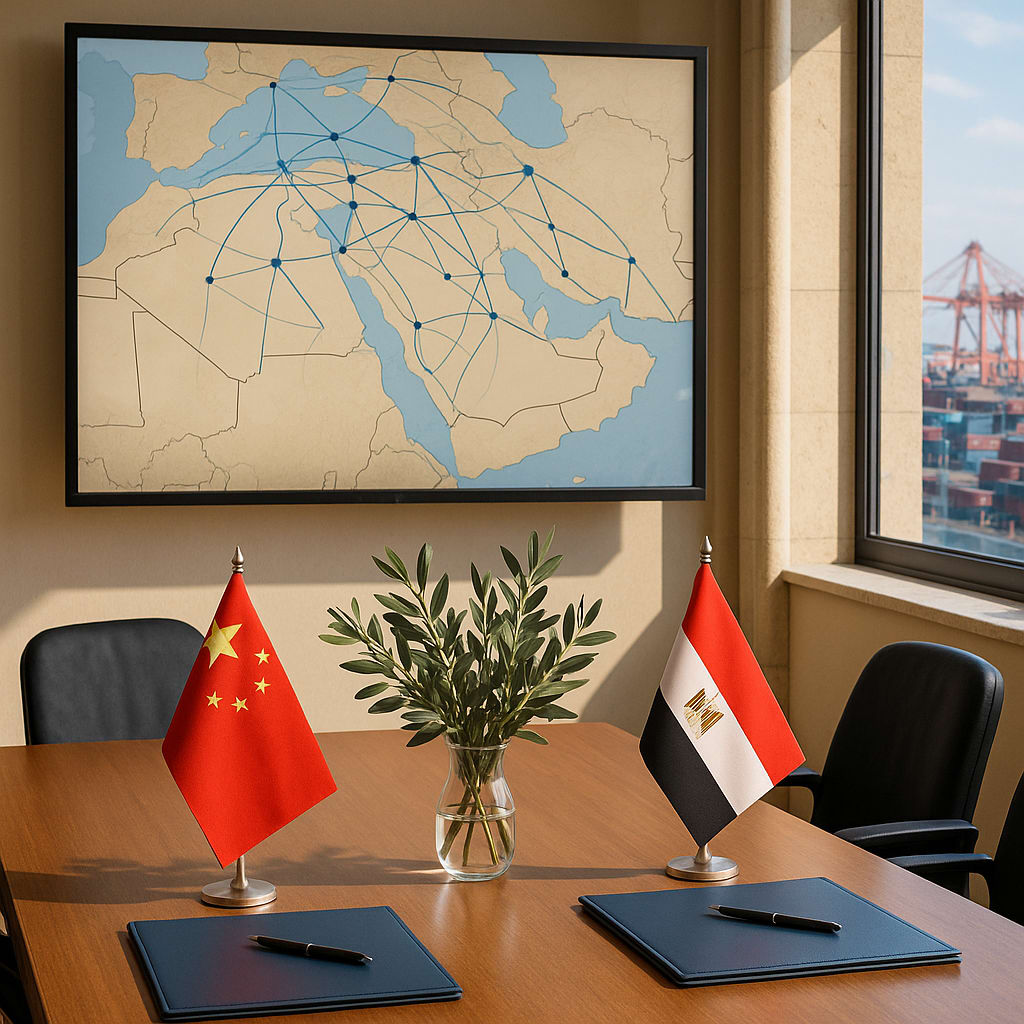
Xi’s Egypt visit couples new China–Egypt agreements with a call for region-led Middle East security
Narrative Snapshot
Across outlets there is broad agreement that Xi Jinping used a rare stop in Cairo to pair new bilateral commitments with a regional message: Middle Eastern states should be “masters of their own affairs,” resisting “external interference,” while prioritizing de-escalation and dialogue. Chinese and Egyptian readouts emphasize the 70th anniversary of diplomatic ties, a refreshed comprehensive strategic partnership, and a joint statement placing the Palestinian question at the core of the region’s agenda, including support for a sovereign Palestinian state on 1967 borders with East Jerusalem as its capital. Coverage also notes tangible cooperation, from signed documents in Belt and Road, artificial intelligence, trade, and supply chains to cultural diplomacy and a museum tour.
International media diverge on framing. U.S. and European outlets interpret the visit as testing Washington’s role amid ongoing conflict dynamics, with the New York Times and France24 positioning the trip as a bid to expand Beijing’s influence while the Iran conflict strains the traditional U.S. security umbrella. The Japan Times and the Times of Israel foreground U.S. sanctions pressure linked to Iran, with the latter warning Egyptian and Chinese banks could be exposed to tightened measures. Al Jazeera situates the talks against what it describes as the US-Israel war on Iran; Hong Kong’s South China Morning Post reads Xi’s security appeal as a signal to reduce reliance on Washington without casting China as a replacement guarantor.
A separate current in the coverage highlights military and economic instruments. The South China Morning Post reports Chinese J-16 fighters, supported by YU-20 tankers, flew to Egypt for the Eagles of Civilisation exercise alongside Egyptian Rafales and MiG-29s—the first J-16 deployment to Africa—underscoring expanding operational reach. Chinese state media largely foreground non-interference, development, and cultural ties, spotlighting long-running Belt and Road projects such as the Suez cooperation zone and Cairo’s new Central Business District. Middle East Eye includes an argument that the partnership is driven by pragmatic economics rather than great-power rivalry, echoing commentary on CGTN that stresses bridge-building over polarization.
What Happened
Xi Jinping visited Egypt for the first time in a decade, meeting President Abdel Fattah el-Sisi in Cairo and calling for Middle Eastern countries to “be the masters of their own affairs,” oppose “external interference,” and reshape regional security through dialogue and de-escalation. China and Egypt issued a joint statement welcoming efforts to ease tensions across the Gulf and the broader region, with China commending Egypt’s role in regional security and Egypt endorsing Xi’s regional proposals. Both leaders reaffirmed that the Palestinian question is central, backing a sovereign state on 1967 borders with East Jerusalem as capital. Marking 70 years of ties, the two sides signed multiple cooperation documents spanning Belt and Road, artificial intelligence, trade, and supply chains, and highlighted ongoing projects from the Suez industrial zone to Cairo’s new CBD. The visit unfolded amid conflict and sanctions pressure involving Iran, and coincided with Chinese J-16 participation in Egypt’s Eagles of Civilisation drills.
Why It Matters
The visit links China’s development-first, non-interference framing to a U.S.-aligned state central to Arab politics, testing how far regional actors can diversify security discourse without seeking a new external guarantor. France24 and the Japan Times situate the outreach within an environment where war with Iran and sanctions instruments challenge assumptions about the U.S. umbrella, while the South China Morning Post underscores Beijing’s message to reduce reliance on Washington even as China declines to offer hard-security guarantees. Economically, the signed documents and showcased projects extend a two-decade pattern of embedding Chinese capital and firms in Egyptian infrastructure and manufacturing, from the Suez cooperation zone to Cairo’s CBD, reinforcing supply-chain and market linkages noted by Chinese outlets. Militarily, the J-16 deployment to Egypt demonstrates a maturing capacity to project airpower to protect far-flung interests. For policymakers, this combination of economic entrenchment, diplomatic messaging, and selective military reach alters the opportunity set for regional hedging and raises sanctions-compliance considerations for Egyptian and Chinese financial institutions flagged by Israeli coverage.
Diverging Narratives
Several Western and regional outlets center strategic competition. The New York Times frames the trip as challenging U.S. influence, and France24 ties Xi’s appeal for region-led security to perceived stress on the U.S. security umbrella amid the Iran conflict. The Japan Times highlights the reactivation of U.S. economic tools against Tehran, while the Times of Israel warns Chinese and Egyptian banks could face sanctions exposure tied to Iran. Al Jazeera places the leaders’ discussion within what it calls the US-Israel war on Iran, linking Xi’s security language to shifting defense calculations across the region. The South China Morning Post threads these strands together, reading Xi’s proposal as a message to Washington but emphasizing that Beijing is not positioning itself as an alternative security guarantor.
Chinese state media and pro-cooperation commentary advance a different emphasis. CGTN and China News Service foreground mutual respect for sovereignty, non-interference, de-escalation, and development deliverables, detailing agreements in Belt and Road, AI, trade, and supply chains. Their coverage highlights Egypt’s role in regional diplomacy and cultural exchange, presenting the visit as a milestone in a “best in history” relationship. Middle East Eye publishes both a wire noting Xi’s “oppose external interference” phrasing and an op-ed arguing the partnership is rooted in long-standing, results-driven economic cooperation rather than zero-sum rivalry. Meanwhile, the South China Morning Post’s reporting on joint drills adds a military capability dimension, which Chinese outlets downplay in favor of economic and diplomatic themes.
What Happens Next
Three decision points emerge. First, implementation of the signed cooperation documents will test whether headline commitments translate into expanded industrial capacity and technology ties; indicators include new phases at the China–Egypt TEDA Suez zone, additional tenants and jobs, and progress on Cairo’s CBD referenced in Chinese coverage. Second, uptake of Xi’s region-led security framing will hinge on whether Cairo and Beijing concretize de-escalation mechanisms or dialogues welcomed in their joint statement; watch for Egyptian facilitation roles that China publicly commends and any multilateral formats they endorse. Third, sanctions risk will shape financial channels around new projects; Israeli and Japanese reporting on tightened U.S. measures toward Iran suggests monitoring any U.S. actions affecting Egyptian or Chinese banks and resultant de-risking. A related military indicator is whether Chinese combat aircraft periodically redeploy to Egypt following the J-16/YU-20 exercise, signaling routineability rather than a one-off demonstration.