
South Korea reviews Hormuz deployment options as US reports 87 ship diversions amid Iran blockade
Narrative Snapshot
Across outlets, there is broad alignment that Seoul is evaluating ways to support navigation in the Strait of Hormuz while publicly denying that a final decision to deploy has been made. France24 reports that South Korea is considering sending military assets but “denied it had decided on a deployment,” and The Times of Israel cites the presidency saying local reports are “different from the facts.” The Guardian, South China Morning Post, and Le Monde place heavier emphasis on mounting US pressure, with The Guardian attributing it to Donald Trump and SCMP noting observers see South Korea potentially becoming one of the first US allies to contribute militarily.
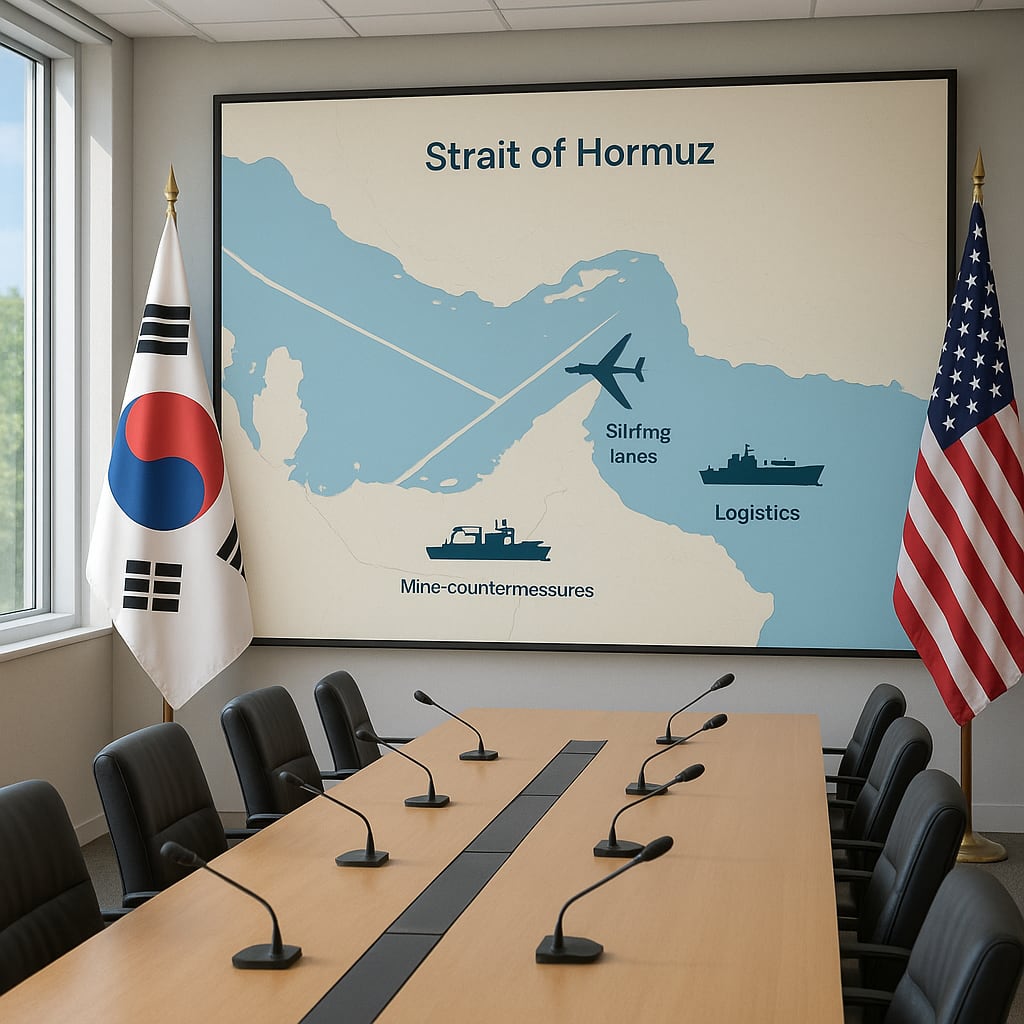
Coverage diverges on readiness and scope. Japan Times and SCMP detail concrete options reportedly under review—maritime patrol aircraft, a logistics support ship, and mine countermeasures—while The Guardian highlights a possible parliamentary-approval track that the president’s office plays down. Middle East Eye quotes a Blue House official insisting claims that Seoul has offered “no assistance” are not true, even as the same official says South Korea–US security talks are “not currently progressing,” underscoring an unsettled coordination channel.
Operational context also varies. Middle East Eye leads with US Central Command’s metrics for enforcing the Iran blockade—87 vessels diverted, three ships disabled, and two boarded—indicating a muscular enforcement posture. France24 adds that Iran launched strikes on American military targets in the Gulf, linking South Korea’s deliberations to a live regional confrontation, whereas several other outlets confine their focus to alliance dynamics and domestic political calculations in Seoul.
What Happened
US Central Command said it has redirected 87 vessels in the Strait of Hormuz, disabled three ships, and boarded two to ensure “total compliance” with what Middle East Eye describes as the naval blockade of Iran. As this enforcement continued, South Korean media reports indicated Seoul was preparing to contribute militarily to support navigation through the strait. Japan Times and the South China Morning Post reported options under review, including a maritime patrol aircraft, a logistics support vessel, and a mine detection and clearance unit. The Guardian said preparations were under way and that the government intended to seek parliamentary approval, but South Korea’s presidency pushed back, telling The Times of Israel that local reports were “different from the facts.” France24 reported Seoul’s consideration of assets while denying a decision, and also noted Iranian strikes on American military targets in the Gulf. Middle East Eye added that South Korea–US security talks were “not currently progressing.”
Why It Matters
The Strait of Hormuz is a strategically vital waterway and, as Clarin notes, crucial for global hydrocarbon transit. Elevating allied participation there would test how Indo‑Pacific partners translate “freedom of navigation” principles—explicitly invoked by France24 and Middle East Eye—into operational commitments far from home waters. South Korea’s deliberations sit at the intersection of alliance management and force availability: Le Monde highlights Seoul’s concern with preserving defenses against North Korea even as American pressure on allies intensifies. If South Korea moves ahead, SCMP reports it could be among the first US allies to contribute militarily, potentially setting a benchmark for broader burden‑sharing in contested sea lanes.
Institutionally, the process matters as much as the outcome. The Guardian’s reporting on potential parliamentary approval suggests domestic scrutiny over mandate, risk, and mission scope. Meanwhile, Middle East Eye’s note that South Korea–US security talks are not currently progressing points to coordination gaps that could affect timelines, command arrangements, and rules of engagement within any prospective multinational presence.
Diverging Narratives
Reports differ on proximity to a decision and the political pathway. The Guardian, citing unnamed sources, says preparations are under way with intentions to seek parliamentary approval, while the presidential office “plays down” such claims and The Times of Israel quotes the presidency saying reports are “different from the facts.” France24 captures both sides by noting consideration of military assets and a denial that a decision has been taken. Japan Times and SCMP emphasize concrete force packages under review, suggesting operational planning is at least scoped, whereas Middle East Eye underscores official insistence that South Korea is not absent from the effort but that bilateral security talks with Washington are “not currently progressing.”
There is also a contrast in framing the operational environment. Middle East Eye foregrounds US Central Command’s enforcement numbers and actions to compel “total compliance” with the blockade. France24 elevates the risk environment by reporting Iranian strikes on American military targets in the Gulf, a factor not foregrounded elsewhere. Le Monde and Clarin situate Seoul’s calculus within alliance pressure and energy‑transit stakes, while SCMP frames the prospective move as potentially precedent‑setting among US allies. Together, these lenses yield different interpretations of urgency, mandate, and the scale of commitment under discussion.
What Happens Next
Key decision points emerge around mandate, assets, and alliance coordination. Domestically, watch for formal moves toward parliamentary approval referenced by The Guardian; an agenda filing or government request would signal intent to proceed and define mission scope. Operationally, indicators include selection among the options reported by Japan Times and SCMP—deployment orders for a logistics support vessel, a P‑8A‑class maritime patrol aircraft, or a mine‑countermeasures unit would clarify roles and timelines. On the alliance track, any shift from Middle East Eye’s “not currently progressing” status in South Korea–US security talks would point to advancing coordination on command-and-control and rules of engagement.
Regionally, France24’s report of Iranian strikes on American targets in the Gulf establishes a volatile backdrop. Further US Central Command updates—such as additional vessel diversions or interdictions reported by Middle East Eye—would affect risk assessments and could influence whether Seoul calibrates toward limited support functions or defers a decision pending clarity on escalation.