
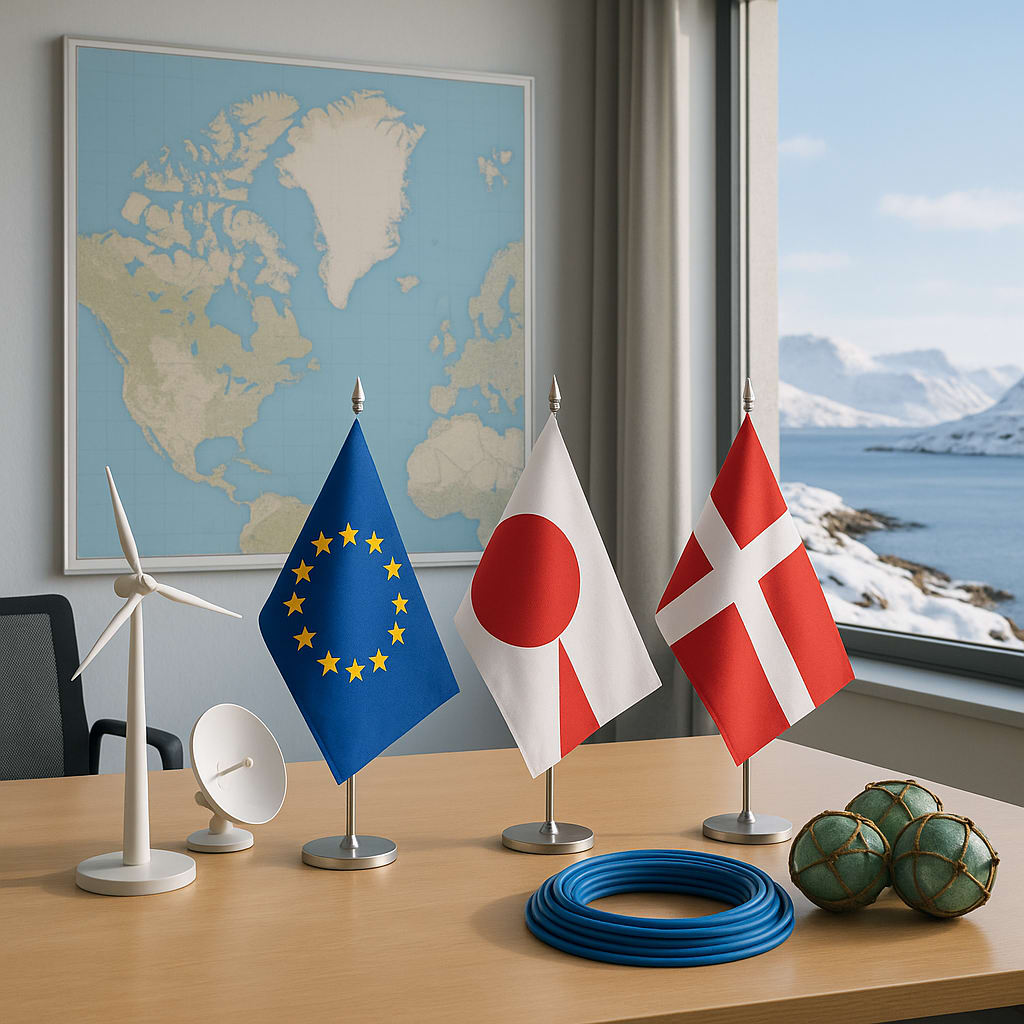
EU announces €200 million partnership package with Greenland during von der Leyen visit
Narrative Snapshot
Across outlets, there is convergence on the scale and scope of the EU package and on the framing of Greenland as a strategic partner. Multiple reports peg the investment at €200 million—roughly $232 million or £171 million—with spending directed to critical minerals, satellite communications, renewable energy, hydropower, fisheries, education, and digital connectivity. Several stories add detail on timing and instruments: coverage describes a two-year window, with CGTN specifying disbursement “this year and next year” under a Global Gateway Partnership Package, and Al Jazeera reporting a proposal to double direct EU aid to Greenland under the bloc’s next budget.
Where accounts diverge is in emphasis. European and North American outlets repeatedly situate the announcement against U.S. claims over Greenland, with France24, Deutsche Welle, Sky News, Toronto Star/AP, and Le Monde highlighting the EU move amid Donald Trump’s push for American control or annexation threats. RT underscores von der Leyen’s sovereignty language—“Greenland’s future is for the people of Greenland and Denmark to decide, no one else”—while ANSA frames the visit explicitly as an EU response to Trump and calls the Arctic a priority. By contrast, CGTN’s coverage centers on programmatic cooperation and lists a wider set of social and economic sectors, and the South China Morning Post stresses an updated partnership declaration and “hundreds of millions” in investment without detailing the confrontation.
What is most at stake in these accounts is less the headline amount than the policy levers it activates: supply chains for critical raw materials, Arctic infrastructure, and the EU’s ability to operate alongside Denmark in Greenland’s development. Several outlets tie the initiative to strategic connectivity and resource access, while others elevate the legal-normative frame of territorial integrity and consent by Greenland and Denmark.
What Happened
European Commission President Ursula von der Leyen made a two-day visit to Greenland, concluding Monday in Nuuk with the unveiling of a €200 million investment package to deepen EU–Greenland cooperation. Reports describe funding across critical minerals, satellite communications, renewable energy, climate projects, hydropower, fisheries, education, and improved internet and cable connectivity. CGTN states the package is a Global Gateway Partnership to be implemented this year and next, and that von der Leyen, Greenland’s Prime Minister Jens-Frederik Nielsen, and Denmark’s Prime Minister Mette Frederiksen signed a joint declaration reinforcing their partnership. Al Jazeera adds that Brussels has proposed doubling direct EU aid to Greenland under the bloc’s next budget. Several outlets note von der Leyen’s accompanying political message that Greenland’s future is for its people and Denmark to decide, a point highlighted by RT amid tensions raised by U.S. claims over the territory.
Why It Matters
The initiative operationalizes the EU’s geoeconomic toolkit—specifically Global Gateway—in the Arctic, linking infrastructure and social investments to strategic supply chains and communications systems. Coverage indicates a focus on critical minerals, renewable energy, and connectivity, aligning with Europe’s broader effort to secure raw materials and resilient networks. The move also interacts with existing governance structures: Greenland is an autonomous territory while Denmark oversees its foreign and security policy, and Denmark is a member of both the EU and NATO as noted by RT. By pairing a political declaration with targeted funding, the EU is signaling capacity to engage in Greenland’s development alongside Copenhagen and Nuuk.
For decision-makers, the package and the reported proposal to double direct EU aid under the next budget suggest a multi-year financial and policy commitment. The stated principles of territorial integrity and consent reinforce legal norms relevant to Arctic politics. The combined emphasis on minerals and infrastructure positions Greenland within European industrial policy and strategic connectivity agendas.
Diverging Narratives
Outlets differ chiefly in their framing. A cluster—France24, Deutsche Welle, Sky News, Toronto Star/AP, and Le Monde—foregrounds the announcement as it relates to heightened tensions following U.S. demands or threats over Greenland, with Le Monde clocking the timing at eight months after American annexation talk. RT builds its narrative around von der Leyen’s sovereignty statement that Greenland’s future is for its people and Denmark to decide, and it situates Denmark institutionally in the EU and NATO. ANSA similarly casts the visit as the EU “responding to Trump,” quoting von der Leyen in Nuuk and emphasizing that the Arctic is an EU priority. In contrast, CGTN concentrates on the mechanics of cooperation and offers the most granular sectoral breakdown, including support for housing, sustainable tourism, and small businesses, alongside minerals and connectivity; it also reports the joint declaration’s signatories and the Global Gateway label. The South China Morning Post points to a “new EU-Greenland declaration” and “hundreds of millions” in investments without specifying the exact amount, while Al Jazeera adds a budgetary angle—doubling direct aid—and notes the context of military exercises starting, which other outlets do not elaborate on.
There are informational gaps consistent across reports: none provide a detailed sector-by-sector allocation, project list, or conditionality. While multiple outlets highlight critical minerals and connectivity, they do not specify procurement modalities or access terms. The timing of disbursements is variably described as over the next two years or “this year and next year,” leaving exact scheduling and program governance for subsequent disclosures.
What Happens Next
Two decision tracks emerge from the reporting. First is budgetary: Al Jazeera’s note that Brussels has proposed doubling direct EU aid under the next budget implies an approvals process and programming decisions that will determine the scale and durability of EU financing beyond the €200 million package. Analysts should watch for formal budget documents, line-item allocations related to Greenland, and any linkage to Global Gateway.
Second is implementation: CGTN’s timeline of this year and next points to near-term project initiation in satellite and cable connectivity, hydropower, and sectoral support from fisheries to education. Procurement notices, MOUs, or licensing steps in critical minerals—highlighted by France24, Japan Times, and others—will indicate whether the package translates into concrete supply-chain partnerships. On the political side, statements reiterating sovereignty principles, as reported by RT, and any U.S., Danish, or Greenlandic responses will signal how the diplomatic framing evolves. Al Jazeera’s mention of military exercises starting provides a security backdrop; changes in exercise scope or posture would be relevant context for the partnership’s rollout.