
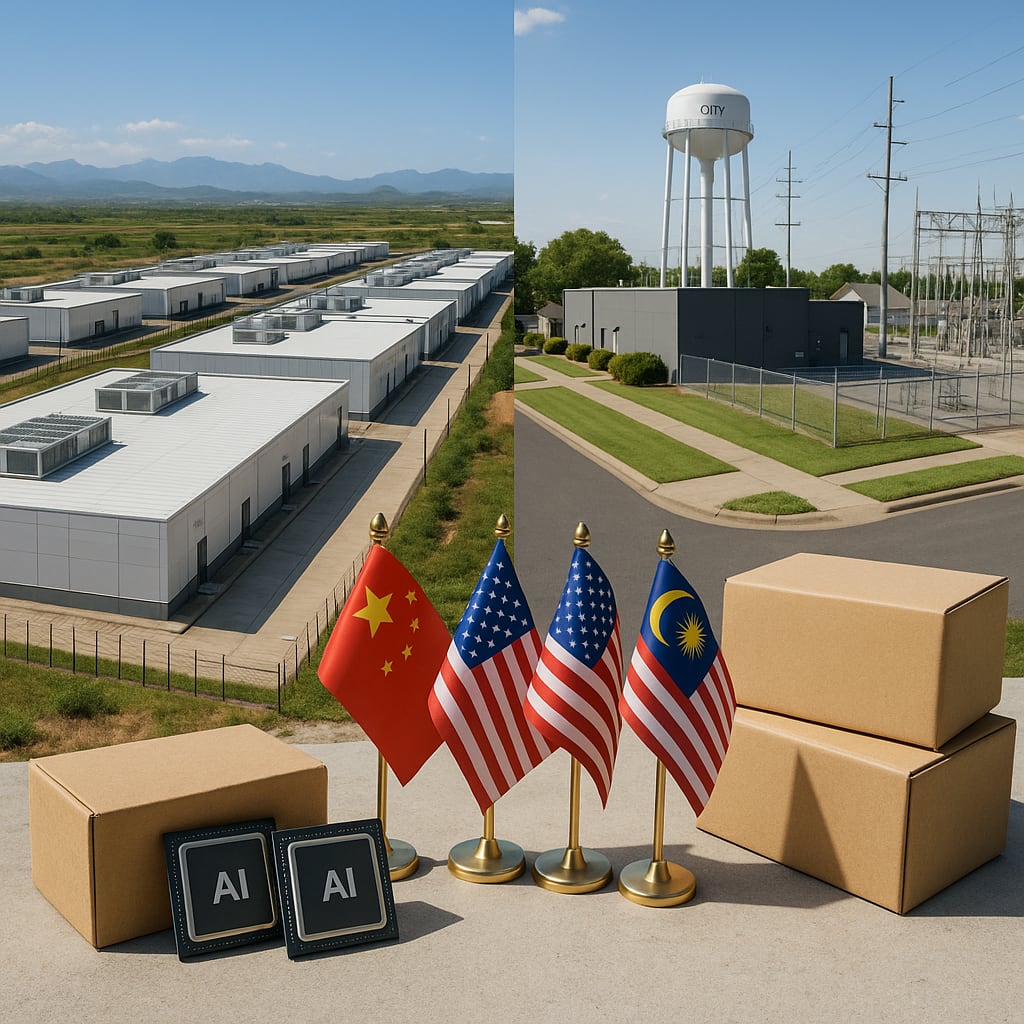
China’s AI compute buildout meets U.S. export controls, domestic data‑center backlash, and allied hedging
Narrative Snapshot
Across outlets, the through-line is capacity: who can acquire, build, and power the infrastructure that trains and serves frontier AI models. Reporting from Hong Kong and Tokyo emphasizes Beijing’s state-driven scale-up, with plans for vast accelerator clusters and a deliberate push beyond megacities to redistribute projects. U.S. coverage splits between enforcement and enablement. One thread probes how sanctions work in practice, detailing continued flows of top chips to Chinese firms through a blacklisted company’s subsidiary. Another centers on domestic constraints, with accounts of local resistance tied to energy and water stress and of national leaders arguing those projects are strategic.
The stakes extend abroad. Southeast Asia appears as a test bed for competing stacks: a Malaysian sovereign AI initiative weighing Huawei hardware is cast as a potential collision with recent U.S. export-control undertakings. A Brazilian lens treats Nvidia as a systemically central actor, whose private agreements and market power shape the field regardless of policy swings.
What Happened
Beijing set explicit targets to expand “intelligent computing” by 2030, including deploying clusters with 100,000 accelerator cards and reaching 9,800 eflops, alongside a call for 3.8 trillion yuan in related investment over five years, according to a Ministry of Industry and Information Technology plan. Coverage from Japan describes a geographic shift in China’s AI build-out away from its largest cities, altering where key projects land. In the United States, public opposition to AI data centers has intensified, tied to electricity prices and grid strain ahead of midterm elections; President Donald Trump has supported the facilities and warned against local resistance. U.S. tech companies counter that facilities are becoming less water-intensive. Separately, the New York Times reports a blacklisted Chinese firm’s subsidiary kept shipping Nvidia’s top chips to leading Chinese AI companies despite sanctions. Malaysia is weighing Huawei’s Ascend chips for a sovereign AI project, a move analysts told SCMP could test export-control commitments made to Washington. Fox News cites Stanford data showing far more U.S. data centers than in China, while noting caveats on capacity and utilization.
Why It Matters
The reporting clusters around three structural levers shaping AI power. First, export controls and their enforcement: the account of continued Nvidia chip flows to China via a blacklisted firm’s subsidiary raises operational questions about how U.S. measures are implemented and monitored. Second, industrial policy and state capacity: China’s MIIT plan sets measurable compute targets and large investment ambitions, while the Japan Times points to spatial rebalancing that could ease bottlenecks in megacities. Third, domestic political economy: U.S. data-center expansion is meeting organized local resistance tied to energy costs and infrastructure strain, with electoral salience noted ahead of midterms.
Allied alignment is a fourth vector. Analysts warn Malaysia’s potential turn to Huawei for a sovereign AI project could test its export-control commitments to Washington, a concrete example of the frictions countries face when engaging both U.S. and Chinese ecosystems. Finally, Folha de S.Paulo’s framing of Nvidia as a “central bank” of AI underscores the market concentration that policy must navigate.
Diverging Narratives
On capacity, Hong Kong and Japan-based reporting foregrounds state-driven acceleration in China—specific compute targets, accelerator cluster counts, and major outlays—portraying a coordinated infrastructure push. U.S. outlets, by contrast, split between threat framing and constraint mapping. Fox News stresses China’s rapid build tempo and quotes commentary warning that local U.S. pushback could slow America’s infrastructure edge, even as Stanford’s data shows the United States with far more facilities than China but cautions against equating counts with capability. Telesur centers domestic unease, highlighting polling that over 70 percent oppose nearby data centers and linking opposition to electricity costs rising more than 35 percent in five years. The Bangkok Post relays the industry’s counter-claim that facilities are becoming less “thirsty,” suggesting a mitigation narrative.
On supply chains and controls, the New York Times underscores enforcement gaps via a sanctioned company’s subsidiary shipping Nvidia’s best chips to leading Chinese AI firms, while South China Morning Post emphasizes Beijing’s indigenous capacity build-out and, separately, the possibility of Malaysia adopting Huawei hardware despite U.S.-linked commitments. Folha’s depiction of Nvidia’s centrality adds a private-market axis that neither sanctions nor state plans fully determine.
What Happens Next
Two enforcement choices bear watching. In Washington, the reported Nvidia chip shipments via a blacklisted firm’s subsidiary put pressure on agencies to refine controls and close routing loopholes; any moves to expand entity listings, update licensing rules, or target intermediaries would signal a tighter posture. In Beijing, follow-through on the MIIT plan—procurements for 100,000-card clusters, budget allocations toward the 3.8 trillion yuan ambition, and siting decisions consistent with the shift beyond major cities—will indicate execution capacity.
Domestic U.S. politics is a second hinge. With data centers a midterm topic and President Trump advocating build-out, track state and local permitting outcomes, utility rate cases, and whether governors “backtrack” as described. Regionally, Malaysia’s sovereign AI procurement is a third pivot: whether it selects Huawei’s Ascend chips, and how it references last year’s export-control commitments to Washington, will clarify how partners navigate competing tech blocs. Finally, Nvidia’s deal-making and shipment patterns—alongside any new curbs discussed above—remain a market signal shaping who can access top-tier compute.