
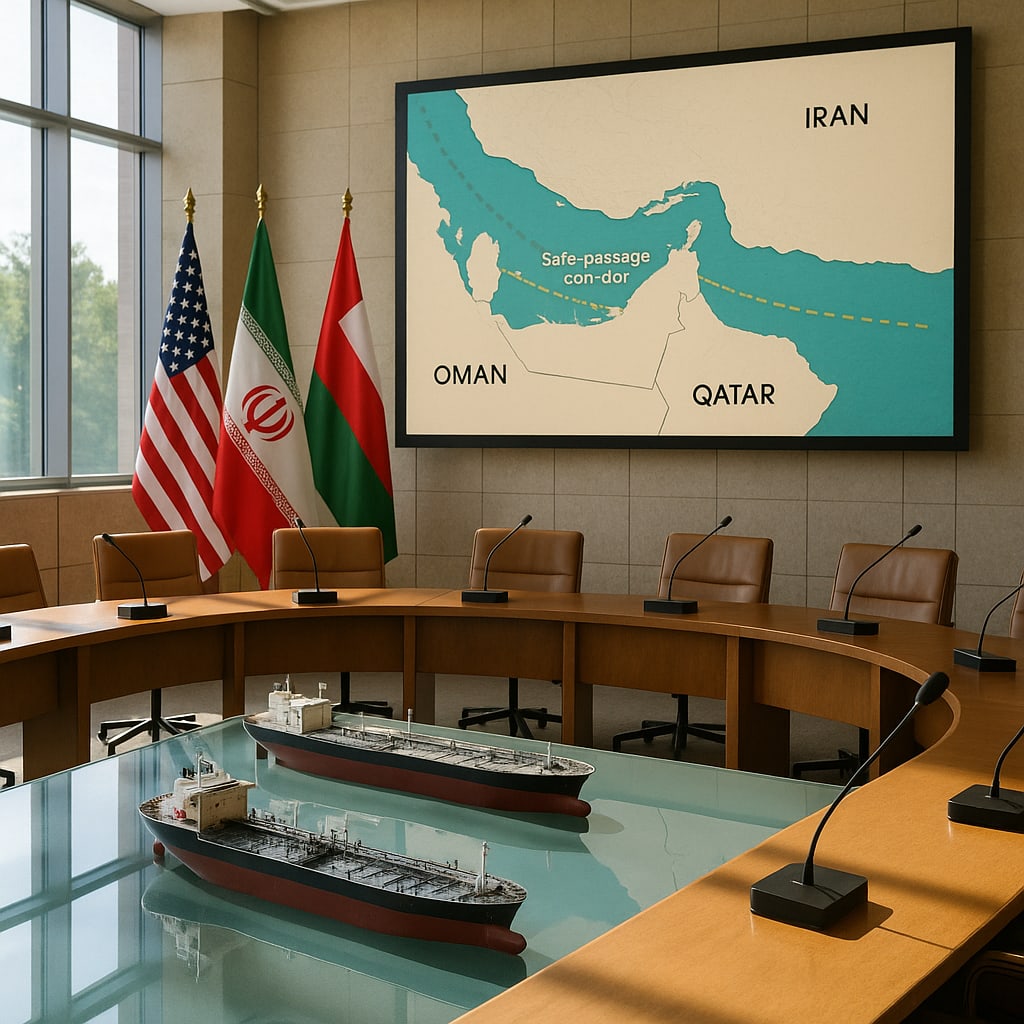
US enforces Iran oil blockade as tanker strikes spread and Oman mediates Hormuz safe-passage plan
Narrative Snapshot
Coverage diverges most sharply over how to characterize maritime actions and their legality, while converging on the fact that both sides escalated at sea and that regional mediation is active. Middle East Eye reports US Central Command redirecting 92 commercial vessels, disabling three and boarding two to enforce a blockade intended to choke Iran’s oil exports, a tally TASS echoes with a slightly higher figure of 94 since the blockade’s resumption. Chinese state media foregrounds Iranian claims: CGTN details IRGC strikes on tankers and US warships, Tehran’s warnings against “unauthorized” transit routes, and Iran’s talks with Oman on a temporary safe-passage corridor, with Qatar pursuing de-escalation.
Two US-oriented narratives emphasize deterrence and regime behavior. A Fox News op-ed argues recent US strikes are degrading Iranian capabilities and resetting the “balance of fear,” citing CENTCOM’s Sept. 1 operation. Separately, Fox News Digital quotes an activist asserting Iran’s leadership prefers external confrontation to suppress domestic unrest, noting alleged US guarantees that did not curb Iranian attacks. RT reports back-channel exchanges via mediators, saying Washington recently sent proposals and Tehran responded with conditions after what it calls repeated US violations. From the Global South, Telesur frames a months-long “U.S.-Israeli war on Iran,” highlights prior closures and a June memorandum governing bilateral conduct, and quotes Iran’s president expressing confidence of victory and pledging reciprocity if US obligations are met.
The stakes identified across sources are operational and institutional: safety of navigation through Hormuz under competing “route” claims, the enforceability of a US-led oil blockade, the prospect of an International Maritime Organization-registered corridor, and whether back-channel contacts can contain spillovers after strikes on Jordan and Bahrain.
What Happened
US strikes on Iranian targets resumed around Sept. 1 after a lull, with CENTCOM hitting IRGC air defenses, radar, maritime assets, mine-laying and communications sites, according to a Fox News op-ed. President Donald Trump vowed “We’re going to hit them hard,” telling Fox that US defenses intercepted or allowed through incoming Iranian missiles deemed non-threatening, CGTN reported. Iran retaliated with missile and drone attacks on US facilities in Jordan and Bahrain, according to RT, and the IRGC said it targeted three oil tankers in the Strait of Hormuz and three US-affiliated vessels elsewhere, warning against “unauthorized” transit routes, per CGTN. CGTN also reported an Iranian tanker near Kharg Island was struck by four US missiles. Concurrently, CENTCOM said it redirected 92 commercial vessels, disabled three and boarded two to enforce the blockade, Middle East Eye reported; TASS put the redirections at 94. Iran and Oman said their talks on a temporary safe-passage route are in the final stage for prospective IMO registration, with Qatar engaging to de-escalate, CGTN added. RT reported Iran conveyed conditions to US proposals via mediators.
Why It Matters
The contest now spans kinetic enforcement at sea, coercive economic pressure, and emergent crisis management mechanisms. CENTCOM’s stated goal of “strict compliance” with a blockade designed to “choke off Iran’s oil exports,” as reported by Middle East Eye, places commercial shipping at the center of coercion, while Iranian warnings against “unauthorized” routes create de facto route politics in Hormuz, CGTN notes. The Iran–Oman plan to register a temporary corridor with the International Maritime Organization, if realized, would inject a procedural channel into a conflict otherwise characterized by unilateral strikes and retaliations, per CGTN.
Narratives imply broader alignments and norms under strain. Telesur’s depiction of a joint US–Israeli campaign and Iran’s SCO-side engagement with Russia situate the crisis within competing security blocs, while Fox News’ deterrence framing underscores a US objective to degrade IRGC capabilities and reestablish costs for maritime coercion. Back-channel exchanges via mediators reported by RT, alongside Qatari and Omani roles cited by CGTN, indicate regional actors are shouldering de-escalation tasks amid contested claims about prior commitments and violations.
Diverging Narratives
Disagreements cluster around legitimacy, metrics, and responsibility. On enforcement, CENTCOM’s emphasis on redirecting 92–94 ships, disabling three and boarding two frames operations as compliance-driven blockade activity (Middle East Eye; TASS), whereas Iranian statements cited by CGTN warn that vessels attempting “unauthorized” routes risk being targeted—implicitly asserting Iran’s authority to shape transit patterns. CGTN reports IRGC claims that two tankers struck mines after attempting such routes; in the same piece, the US military is said to dispute that any ships hit mines, underscoring contested attribution.
On escalation dynamics, Fox News’ op-ed presents US strikes as a calibrated effort to dismantle IRGC capabilities and restore deterrence following attempted attacks on shipping and US personnel, while CGTN highlights Iranian retaliatory strikes on tankers and US warships, and labels insecurity a consequence of US–Israeli “military aggression.” RT’s source asserts that US “repeated violations” halted prior talks and that Tehran has now conveyed conditions through intermediaries, contrasting with a Fox News Digital interview claiming Washington had extended guarantees that did not prevent subsequent Iranian attacks. Even the scope and trajectory of the confrontation are framed differently: a senior Iranian source quoted by CGTN via Reuters called an earlier exchange “limited and contained,” while Telesur characterizes a months-long “U.S.-Israeli war on Iran,” references prior closures, and cites a June memorandum that Iranian leaders say the US should honor.
What Happens Next
Three decision points emerge from reported positions. First, whether Iran and Oman finalize and register a temporary Hormuz route with the IMO: CGTN says talks are in their final stage, but Tehran conditions vessel “confidence and a sense of security” on an end to US–Israeli “military aggression,” signaling that any corridor’s effectiveness hinges on parallel de-escalation. Analysts should watch for formal IMO filings and accompanying Iranian guidance to mariners.
Second, the sustainability and scope of US blockade enforcement. CENTCOM’s redirection, disabling, and boarding metrics (Middle East Eye; TASS) will indicate whether compliance operations expand or plateau, and whether rules of engagement change as tanker incidents accumulate.
Third, the back-channel track. RT reports US proposals conveyed via mediators and Iranian counter-conditions; CGTN notes Qatari and broader regional de-escalation efforts. Concrete signs—mediator shuttle diplomacy, public references to the June memorandum cited by Telesur, or explicit acknowledgments of “guarantees” referenced by Fox News Digital—will clarify if parameters for restraining strikes and shipping friction are coalescing or if parties revert to episodic retaliation, including further attacks on US facilities in Jordan and Bahrain reported by RT.