
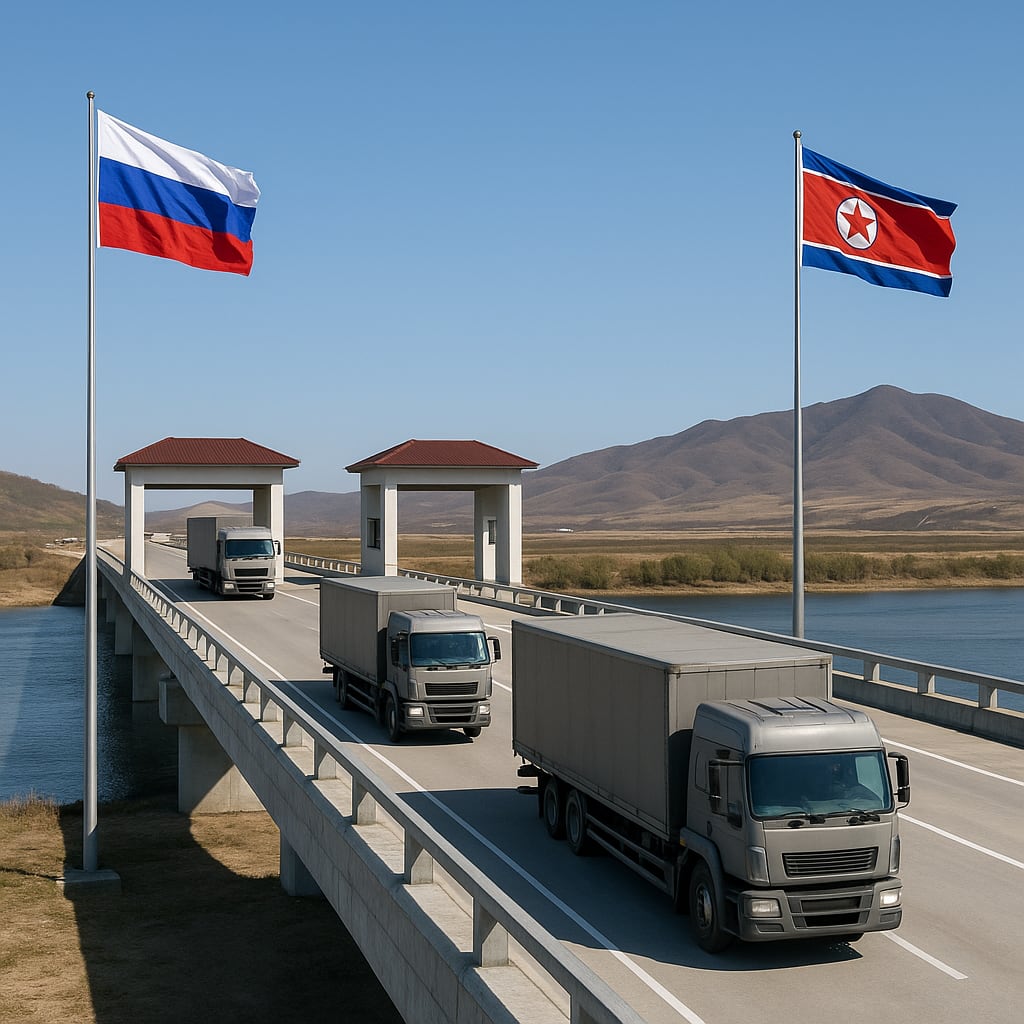
Russia and North Korea open first cross-border road bridge over the Tumen River
Narrative Snapshot
Across outlets, the bridge is reported as the first road link between Russia and North Korea, with basic facts aligning on location, scope, and the leaders involved. Many Western outlets place the development within the arc of post-2022 deepening ties, foregrounding the political context more than the engineering specifics. Russian and aligned coverage highlights anticipated economic utility and regional benefits for the Russian Far East, while North Korean framing—relayed via regional reporting—casts the opening as a concrete manifestation of bilateral solidarity.
Where accounts diverge is in emphasis and tone. The South China Morning Post and Folha de S.Paulo stress choreography and symbolism, describing a staged display of friendship. RT, TASS, and Telesur focus on promised year-round traffic, lower logistics costs, and even tourism. The Guardian notes the remoteness of the crossing, implicitly raising the question of scale and practical impact. Ukrainian outlets document the opening succinctly, with the Kyiv Independent situating it in a narrative of intensifying partnership without elaborating on operational implications.
What Happened
Russia and North Korea opened their first cross-border road bridge on 7 September 2026, spanning roughly one kilometer over the Tumen River between Khasan in Russia’s Primorsky Krai and Tumangang in North Korea, according to multiple outlets including the Guardian, the Kyiv Independent, and the South China Morning Post. The ceremony was conducted by video link, with Russian Prime Minister Mikhail Mishustin and North Korean Premier Pak Thae Song addressing officials and workers, as reported by TASS, RT, and the South China Morning Post. The South China Morning Post described the bridge as a two-lane structure, with initial trucks crossing during the opening. RT and Telesur noted that until now the only direct land link was the Friendship railway bridge opened in 1959. RT added that construction began in April 2025 under a 2024 bilateral agreement. A TASS preview on 3 September said the launch would streamline logistics and reduce costs.
Why It Matters
Outlets consistently frame the bridge as both infrastructure and signal. DW, the BBC, the Guardian, Al Jazeera, and the Japan Times link it to the deepening of political, economic, and, per DW, military ties since the start of the war in Ukraine. In functional terms, Russian and aligned sources say the crossing is intended to provide year-round vehicular access, streamline logistics, increase bilateral trade, and lower transportation costs, with RT and TASS emphasizing stable supplies and expanded cooperation for Russia’s Far Eastern regions. Telesur adds expectations for tourism. The South China Morning Post and Folha de S.Paulo underscore the carefully choreographed nature of the event, highlighting its value as a visible milestone in a strategic partnership. For policymakers, the bridge constitutes a tangible expansion of cross-border connectivity on a frontier that previously depended on a single rail link, and a barometer of how far both sides operationalize their declared partnership.
Diverging Narratives
Russian official and regional voices, relayed by TASS and RT, characterize the bridge as an economic enabler that will ensure “reliable and stable supplies,” cut costs, and facilitate year-round traffic. Telesur reinforces that frame, projecting expanded trade and tourism and quoting Mishustin on benefits for the Far East. North Korea’s position, as reported by the Bangkok Post citing state media, hails the bridge as a “concrete sign” of tightening bonds and situates it among gains from powerful neighbors, including Moscow and Beijing.
Western and some Asian outlets emphasize the geopolitical signal. The Guardian, the BBC, DW, Al Jazeera, and the Japan Times tie the opening to the intensification of ties since the war in Ukraine, with DW explicitly noting deepening political, economic, and military relations. The South China Morning Post and Folha de S.Paulo stress orchestration and symbolism, portraying the event as a staged affirmation of friendship. Practical uncertainty resides in scale and utilization: while Russian and aligned outlets promise increased trade, the Guardian notes the remoteness of the crossing. Ukrainian outlets—Ukrinform and the Kyiv Independent—register the fact of the opening, with the latter referencing the deepening partnership but not elaborating on expected volumes or sectors, leaving operational impact as an open question.
What Happens Next
Two near-term tests flow directly from stated aims. First is utilization: Russian officials and the Transport Ministry previewed gains in logistics efficiency and lower costs; RT and Telesur pointed to year-round truck traffic and added tourism. Analysts should watch for reported increases in truck movements, trade statistics from Primorsky Krai, and any publicized cross-border freight or tour operations that would substantiate those claims. Second is institutional follow-through: the bridge’s effectiveness hinges on how border procedures and regional coordination deliver the “reliable and stable” supplies officials emphasized. Signals would include announcements from the Primorye governorate or federal ministries about expanded routes or processing capacity.
At the political level, several outlets frame the bridge as emblematic of deepening ties since 2022. Continued high-level statements or ceremonies tied to the crossing would indicate that both governments intend to use the new link as a recurring platform for projecting partnership, beyond the initial opening described by TASS, RT, and the South China Morning Post.