
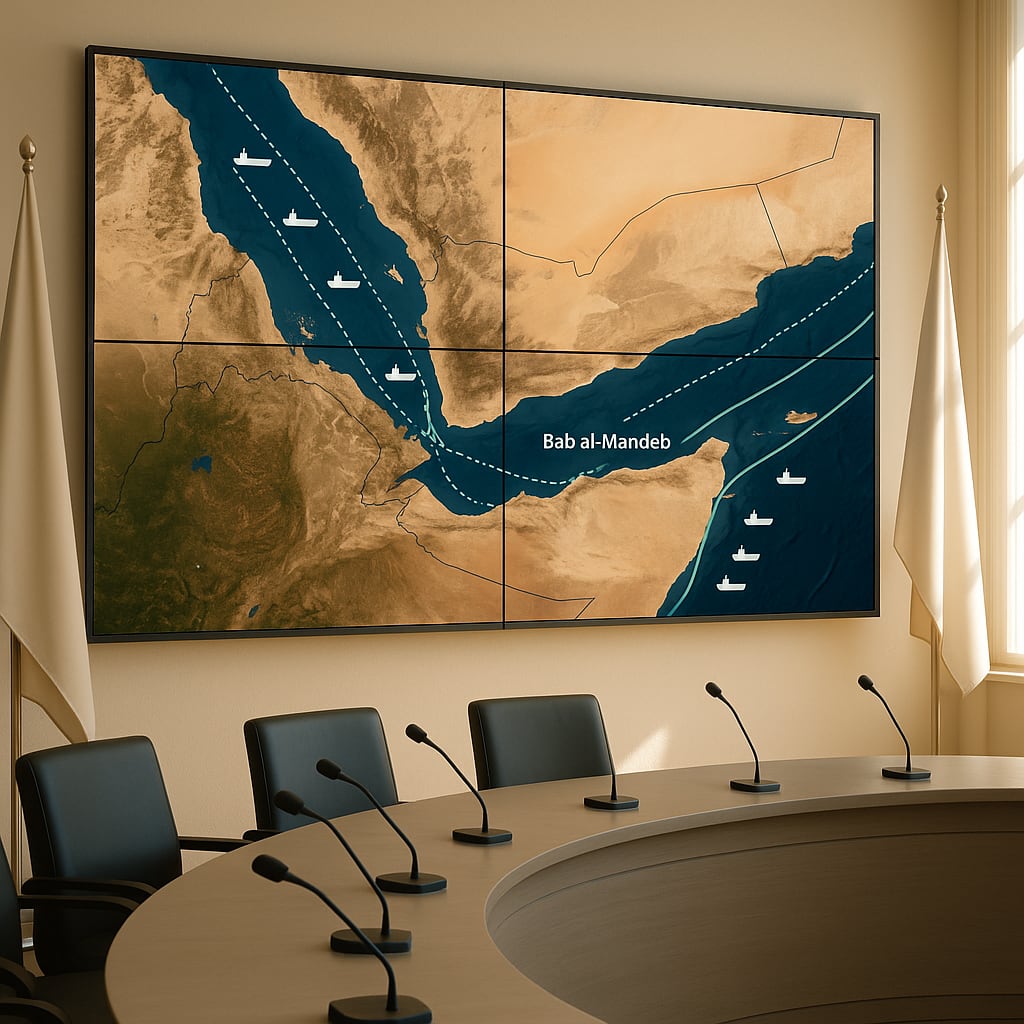
Houthis seize Mocha and Perim (Mayun), consolidating control around Bab al-Mandeb
Narrative Snapshot
Across outlets, there is broad concurrence that Houthi forces rapidly overran remaining government positions along Yemen’s Red Sea coast, seized Mocha, and moved onto Perim (Mayun) Island at the center of the Bab al-Mandeb. Reporting varies most on the scope and durability of control. Some describe a “complete takeover” of the waterway or Yemen’s Red Sea coastline based on official and eyewitness accounts (Bangkok Post via AFP; Middle East Eye, 11 Sep), while others rely on language that the Houthis “reached” or “captured” Perim, with government forces withdrawing (South China Morning Post citing Reuters; BBC; New York Times; Deutsche Welle). Al Jazeera underscores uncertainty over whether the group can hold the island over time.
Outlet emphases diverge on strategic meaning. Several Western and regional sources foreground risks to global shipping and energy markets and the advance as a geopolitical gain for Iran (France24; NBC News; The Guardian; The Hindu). Chinese state media highlights immediate market effects and external responses, reporting crude above $100, Saudi moves to seek U.S. help, and Washington’s limited assistance to intelligence and targeting support (CGTN). Iranian and Houthi-aligned messaging asserts control and frames navigation as safe except for Saudi ships (Middle East Eye citing Tasnim and a Houthi spokesman), while Telesur amplifies the Houthi defense minister’s declaration of a new “national liberation” stage.
What is most at stake is control over a chokepoint central to Saudi oil exports and global trade. Several outlets connect the advance to the broader U.S.–Iran confrontation and a possible widening of the conflict arena (France24; The Hindu; Haaretz), while immediate military counteraction—such as Saudi airstrikes on Mokha airport—signals the contest is not settled (TASS; CBC).
What Happened
Following a week-long offensive along Yemen’s Tihama coast, Houthi forces seized the Red Sea port of Mocha on 10 September (Le Monde; Deutsche Welle; Haaretz). Within a day, government forces withdrew from Perim (Mayun) Island at the center of the Bab al-Mandeb, and the Houthis moved in, reportedly without resistance, after also taking the adjacent coastal town of Dhubab (South China Morning Post citing Reuters; CGTN). Multiple outlets reported Houthi advances across the remaining government-held coastline, with some characterizing the result as control of Yemen’s entire Red Sea coast and near-complete grip over the strait (Middle East Eye, 11 Sep; Bangkok Post via AFP). Telesur reported additional seizures in the Hanish archipelago, including Zuqar, as part of operations expanding Houthi reach into the Red Sea. Saudi Arabia responded with airstrikes on Mokha airport (TASS; CBC). Houthi officials claimed navigation was safe except for Saudi vessels, and framed the campaign as a new stage of “national liberation” (Middle East Eye, 12 Sep; Telesur).
Why It Matters
Bab al-Mandeb is a critical maritime chokepoint linking the Red Sea to the Gulf of Aden. Consolidated Houthi control at its approaches could impact global shipping, heighten risk premia, and constrain Saudi export routes—effects several outlets already tie to oil and diesel price spikes (France24; CGTN; CBC; Times of Israel). The battlefield shift strengthens an Iran-aligned actor at the western gateway to the Red Sea, a dynamic multiple sources frame as enhancing Tehran’s leverage opposite the United States and its partners (NBC News; The Hindu; The Guardian). It tests the capacity of Saudi-led arrangements and U.S. security support models; CGTN reports Riyadh seeking U.S. military assistance and Washington limiting its role to intelligence and targeting aid. Regionally, coalitional cohesion appears uncertain—La Repubblica notes Islamabad’s initial promises of aid followed by hesitation—complicating any counteroffensive or sustained maritime security posture.
Diverging Narratives
Several outlets present the advance as conferring effective control of the Bab al-Mandeb—via “complete takeover” language or assertions of a “full grip” (Bangkok Post via AFP; CGTN; Times of Israel). Others use more circumspect formulations, reporting the seizure of Perim and coastal towns after government withdrawals, while stopping short of declaring uncontested control of the strait (South China Morning Post citing Reuters; BBC; New York Times; Deutsche Welle). Middle East Eye relays Iranian Tasnim’s claim that the Houthis control the strait and cites a Houthi spokesman’s statement that navigation is safe for all but Saudi ships, a framing that contrasts with Western and Gulf-focused coverage emphasizing broader risks to global shipping and supply chains (Middle East Eye, 12 Sep; Haaretz; NBC News).
Questions remain about the extent and durability of island holdings and offshore positions. Telesur reports operations in the Hanish archipelago, and Middle East Eye notes fighting still ongoing on Zuqar, indicating a still-fluid maritime picture. Saudi airstrikes on Mokha airport (TASS; CBC) underscore the likelihood of continued contestation. Al Jazeera explicitly raises whether the Houthis can hold Mayun over time, injecting operational uncertainty into otherwise convergent accounts that Perim was seized.
What Happens Next
Key decision points center on external military response, maritime risk management, and the Houthis’ ability to sustain island and coastal positions. CGTN reports Saudi Arabia seeking U.S. military assistance and Washington confining support to intelligence and targeting; any shift toward direct U.S. or expanded coalition operations, or intensified Saudi strikes beyond Mokha airport (TASS; CBC), would signal a move to roll back Houthi gains. On shipping, watch for changes in routing, insurance pricing, or explicit interdictions, given Houthi statements that navigation is safe except for Saudi ships (Middle East Eye, 12 Sep). Al Jazeera’s question about holding Mayun highlights logistics and resupply as indicators of durable control. Regionally, La Repubblica’s note on Pakistan’s hesitation suggests coalition limits; announcements of new partners or basing/access decisions would illuminate the feasibility of a counteroffensive or enhanced maritime patrol posture.