
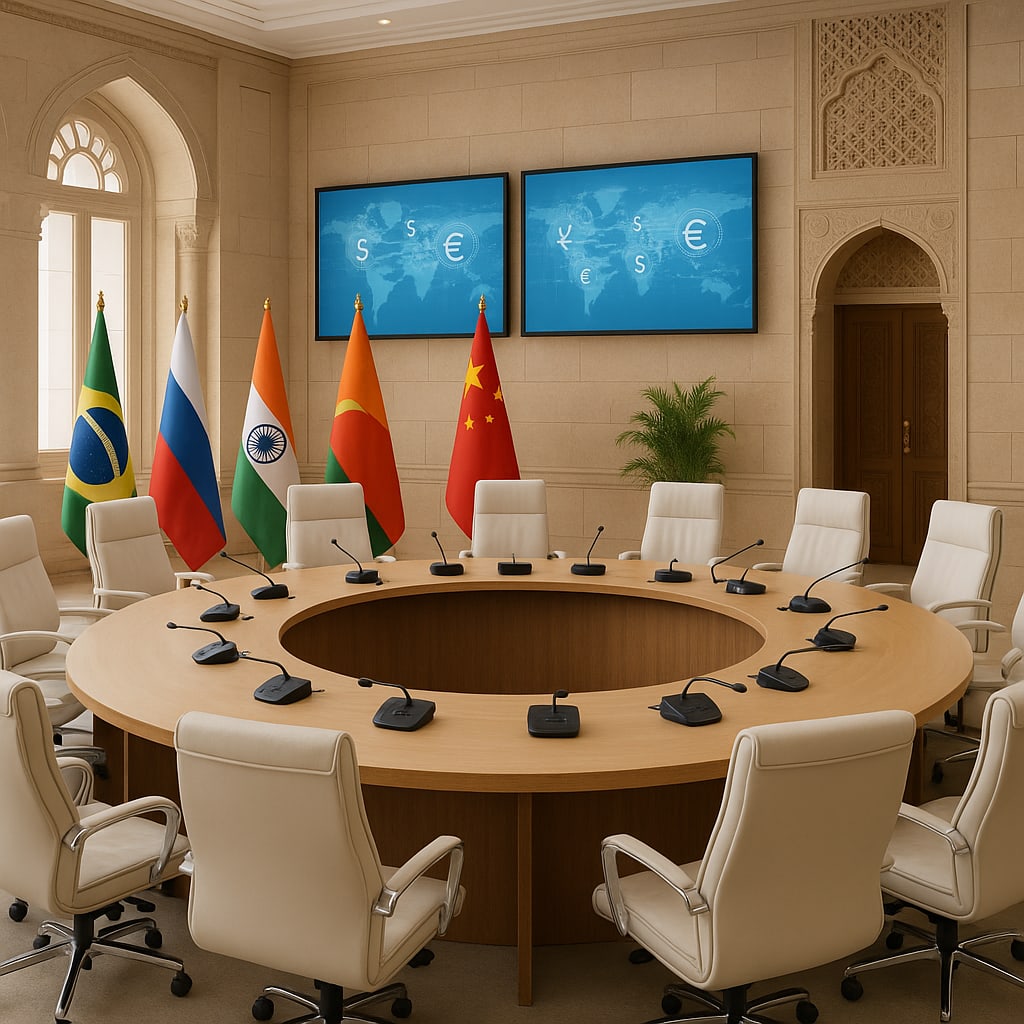
BRICS summit in New Delhi pairs expansion-era frictions with a joint push for global governance reform
Narrative Snapshot
Across outlets, coverage converges on two anchors: BRICS’ broadened ambitions and the constraints revealed by its diversity. Chinese and Russian state-linked media emphasize continuity and institution-building. CGTN frames the summit as “greater BRICS cooperation” rooted in openness and consensus-building despite diversity, positioning the bloc as a steadying force and “adult in the room,” while ECNS highlights a mandate to amplify Global South demands for “better governance” and the “right to development.” TASS underlines concrete outcomes: a collective stance against any “arbitrary revision” of G20 membership and prioritization of reforming global economic governance.
Western and Latin American outlets stress coherence tests. The New York Times and Folha de S.Paulo foreground disagreements and overlapping national agendas. The South China Morning Post warns internal splits could slow progress, even as it notes two decades of growth. RT and Al Jazeera situate the meeting within live geopolitical rifts—UAE and Iran on opposing sides in Middle East hostilities and tariffs weighing on trade—while noting India’s chairmanship has moderated talk of rapid de-dollarization in favor of practical connectivity. The Hindu isolates India’s balancing act: sustaining ties with Russia and Iran while deepening links with the U.S. and Europe. France24, Toronto Star/AP and Clarin capture the breadth of the agenda—from trade and investment to alternatives to the dollar—and report a joint declaration that couples calls for greater Global South influence with appeals for restraint in the Middle East. Telesur underscores language against unilateral sanctions and the bloc’s interest in payments, IMF reform, and technology cooperation, including China’s proposal for an open-source AI platform.
What Happened
Leaders of BRICS met in New Delhi on September 12–13 for the group’s 18th summit under India’s chairmanship. The gathering focused on trade, investment, and global conflicts, with an expanded agenda that included financial cooperation, payment systems, proposals to increase non‑dollar trade, and calls for IMF and broader governance reforms, according to Telesur and Toronto Star/AP. Attendees included China’s Xi Jinping, Russia’s Vladimir Putin, and Iran’s Masoud Pezeshkian, as noted by the South China Morning Post; RT added that this marked Xi’s first visit to India in seven years. France24 reported the summit concluded with a joint declaration calling for greater Global South influence and urging restraint in the Middle East, alongside leader‑level bilateral diplomacy. TASS cited summit documents rejecting any arbitrary revision of G20 membership and affirming reform of institutions of global economic governance as a consistent BRICS priority. RT and Al Jazeera noted India’s more practical framing and the backdrop of geopolitical rifts and tariffs.
Why It Matters
The summit’s outcomes feed directly into ongoing contests over rules and representation in global institutions. TASS’s reporting that BRICS opposes any arbitrary change to G20 membership and seeks reform of global economic governance signals coordinated positioning ahead of multilateral deliberations. Telesur’s account of proposals to diversify away from the dollar and expand alternative payment systems reflects how sanctions and tariffs are reshaping financial statecraft and trade practices among emerging powers, a theme also raised by Clarin and Al Jazeera. France24’s coverage of a joint declaration advocating greater Global South influence aligns with ECNS and CGTN narratives of BRICS as a platform to amplify developing countries’ demands. The Hindu’s focus on India’s concurrent engagement with Russia, Iran, the U.S., and Europe underscores how BRICS deliberations intersect with broader alignment strategies. Together, these strands indicate that BRICS is testing pathways to institutional leverage—within the G20, IMF reform debates, and cross‑border payments—while navigating members’ divergent risk exposures.
Diverging Narratives
Outlets split on whether expansion enhances leverage or strains cohesion. CGTN’s commentary argues BRICS has entered a “Greater BRICS” phase, contending that added diversity can be managed through consensus-building. ECNS casts the bloc as an amplifier of Global South priorities. By contrast, Folha de S.Paulo characterizes the summit as reaffirming a lack of cohesion, and the South China Morning Post cautions that internal splits could slow progress. The New York Times and Al Jazeera emphasize that active conflicts and economic headwinds complicate unity.
There is also a tonal divide on policy thrust. RT reports India has deemphasized de-dollarization rhetoric in favor of practical connectivity, even as Telesur highlights de-dollarization, IMF reform, and payment systems as central agenda items. On geopolitical context, RT points to UAE‑Iran tensions and recalls a BRICS foreign ministers’ meeting in May that ended without a joint statement on the Middle East, whereas France24 reports that leaders in New Delhi did agree on a joint declaration urging restraint and used the summit for bilateral de‑escalation efforts. Finally, technology cooperation features unevenly: Telesur reports China’s proposal for an open-source AI platform and calls for AI governance, while many Western reports foreground trade, investment, and the wars testing the bloc rather than new tech initiatives.
What Happens Next
Implementation pathways now hinge on a few decisions and signals. On governance reform, watch whether BRICS members coordinate positions in G20 and IMF fora, consistent with TASS’s reporting on resisting arbitrary G20 changes and seeking economic governance reform; alignment across capitals in those venues would indicate follow‑through. On financial cooperation, monitor concrete steps on payment systems and use of non‑dollar currencies flagged by Telesur and Clarin; shifts in invoicing practices or new settlement mechanisms would mark movement beyond rhetoric, especially given RT’s note of India’s pragmatic tilt. On managing geopolitical divergences, track whether future ministerial meetings can sustain joint statements on conflict issues, after RT’s reminder of a May breakdown and France24’s account of renewed restraint language in New Delhi. On technology, indicators include whether BRICS sets up working groups or pilot projects for the open‑source AI platform reported by Telesur, signaling an agenda expansion from finance into digital standards and cooperation.