
AfD’s Saxony-Anhalt win triggers nationwide protests and reopens fault lines in German and European politics
Narrative Snapshot
Across outlets, the scale of the AfD’s breakthrough is treated as historically significant and nationally consequential, with broad agreement on two immediate reactions: mass street mobilization in roughly 20 cities and the reiterated refusal of mainstream parties to govern with the AfD. Reporting converges on the electoral shock in Saxony-Anhalt and the political pressure it places on Chancellor Friedrich Merz, whose standing and strategy feature prominently in coverage from France and Russia-based media.
Interpretive frames diverge over causes and character. Socioeconomic explanations that foreground austerity, regional disparities, and wage stagnation (as in Venezuelan coverage) sit alongside accounts that stress migration and identity, as well as Germany’s remembrance culture and how AfD leaders challenge it. International outlets also differ on the AfD’s geopolitical positioning, with some describing it as pro-Israel while others label it pro-Kremlin. What is most at stake in the reporting is whether Germany’s postwar party cordon sanitaire can contain a party that has mobilized previously disengaged voters and now leads a state by a wide margin.
What Happened
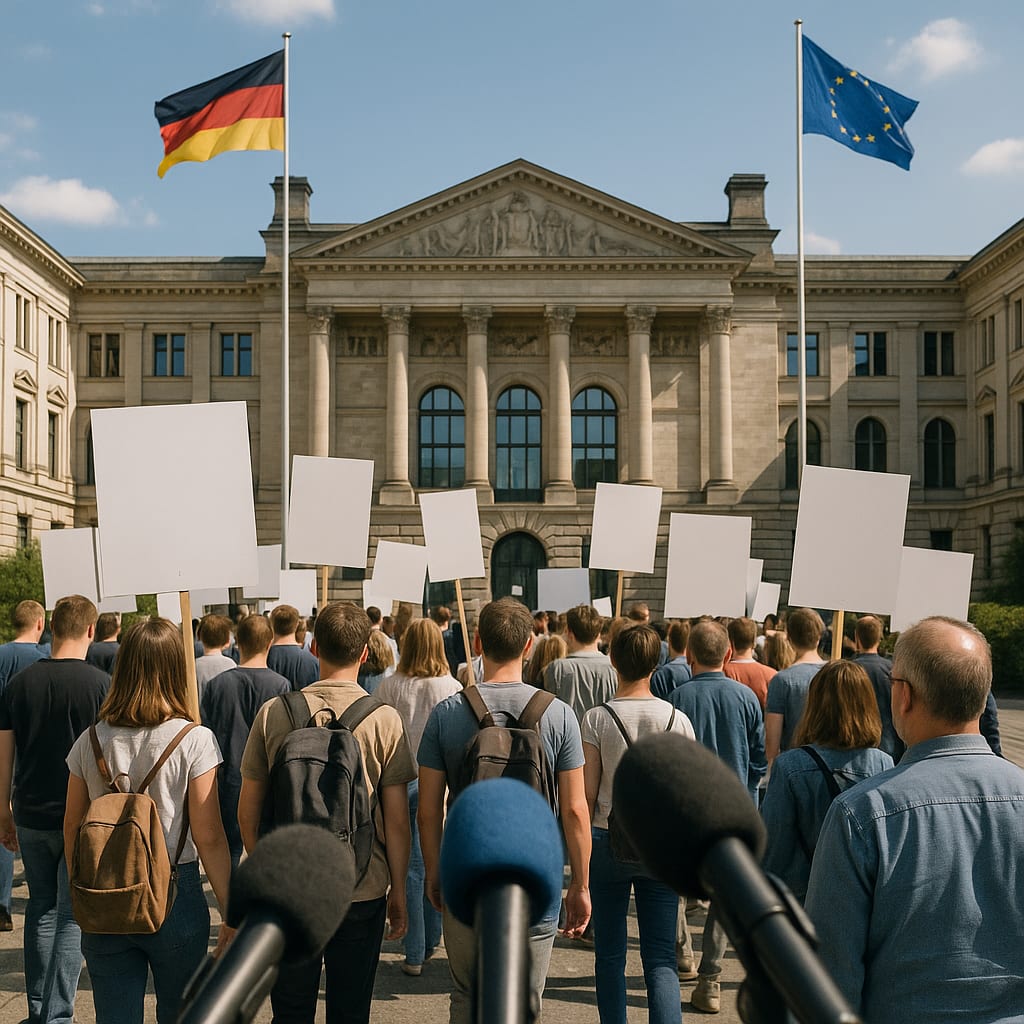
The AfD won a sweeping first-place finish of around 44–44.5% in Saxony-Anhalt, described by multiple outlets as the biggest far-right victory in a German state since the Nazi period. Exit polling by public broadcaster ARD pointed to the 44.5% figure. The win elevated co-leader Alice Weidel, noted for attacking Germany’s culture of remembrance as a “cult of guilt.” German and international media reported immediate street protests: tens of thousands marched in about 20 cities, including Berlin, Hamburg, and Munich, with police estimating around 20,000 in Düsseldorf under the slogan “Not a Step Back!” Demonstrators framed their action as a defense of democracy; some called for banning the AfD. Mainstream parties reiterated they would not govern with the AfD. Coverage also underscored the blow to Chancellor Friedrich Merz, amid voter ire over cost-of-living pressures.
Why It Matters
The result intensifies a structural test of Germany’s party system: a strong AfD facing a broad refusal by established parties to cooperate creates governance and coalition-design challenges if replicated elsewhere. Analysts highlighted the potential federal implications for Merz, whose low approval ratings and association with economic grievances were central to voter discontent, and whose leadership could face new pressure after further September state contests. Internationally, several outlets framed the outcome as part of a wider European shift in which populist forces, normalized by earlier shocks, convert long-running crises into electoral power. Others cast it as a setback for the postwar European project. The arrival of a small, heterodox party (BSW) as a possible kingmaker in German state politics further complicates coalition arithmetic. The AfD’s ability to mobilize previously disengaged voters suggests a durable reconfiguration of participation that challenges existing institutional strategies for containment.
Diverging Narratives
Competing explanations recur across coverage. One line centers on socioeconomic strain—long-term austerity, infrastructure decline, and wage stagnation channeling anger toward immigration—arguing the AfD’s rise is rooted in structural inequality rather than culture-war issues. A second emphasizes identity and memory politics, citing the party’s anti-immigration stance and leadership critiques of Germany’s remembrance culture as signals of a deeper normative rupture. Outlets also characterize the party’s external orientation differently: some stress its pro-Israel positioning and anti-Palestinian politics, while others describe it as pro-Kremlin. On implications, Russian and Brazilian commentary suggests the end of Europe’s “old order” or a broader defeat for the traditional European project, whereas French coverage situates the result within a continent-wide populist trend, with Merz’s personal unpopularity and economic insecurity as proximate drivers. Protest coverage ranges from calls to defend democracy to explicit demands to ban the AfD, reflecting varied tactical responses to a party that German domestic intelligence has classified as “rightwing extremist,” according to British reporting.
What Happens Next
Coalition formation in Saxony-Anhalt is the immediate test of the cordon sanitaire. With mainstream parties reiterating they will not govern with the AfD, watch for minority or multi-party arrangements and whether smaller actors like BSW gain leverage. Nationally, Merz’s response is pivotal; France-based reporting highlights voter anger over living costs and pensions, while Russian coverage flags additional September state votes in Mecklenburg-Western Pomerania and Berlin as consequential signals for his leadership. Street mobilization will remain a barometer: German and Qatari outlets document large protests and explicit calls to ban the AfD; analysts should track whether these translate into institutional initiatives or remain civic pressure. Finally, monitor whether the AfD’s newly mobilized electorate, identified by transatlantic analysts, persists beyond a single cycle, and whether socioeconomic grievances spotlighted by Venezuelan coverage are mitigated or deepen, shaping the party system’s next moves.