
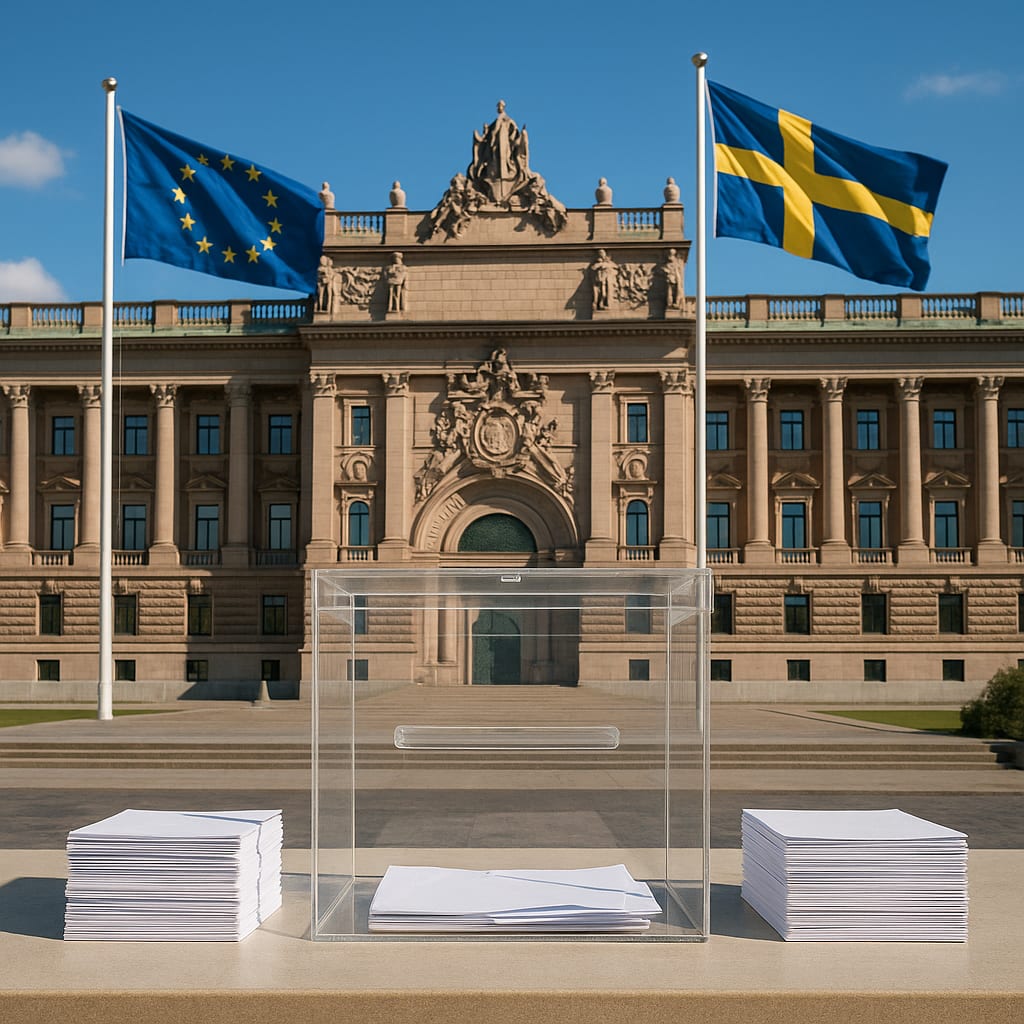
Sweden votes in razor‑thin election as far right poised for first government role
Narrative Snapshot
Across European and global outlets, coverage converges on the extraordinary closeness of Sweden’s vote and the unprecedented prospect of the Sweden Democrats entering government. Several international reports emphasize narrowing polls in the campaign’s final stretch and frame the stakes as reputational as well as political, with one UK outlet explicitly tying Sweden’s standing as a human rights champion to the outcome, while French and Hong Kong coverage juxtapose a possible far-right breakthrough with a return to the liberalism associated with Sweden’s postwar politics.
There is divergence on who holds the late advantage and on which issue set defines the race. UK, French and Hong Kong reports describe a centre-left edge as voting began, even as they note momentum on the right; Italian and German outlets stress the incumbent’s effort to renew his mandate alongside nationalists. US coverage centers the agenda on migration, gang crime and the economy, echoing an Italian paper’s summary of the Sweden Democrats’ anti-immigration message, while a Qatari outlet underscores that Israel–Palestine policy is also explicitly at stake.
Several pieces situate Sweden within a broader European shift highlighted by the Alternative for Germany’s surge in Saxony‑Anhalt. US coverage links the Swedish contest to that result; Chinese, Venezuelan and Russian outlets detail the AfD’s record state‑level share and the ensuing institutional frictions, including a reported debate over potential EU funding leverage. That parallel colors how some outlets assess what is at stake in Sweden: whether a hard‑right party moves from outside support to cabinet posts, and what that would signal for coalition norms across the EU.
What Happened
Swedes voted on Sunday in a general election described as extremely close by multiple international outlets, with several polls indicating a paper‑thin gap between left and right blocs as ballots were cast. Reports from the UK, France and Hong Kong said the centre‑left opposition held a narrow lead, while Germany’s public broadcaster and others noted the lead had tightened markedly in the final days. Prime Minister Ulf Kristersson sought a second term at the head of a four‑party right‑of‑centre alliance that, according to France‑based and Venezuelan coverage, includes the Sweden Democrats and has been gaining late momentum. Several outlets said the Sweden Democrats could enter government for the first time if the right secured a majority. Campaign salience varied by source, with US reporting foregrounding migration, gang crime and the economy, an Italian daily highlighting the Sweden Democrats’ anti‑immigration line, and a Qatari outlet pointing to Israel–Palestine policy. US coverage, citing the Associated Press, recalled the Sweden Democrats’ origins among extremists even as the party has moved toward the mainstream.
Why It Matters
The outcome will determine whether Sweden normalizes cabinet participation by a party long kept outside government, a test of coalition practices that have structured Scandinavian politics. Several outlets tie the result to questions of national identity and international standing, including whether Sweden’s human rights reputation endures or the policy agenda shifts more decisively toward restrictionist migration and law‑and‑order platforms. Venezuelan coverage points to concerns from critics about civil liberties under the current government, indicating that rights‑governance trade‑offs will be scrutinized whichever bloc prevails.
Regional context heightens the stakes. Chinese, Venezuelan and Russian reporting on the AfD’s state‑level landslide in Germany, alongside an Italian paper’s account of calls for early federal elections, underscores that far‑right strength is reshaping coalition math and institutional bargaining in major EU states. Russian coverage that EU funds could be leveraged in Saxony‑Anhalt if the AfD governs illustrates how Brussels’ conditionality tools can intersect with domestic outcomes. For EU and Nordic policymakers, Sweden’s coalition choice will signal how permeable cordon‑sanitaire strategies remain and where migration, internal security and foreign‑policy positioning—explicitly including Israel–Palestine—are likely to move.
Diverging Narratives
Outlets differ on late polling and framing. UK, French and Hong Kong sources describe the centre‑left as narrowly ahead as voting began, positioning Social Democrat Magdalena Andersson as the likeliest prime ministerial candidate, while Italian and German coverage foregrounds Ulf Kristersson’s bid for renewal with nationalist partners and the shrinking gap between blocs. The narrative emphasis splits as well: a UK report casts Sweden’s human rights image as implicated in the result; French and Hong Kong articles contrast a potential far‑right breakthrough with a return to liberal traditions; US coverage stresses migration, crime and economic pressures, punctuated by an expert’s diagnosis of integration shortfalls. An Italian daily boils the Sweden Democrats’ message down to rejecting immigration, while US reporting, citing the Associated Press, reintroduces the party’s extremist origins despite its mainstreaming.
Issue salience also varies. A Qatari piece elevates Israel–Palestine policy as a ballot‑box consideration, which is largely absent elsewhere. Venezuelan coverage notes critics who say the incumbent’s policies have curtailed civil liberties, contrasting with right‑bloc themes of order and control highlighted in US reporting. In the European backdrop, Chinese and Venezuelan outlets offer statistical accounts of the AfD’s Saxony‑Anhalt win; Russian pieces frame it as a repudiation of Germany’s EU‑aligned model and Ukraine policy and flag potential EU funding consequences, while an Italian daily stresses the AfD’s push for early federal elections. US coverage explicitly links Sweden’s race to that German result, using it to illustrate far‑right momentum.
What Happens Next
Coalition arithmetic is the immediate hinge. If Kristersson’s right‑of‑centre alliance secures a majority, several outlets report that the Sweden Democrats are poised for cabinet roles, with Venezuelan coverage quoting a pledge to bring them into government. Analysts should watch for the sequencing of coalition talks, portfolio allocations, and whether the party’s migration and internal‑security priorities are translated into early legislative proposals. If the centre‑left edges ahead, French and Venezuelan reports suggest a reversion to Sweden’s liberal policy profile, with UK coverage indicating Andersson would be positioned to attempt government formation; signals to track include opening statements on migration, crime, and any review of Israel–Palestine policy flagged by Qatari reporting.
Regionally, German developments will continue to frame interpretations of Sweden’s choice. Indicators include whether the AfD’s Saxony‑Anhalt momentum broadens—Italian reporting cites a call for early federal elections—and how EU instruments are discussed in response to far‑right governance, as raised by Russian coverage of potential funding leverage. These dynamics will shape expectations about coalition norm‑setting across the EU.