
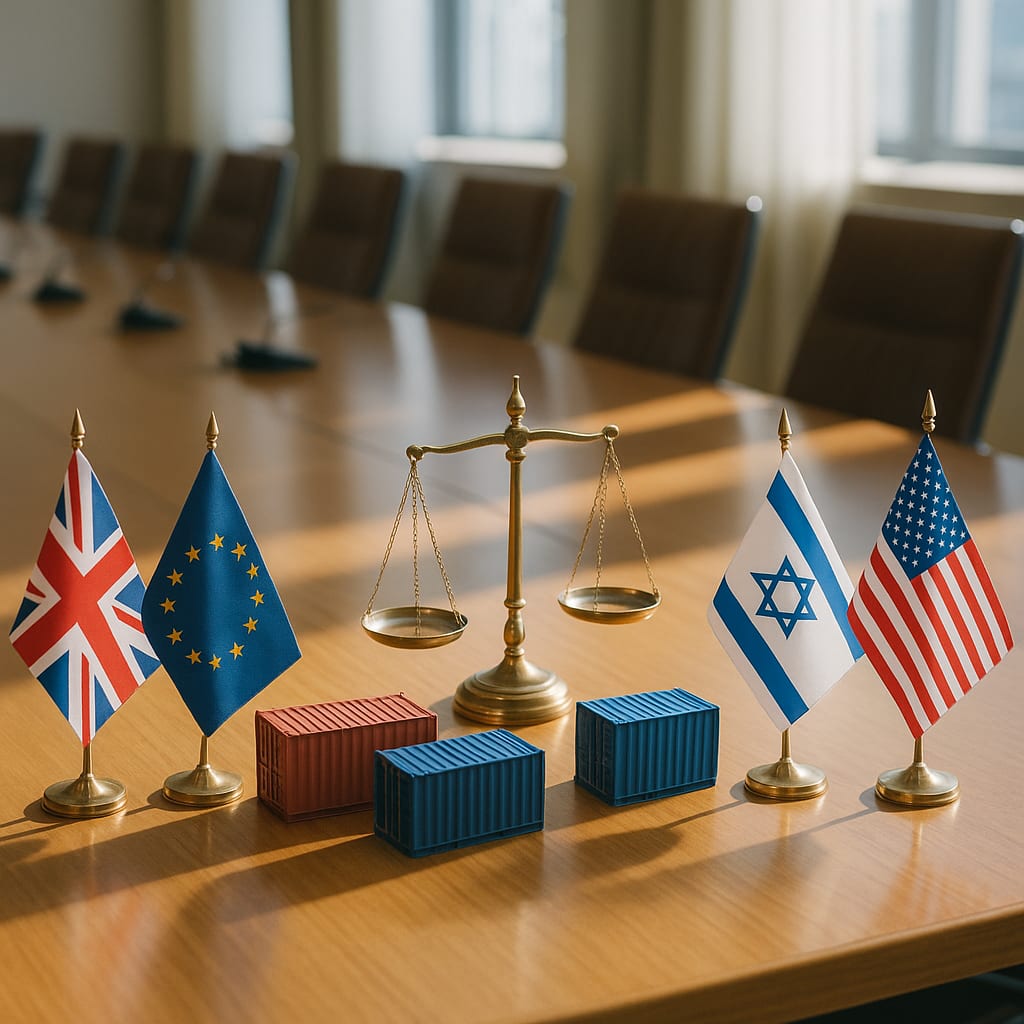
UK and allies impose measures on Israeli settlements; responses split in Britain, Israel, and the United States
Narrative Snapshot
Across European and Middle Eastern outlets, there is broad acknowledgment that London moved alongside partners to restrict economic engagement with Israeli settlements, but the framing diverges sharply. French commentary casts the actions as overdue and necessary to confront the logic of ongoing colonization, emphasizing product boycotts from occupied territories as legitimate statecraft. An Indian perspective treats the measures as largely symbolic, signaling diplomatic intent rather than delivering material impact. Within Israeli discourse, one former prime minister explicitly endorses external sanctions while a separate analysis advises the government to keep lines to Europe open despite domestic political pressures behind the moves abroad.
UK-focused reporting highlights domestic consequences beyond foreign policy. One strand scrutinizes cultural sponsorships tied to sanctioned settlements; another documents mixed rabbinical reactions and concerns about repercussions for Jews in Britain. On transatlantic dynamics, Washington’s stance is captured as non-aligned and restrained, in contrast to sharper earlier rhetoric from a senior U.S. envoy. Additional context from declassified British files places current steps against a longer record of official awareness of Israeli abuses. A Palestinian outlet characterizes the policy shift as a notable British turn, even invoking U.S.-linked personalities in narrating how it came together.
What Happened
Several European countries, including France, decided on September 8 to boycott Israeli products manufactured in occupied territories. In parallel, the United Kingdom announced sanctions on Israeli settlers, with the British foreign secretary quoting former Israeli prime minister Ehud Olmert during the rollout. Olmert publicly backed the UK move and condemned extremist settlers in stark terms. Commentary in Israel urged the government to keep communication channels with Europe open, even as it noted that domestic politics in sanctioning states might be shaping their decisions. The Hindu reported that as many as 12 countries, among them the UK, France, and Canada, issued a joint statement on new trade restrictions targeting West Bank settlements, judging the measures largely symbolic. In London, a Green Party leader urged an investigation into a British Museum exhibition sponsor linked to a sanctioned settlement. Washington signaled it would not follow suit.
Why It Matters
The measures touch core questions of international legal alignment and Western policy coherence. A UK outlet argued that London’s move nears, but does not fully reach, a broader alignment with international law, noting the foreign secretary’s public recognition of the occupation’s unlawfulness as reaffirmed by the International Court of Justice in 2024. France’s leading daily framed boycotts of settlement goods as a necessary correction to a long-delayed response to colonization. Conversely, an Indian assessment underscored limited practical bite while acknowledging a reaffirmed commitment to a two-state horizon. The United States’ decision not to mirror allied actions introduces a transatlantic gap precisely as European partners coordinate. Within Israel, the juxtaposition of high-level endorsement of external pressure and counsel to preserve European ties points to a policy calculus that weighs international isolation risks against domestic political dynamics.
Diverging Narratives
The legitimacy and urgency of targeting settlement-linked commerce receive strong endorsement in French commentary and in Olmert’s denunciation of extremist settlers, whereas The Hindu emphasizes the likely modest economic impact and symbolic character of the trade curbs. UK advocacy writing presses for steps beyond the settlement enterprise toward broader accountability, setting a higher bar than the current package, while an Israeli column advises against overreaction and stresses maintaining dialogue with Europe. U.S. positioning is depicted as restrained and non-convergent: the secretary of state said Washington would not follow allied sanctions, even as prior remarks by the U.S. ambassador to Israel castigated the UK in sharper terms. British domestic coverage adds another axis of contention, with prominent rabbis split between support, condemnation, and concern over implications for Jews in Britain, and with cultural institutions facing calls to scrutinize sponsorship tied to sanctioned settlements. Al Jazeera situates UK actions within a two-decade record of internal warnings about Israeli abuses, and a Palestinian outlet presents the development as a notable British shift, invoking U.S.-related figures in its narrative of how the move came about.
What Happens Next
Key decision points cluster around scope, enforcement, and diplomatic management. On scope, UK advocacy writing’s call for fuller alignment with international law—set against the foreign secretary’s recognition of the occupation’s unlawfulness—sets a watchpoint for whether London limits measures to settlements or expands them; signals would include additional policy steps or accountability mechanisms. On enforcement and reach, The Hindu’s assessment of limited bite directs attention to how the reported multi-country trade restrictions are operationalized; indicators include product coverage, compliance checks, and partner follow-through among the 12 signatories it cites. Israel’s response will be shaped by whether leaders heed advice to preserve European channels despite political pressures; observable markers include rhetoric, retaliatory steps, or outreach. Transatlantic dynamics bear monitoring given Washington’s decision not to follow allied sanctions; subsequent U.S. statements will clarify whether policy distance widens or narrows. In the UK domestic arena, responses to calls for investigating cultural sponsorships linked to sanctioned settlements will test how far the measures extend into institutional practice.