
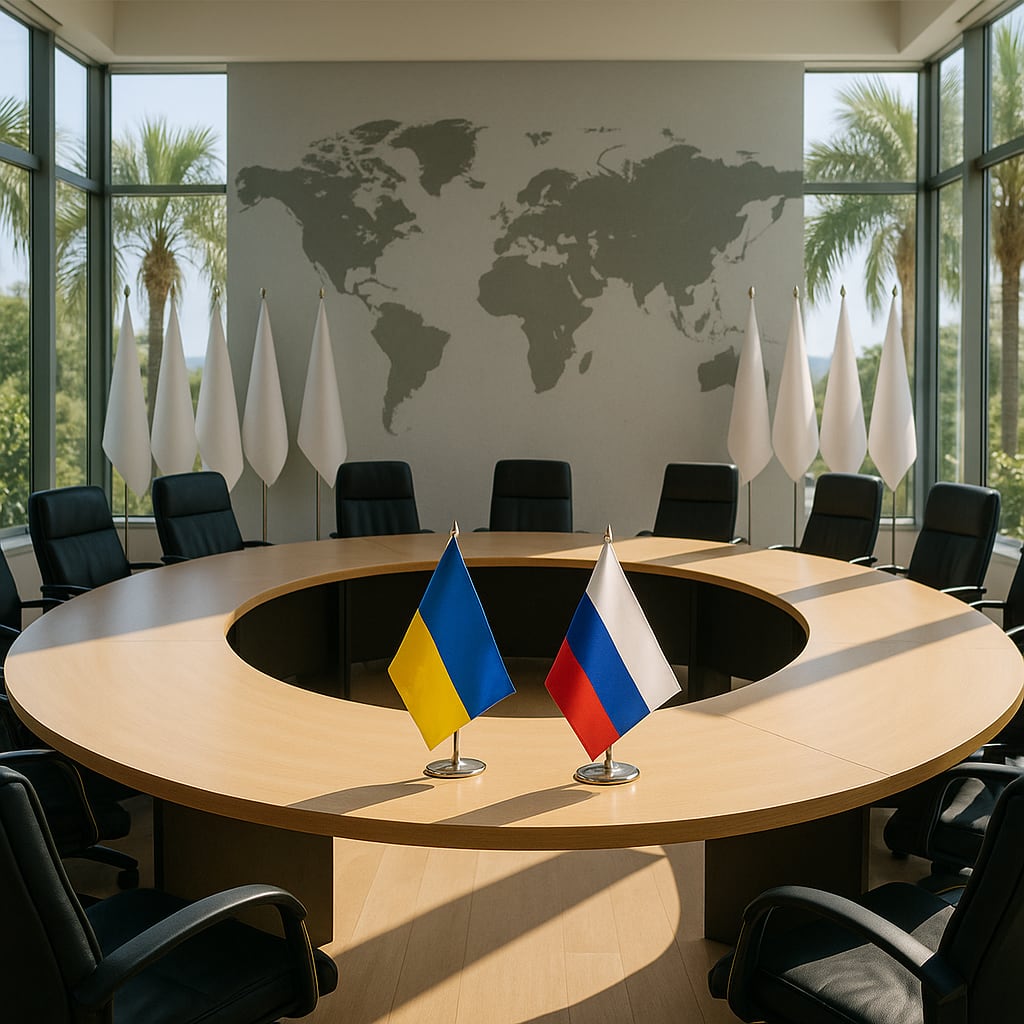
Zelensky offers to meet Putin at Miami G20; Kremlin insists talks only in Moscow
Narrative Snapshot
Across European and Ukrainian outlets, coverage centers on a public opening from Kyiv and a rejection from Moscow, but the framing varies. DW highlights President Volodymyr Zelenskyy’s assertion that Ukraine is “in a strong position to negotiate,” casting his offer as an initiative from relative strength. Italian coverage, including ANSA and Corriere della Sera, amplifies the immediacy of Zelenskyy’s call to “meet” while foregrounding the Kremlin’s response to “come to Moscow.”
French and Italian outlets underline uncertainty over Vladimir Putin’s participation, with France24 and ANSA reporting that the Kremlin has not decided on attendance even as it demands talks on Russian soil. Russian state media closes the door more firmly: TASS rules out any Putin-Zelensky meeting during the Miami summit and reiterates Moscow as the only acceptable venue.
Regional context pieces add institutional texture. The Hindu notes the United States’ G20 presidency, the forum’s membership including the EU and African Union, and Russia’s participation in a G20 energy meeting, indicating ongoing engagement at working levels. The Bangkok Post situates the development within what it describes as intensifying efforts to end the conflict, a framing largely absent from the more procedural accounts elsewhere.
What Happened
In an interview with Deutsche Welle, Ukrainian President Volodymyr Zelenskyy said Ukraine is in a strong position to negotiate and offered to meet Russian President Vladimir Putin during the G20 leaders’ summit in Miami. Ukrainian outlets reported the timing and conditions: the Kyiv Independent noted the December schedule, while Ukrinform said Zelenskyy was ready to attend and meet Putin if the United States invites the Kremlin leader to the forum. European reporting captured the Kremlin’s reaction. France24 said Moscow had not decided whether Putin would attend and instead demanded Zelenskyy come to Russia for talks, a line echoed by ANSA. TASS stated a meeting at the G20 is ruled out and could take place only in Moscow, a stance also reflected by Le Monde. The Hindu provided context on the U.S. G20 presidency and reported a Russian delegation would join a G20 energy meeting. Corriere della Sera cited the summit dates, December 14–15.
Why It Matters
The episode tests whether leader-level multilateral venues can facilitate contact in a high-intensity interstate war when one party conditions dialogue on talks in its own capital. With the United States holding the G20 presidency and the forum now comprising 19 countries plus the EU and the African Union, any attempt to use summit margins for crisis diplomacy intersects with host-country logistics, agenda-setting, and protocol, as reported by The Hindu. Russia’s planned participation in a G20 energy meeting underscores selective engagement with G20 structures while signaling limits at the leader level. For governments and international organizations, this highlights both the utility and constraints of summitry for conflict management. It also places a premium on anticipating security, protocol, and deconfliction requirements at Miami should parallel interactions occur, even if formal bilateral talks remain off the table.
Diverging Narratives
Zelenskyy’s message, as carried by DW and echoed in Italian and Ukrainian outlets, frames readiness to engage as a function of strength and urgency, with Corriere della Sera quoting “We must meet” and Ukrinform emphasizing conditionality tied to a U.S. invitation to Putin. Moscow’s counternarrative is venue sovereignty and control: France24 reports a demand that Zelenskyy come to Russia for talks and notes Putin has repeatedly rejected face-to-face meetings, while TASS states that any Miami encounter is impossible and that only Moscow is acceptable. The level-of-engagement signal also splits: The Hindu’s note that a Russian delegation will attend a G20 energy meeting points to continued participation in technical tracks despite leader-level resistance. Meanwhile, France24 and ANSA stress that Putin’s attendance decision remains pending, a point that coexists with, but does not soften, the Kremlin’s categorical rejection of a G20-side meeting reported by TASS and reiterated by Le Monde.
What Happens Next
Three decision points emerge from the reporting. First is the Kremlin’s call on Putin’s Miami attendance. If he attends, TASS’s position suggests no bilateral with Zelenskyy; analysts should watch for any rhetorical shift from Dmitry Peskov that would reopen the door. If he does not attend, leader-level contact is foreclosed at the summit, though working-level Russian participation, flagged by The Hindu in the energy track, may continue.
Second is host-country handling and guest dynamics. Ukrinform reports Zelenskyy tied his attendance and willingness to meet to the United States inviting Putin. Watch for U.S. communications on summit participation and modalities that could shape room for informal interactions.
Third is Kyiv’s own calculus. DW’s framing of a “strong position to negotiate” suggests continued signaling from Ukraine; changes in Kyiv’s stated conditions or scheduling around the December 14–15 summit, cited by Corriere della Sera, would indicate how actively it intends to pursue summit-margin engagement.