
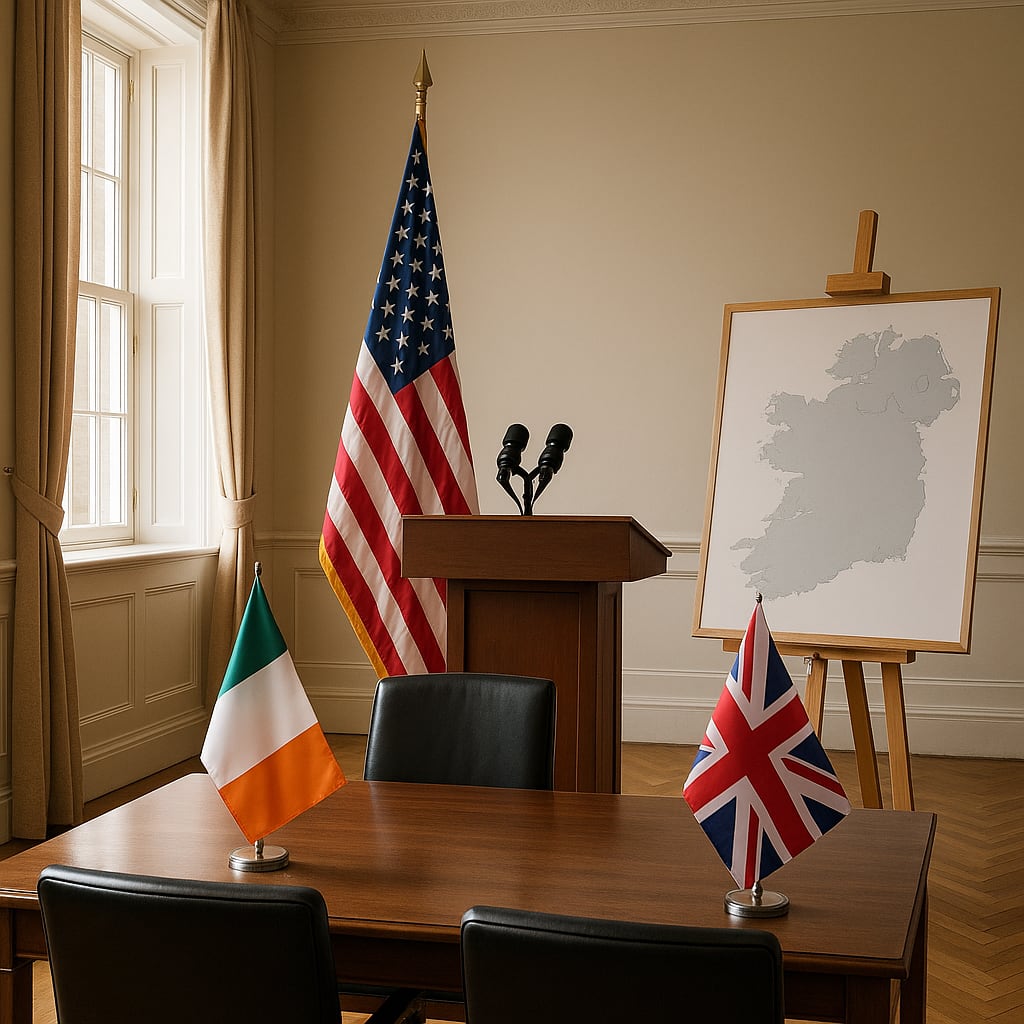
Trump endorses Irish unification on Dublin visit, prompting UK and unionist pushback
Narrative Snapshot
Across outlets, the central quotes are uncontested: Donald Trump said in Dublin he would “love” to see Ireland unified, called it “fantastic,” argued it will happen “eventually,” and added it “may as well happen now,” while acknowledging the UK would have a say (Fox News; The Guardian; New York Times; Sky News; Al Jazeera; RT). Where coverage diverges is in interpretation and consequence. US and UK papers emphasize policy departure and political blowback: the New York Times frames the remarks as breaking with the longstanding US posture of neutrality on Northern Ireland’s constitutional status; UK coverage highlights swift rebuttals from London and unionist leaders (The Guardian; BBC; CBC). Several European and Latin American outlets elevate process and domestic UK implications, emphasizing the Good Friday Agreement’s consent principle and London’s position that there is no consensus for a referendum, alongside visible unionist resistance and nationalist enthusiasm (Clarin; ANSA; La Repubblica). Other angles surface in single-country coverage: Deutsche Welle stresses the trip’s mix of golf and meetings; RT foregrounds Trump’s prediction of inevitability and his praise for Ireland’s prime minister; The Times of Israel notes large protests in Dublin during the visit.
What Happened
During a two-day visit to Ireland that combined meetings with watching a golf tournament, US President Donald Trump said in Dublin he would “love to see” a unified Ireland, calling it “fantastic,” asserting it will happen “eventually,” and adding it “may as well happen now.” He made the remarks on stage with Taoiseach Micheál Martin, while noting the UK would “have something to say about it” (Fox News; Deutsche Welle; The Guardian; New York Times; Sky News; Al Jazeera). RT reported Trump suggested Martin was the “right man” to “get it moving.” The comments drew immediate pushback: the UK government and Northern Ireland’s unionist leaders issued swift rebuttals, with a spokesperson for Prime Minister Burnham saying there is no public support and London stating there is no consensus for a referendum; unionist leaders insisted Northern Ireland will remain part of the UK (The Guardian; ANSA; La Repubblica; CBC; RT; Clarin). Clarin underscored that British responses referenced the Good Friday Agreement. The Times of Israel reported thousands of protesters in Dublin during the visit.
Why It Matters
The New York Times underscores that the United States has maintained official neutrality on Irish unification since the 1998 Good Friday Agreement, which ended decades of violence. Trump’s endorsement departs from that precedent, raising questions about how Washington signals on contested constitutional issues involving close allies. UK outlets report immediate government and unionist rejections, highlighting the continued salience of the consent principle and the sensitivity of external commentary on UK internal constitutional arrangements (The Guardian; CBC; Clarin). Italian coverage extends the lens to wider UK cohesion, with London reiterating “no consensus” for a border poll and, in subsequent reporting, an unprecedented push by leaders in Scotland, Wales, and Northern Ireland for a summit on independence agendas following Trump’s remarks (La Repubblica). The BBC suggests the comments may have been aimed at audiences “across the Atlantic,” pointing to the interplay between US domestic politics and transatlantic diplomacy.
Diverging Narratives
For proponents of change, Trump’s language casts unification as both desirable and inevitable—“it’s going to happen eventually”—and personalizes momentum by implying Dublin’s leader could “get it moving” (Fox News; RT). London and unionist leaders counter on principle and process: the UK government’s response references the Good Friday Agreement framework, emphasizes the absence of public support and “no consensus” for a referendum, and asserts Northern Ireland’s place in the UK (ANSA; La Repubblica; Clarin; CBC; RT). Some outlets frame the remarks as a provocation toward London (Folha de S.Paulo), while others stress institutional safeguards that constrain any near-term shift (Clarin). Media also diverge on the scope of political aftershocks: Italian reporting highlights applause for Sinn Féin and links the episode to broader centrifugal pressures within the UK (La Repubblica), whereas several Anglo-American headlines confine the story to Trump’s quotes and the immediate rebuttal (Fox News; Sky News; BBC). The New York Times centers the US policy break; the BBC interprets the messaging as possibly calibrated for US audiences, an angle largely absent elsewhere.
What Happens Next
Three decision points emerge from the reporting. First, London’s threshold for a border poll: with the UK government stating there is “no consensus” and “no public support,” immediate procedural movement appears unlikely; any shift would hinge on changes in political signals or public sentiment as understood by London (ANSA; La Repubblica; Clarin). Second, nationalist and devolved-level coordination: La Repubblica reports an unprecedented summit call by leaders in Scotland, Wales, and Northern Ireland to advance independence agendas after Trump’s remarks; whether that convenes, and with what demands, will indicate if this moment feeds broader constitutional campaigns. Third, Washington’s posture: given the New York Times’ note that Trump’s statement breaks with US neutrality precedent, watch for any formal clarification or reaffirmation from US officials that would define how far—if at all—US policy has substantively shifted. The scale and tone of unionist, Dublin, and London follow-on statements will be the proximate indicators of traction or containment.