
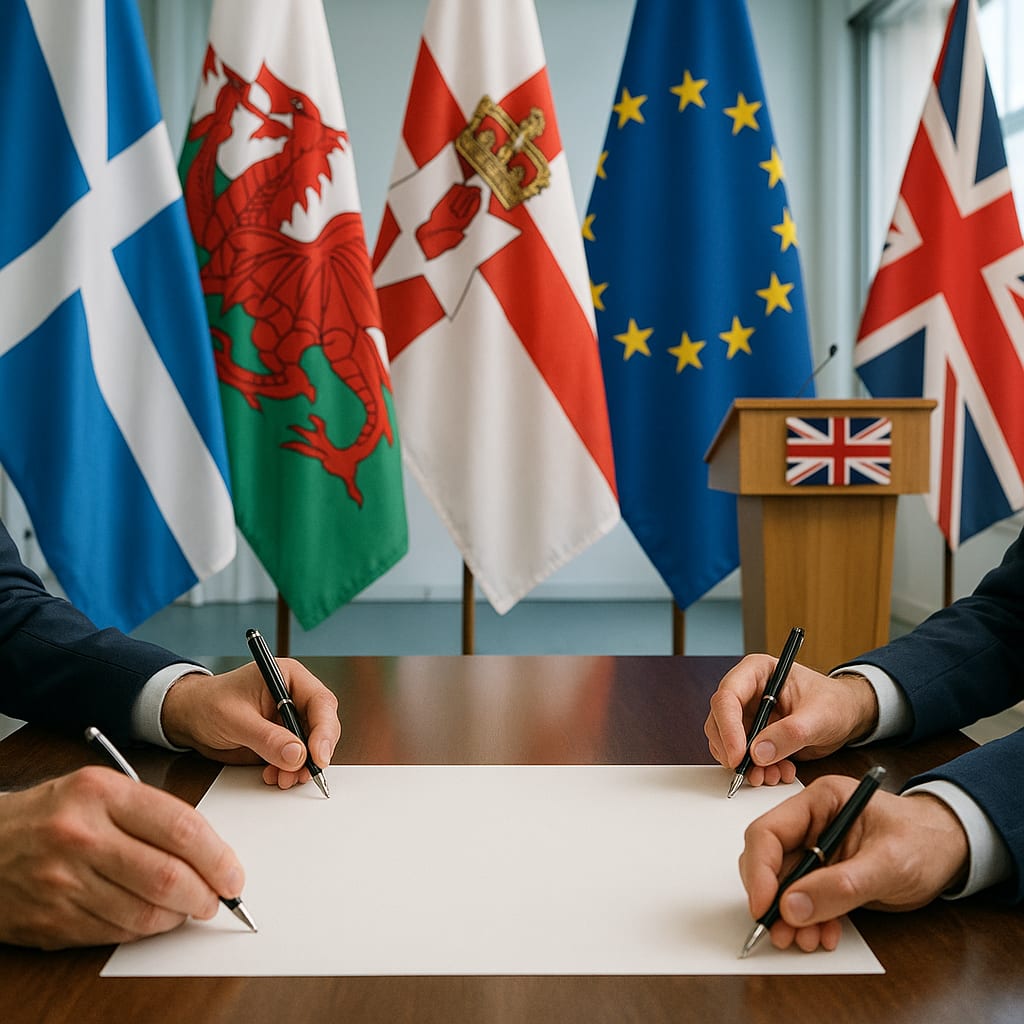
Celtic leaders sign Cardiff pact asserting self-determination; London rejects referendums
Narrative Snapshot
Across outlets, there is broad agreement that leaders of Scotland, Wales and Northern Ireland formalized coordinated demands for self-determination at a Cardiff summit and used pointed language about Westminster’s diminishing authority. UK and international coverage highlights the shared nationalist orientation of the devolved governments and the bid to channel that alignment into a common strategy, with The Guardian describing a memorandum calling on Westminster to “prepare, plan and facilitate constitutional change” and noting Mary Lou McDonald’s attendance as Ireland’s opposition leader (The Guardian, 14 Sep; The Guardian, 15 Sep). Several European and Latin American outlets emphasize that the signatories explicitly link their future to the European Union (Le Monde; Folha de S.Paulo), a frame echoed in reporting that the first ministers told London to prepare for constitutional change and that their future lies with the EU (South China Morning Post).
Where accounts diverge is in scale and immediacy. Some reports stress the pact’s destabilizing potential for the UK union, calling it a threat to unity or a historic challenge (South China Morning Post; Toronto Star; Fox News), while others stress that it is largely symbolic and does not set any timetable, even as it ramps up pressure on London to authorize votes (Clarín). The UK government’s public posture is consistently captured as firm rejection of referendums and an affirmation of the union, with TASS citing the prime minister’s office and ANSA summarizing Andy Burnham’s “United, we are stronger” message (TASS; ANSA). Additional international angles appear unevenly: Al Jazeera relays the nationalist leaders’ contention that London has “no right” to block democracy, while Israeli and US coverage foregrounds the timing “days after” Donald Trump backed Irish reunification (Al Jazeera English; Times of Israel; Fox News). The Hindu points out that, despite the joint stance, the parties differ on how and when any break with the UK might proceed, underscoring heterogeneity behind the coordination.
What Happened
On 14 September 2026 in Cardiff, leaders of Scotland’s SNP, Wales’s Plaid Cymru and Northern Ireland’s Sinn Féin signed a memorandum of understanding asserting a right to self-determination and calling for constitutional change. The Guardian reports the signatories included John Swinney, Rhun ap Iorwerth and Michelle O’Neill, with Sinn Féin president and Irish opposition leader Mary Lou McDonald also present. Statements from the summit declared “Westminster’s time is coming to an end” and urged the UK government to “prepare, plan and facilitate” constitutional change (The Guardian, 14 Sep; The Guardian, 15 Sep). Multiple outlets note the leaders’ view that their nations’ future lies in the European Union (Le Monde; Folha de S.Paulo; South China Morning Post). The UK prime minister’s office rejected the prospect of referendums on leaving the UK, emphasizing a commitment to deliver change across all four nations and belief in the union (TASS). ANSA summarized Andy Burnham’s response as “United, we are stronger.”
Why It Matters
The pact formalizes coordination among devolved administrations currently led by parties that favor eventual separation, marking what The Guardian describes as the first simultaneous tenure of such parties across Scotland, Wales and Northern Ireland and the “initial codification” of that shift (The Guardian, 15 Sep). The explicit call for Westminster to prepare and facilitate constitutional change moves debate from aspiration to demands for agreed processes, placing procedural design squarely on the agenda. Several outlets report that leaders framed EU membership as their destination, signaling a deliberate European orientation to their constitutional projects (Le Monde; Folha de S.Paulo; South China Morning Post).
London’s immediate refusal to countenance referendums, conveyed via the prime minister’s office and reinforced by messages of union strength, sets up an institutional impasse between centralized authority and devolved aspirations (TASS; ANSA). Sinn Féin’s dual presence in Northern Ireland’s executive and in the all-Ireland opposition, noted by The Guardian, and external attention following comments supportive of Irish unity (Fox News; Times of Israel) add cross-border and international dimensions that policy actors will need to factor into sequencing, engagement, and risk management.
Diverging Narratives
Competing framings emerge around stakes and timing. The South China Morning Post and Toronto Star characterize the pact as one that “threatens to lead to the break-up of the United Kingdom,” while Fox News labels it a “historic” challenge to the constitutional settlement, tying the moment to recent remarks by Donald Trump favoring Irish reunification (South China Morning Post; Toronto Star; Fox News; Times of Israel). By contrast, Clarín underscores the pact’s symbolic weight but stresses that it sets no dates and does not make dissolution imminent; instead, it is designed to increase pressure on London to authorize referendums (Clarín, 14 Sep; Clarín, 15 Sep).
On substance, European and Latin American outlets accent the EU destination declared by the leaders (Le Monde; Folha de S.Paulo), while Al Jazeera foregrounds the democratic-legitimacy argument that London has “no right” to block self-determination (Al Jazeera English). The UK government’s counter-narrative is a categorical rejection of referendums alongside a message of delivering change within the union (TASS; ANSA). The Hindu’s note that the parties differ on how and when separation might occur indicates that beneath a common platform lie distinct strategies and timelines, a nuance less visible in coverage that focuses on unity of purpose (The Hindu).
What Happens Next
Key decisions lie with Westminster and the devolved governments. The memorandum’s demand that London “prepare, plan and facilitate” constitutional change sets a clear test of the UK government’s willingness to engage in process design; the current position, however, rejects referendums outright (The Guardian, 15 Sep; TASS). Analysts should watch for any formal requests from Edinburgh, Cardiff or Belfast to authorize votes, and for any shift in UK messaging beyond affirmations of union strength (ANSA).
Within the devolved administrations, indicators include whether Scotland moves to secure a new referendum, consistent with John Swinney’s view that devolution is insufficient and his push for a fresh vote, framed alongside policy needs on immigration and fiscal flexibility (La Repubblica). In Northern Ireland, Sinn Féin’s coordination with McDonald’s opposition leadership and the external spotlight from recent US commentary may shape how constitutional claims are advanced, though the pact itself sets no timetable (The Guardian, 14 Sep; Fox News; Times of Israel; Clarín). Continued trilateral summits or joint communiqués would signal sustained alignment on strategy.