
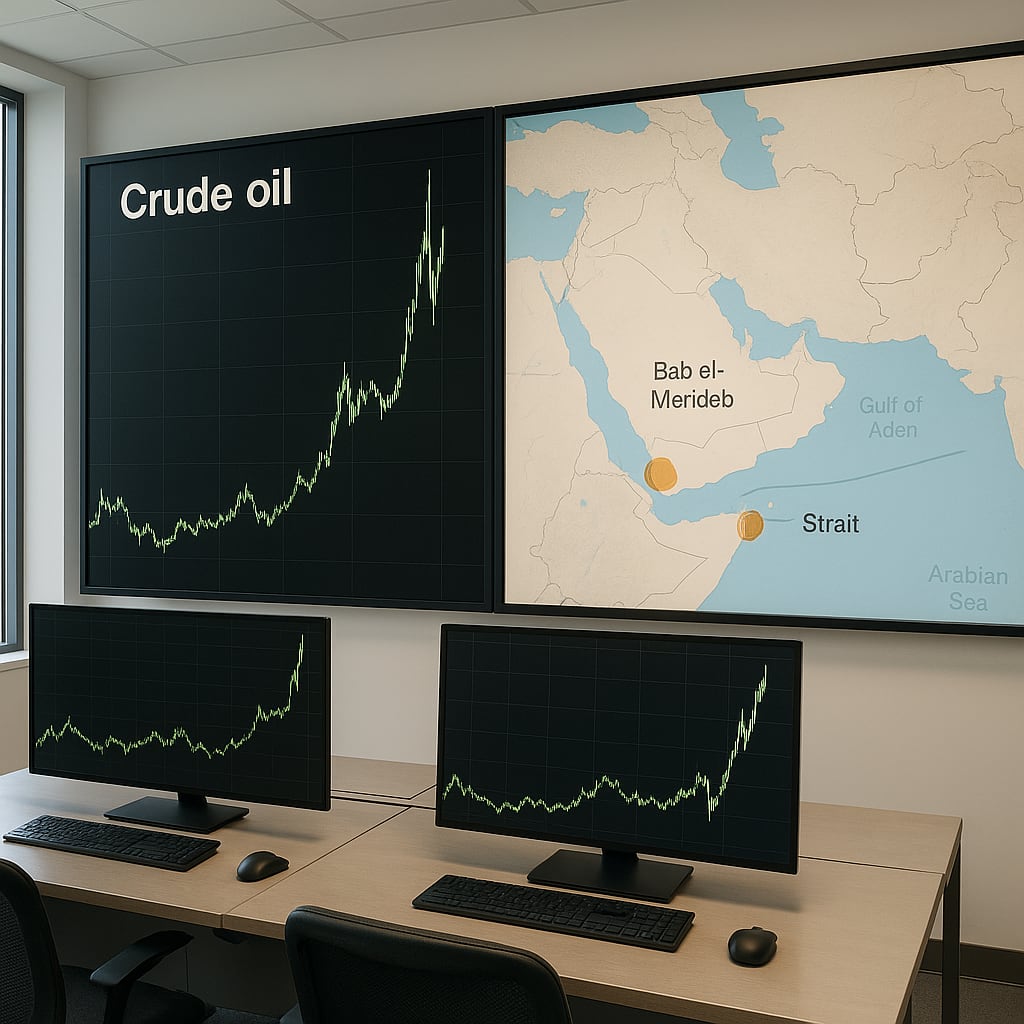
Oil tops $107 as Saudi pipeline outage and Hormuz strain threaten up to 4% of global supply
Narrative Snapshot
Across outlets, the focal point is a swift repricing of oil and refined fuels on mounting supply risk from the Gulf and Red Sea corridors. Market-facing coverage in the United Kingdom, United States, India and Italy converges on the price levels and day-on-day gains for Brent and WTI while tying the move to the shutdown of Saudi Arabia’s East–West Pipeline after a drone attack and continued uncertainty in the Strait of Hormuz. Reporting from Middle East Eye and The Hindu advances the core risk metric—up to 4% of global supply potentially sidelined if Saudi exports cannot be rerouted—and foregrounds how long repairs could take, a variable that traders are now reading closely.
Where coverage diverges is in assignment of agency and in geopolitical framing. Fox News and several outlets emphasise “Iran-backed” attacks and Houthi gains around Bab el-Mandeb as the proximate risk to bypass routes, reinforcing a narrative of Iranian-linked pressure on multiple chokepoints. By contrast, Tehran Times and Telesur locate causality in the US and Israeli offensive against Iran, arguing that the war itself—and Tehran’s response in Hormuz—has precipitated the supply shock. The New York Times and South China Morning Post focus on downstream consequences—record diesel prices and a stronger-than-expected US producer price print—while noting analysts’ view that the Iran war is the larger diesel driver despite parallel disruptions from Ukrainian strikes on Russian refineries.
A consistent secondary thread is macro spillover. Coverage from Folha de S.Paulo and The Guardian links energy’s surge to tighter financial conditions, with US Treasury yields jumping and upcoming rate decisions in the US, Japan and the UK now set against resurgent inflation pressure. Al Jazeera captures the operational-policy tension: even as Washington says it is clearing Hormuz traffic, futures remain well above $100, underscoring market scepticism that physical throughput and risk premia can normalise quickly under current conditions.
What Happened
Global oil benchmarks extended gains, with Brent crossing $107 per barrel and WTI above $102, after Saudi Arabia shut its East–West (Petroline) pipeline due to a drone attack, removing a critical bypass to the Red Sea. Multiple reports citing traders warned that if flows are not restored within days, Saudi exportable stocks could be depleted, jeopardising up to 4% of global supply. Riyadh has not detailed damage or a restart schedule; estimates reported via Reuters range from partial resumption sooner to repairs lasting five to six weeks, while other accounts put repairs at three to five weeks. At sea, Iran claimed attacks on 10 ships near the Strait of Hormuz after US strikes, and Iran-aligned Houthis asserted control of a strategic island overlooking Bab el-Mandeb. Talks on Hormuz’s future were postponed, even as the US said it was clearing traffic. Diesel prices in the US hit record highs around $6 per gallon, and bond yields surged alongside energy.
Why It Matters
The episode exposes the fragility of redundancy built into Gulf export systems. With Hormuz contested and Bab el-Mandeb under pressure, the Saudi East–West Pipeline—designed to bypass Hormuz—has become a single point of failure; its outage elevates systemic risk across two maritime chokepoints simultaneously. The price pass-through is already visible in record diesel costs and a hotter US producer price index, feeding a broader inflation impulse just as central banks in the US, Japan and the UK meet to set rates. Rising benchmark yields reflect a market recalibration to higher-for-longer energy costs. For energy importers such as Brazil, the renewed oil spike revives inflation management challenges. Analysts cited by TASS frame a near-term Brent range of $95–$115, signalling that volatility, not just price level, is now a policy variable. The contest over Gulf shipping lanes and the resilience of bypass infrastructure now sit at the intersection of security policy, monetary tightening, and fiscal pressure from fuel subsidies or relief measures.
Diverging Narratives
Accounts split on attribution and emphasis. US and UK outlets highlight the immediate market mechanics and supply math, with Fox News stressing that “Iran-backed” attacks have not only constrained Hormuz but also compromised the very routes meant to shield other producers, and specifying recent Petroline throughput at roughly 2.6–4.0 million barrels per day. Middle East Eye and The Hindu foreground the quantitative risk—up to 4% of global supply—and the uncertainty around repair timelines, relaying Reuters’ five-to-six-week scenario alongside the possibility of partial pumping sooner. Al Jazeera juxtaposes Washington’s claim of clearing Hormuz with futures remaining above $100, indicating unresolved operational and risk-pricing gaps. On causality, Tehran Times and Telesur argue the US–Israeli offensive against Iran triggered Tehran’s maritime disruption, while Fox and The Guardian emphasise Iranian and proxy actions escalating the squeeze. The New York Times notes President Trump’s attribution of diesel spikes to Ukrainian attacks on Russian refineries but reports analysts’ assessment that the Iran war is the larger factor; Telesur also cites Russia’s diesel export ban as compounding pressure. Factual uncertainties persist around the extent of pipeline damage, the durability of Houthi positions near Bab el-Mandeb, and whether postponed Hormuz talks can resume under current conditions.
What Happens Next
Three decision points will shape trajectories. First, Saudi restoration of the East–West Pipeline: if repairs proceed on the shorter end of reported windows or partial flows resume, the immediate 4% supply-at-risk scenario could ease; if outages persist for weeks, buyers’ warnings about exportable stocks and tighter Red Sea flows gain force. Analysts should watch for official throughput updates and independent satellite imagery, which several reports referenced. Second, maritime security and governance around Hormuz: US assertions of clearing traffic will be tested against incident rates and whether talks postponed this week are rescheduled; renewed attacks like those Iran claimed would sustain elevated risk premia. Third, Red Sea routing via Bab el-Mandeb: reports of Houthi control over a strategic island increase exposure of the Red Sea lane; any shift in territorial control would materially affect insurers’ and shippers’ route choices. On the macro side, central bank statements in the US, Japan and UK will signal how much energy’s surge feeds policy paths, while price bands suggested by TASS provide a benchmark for market-implied tightening of financial conditions.