
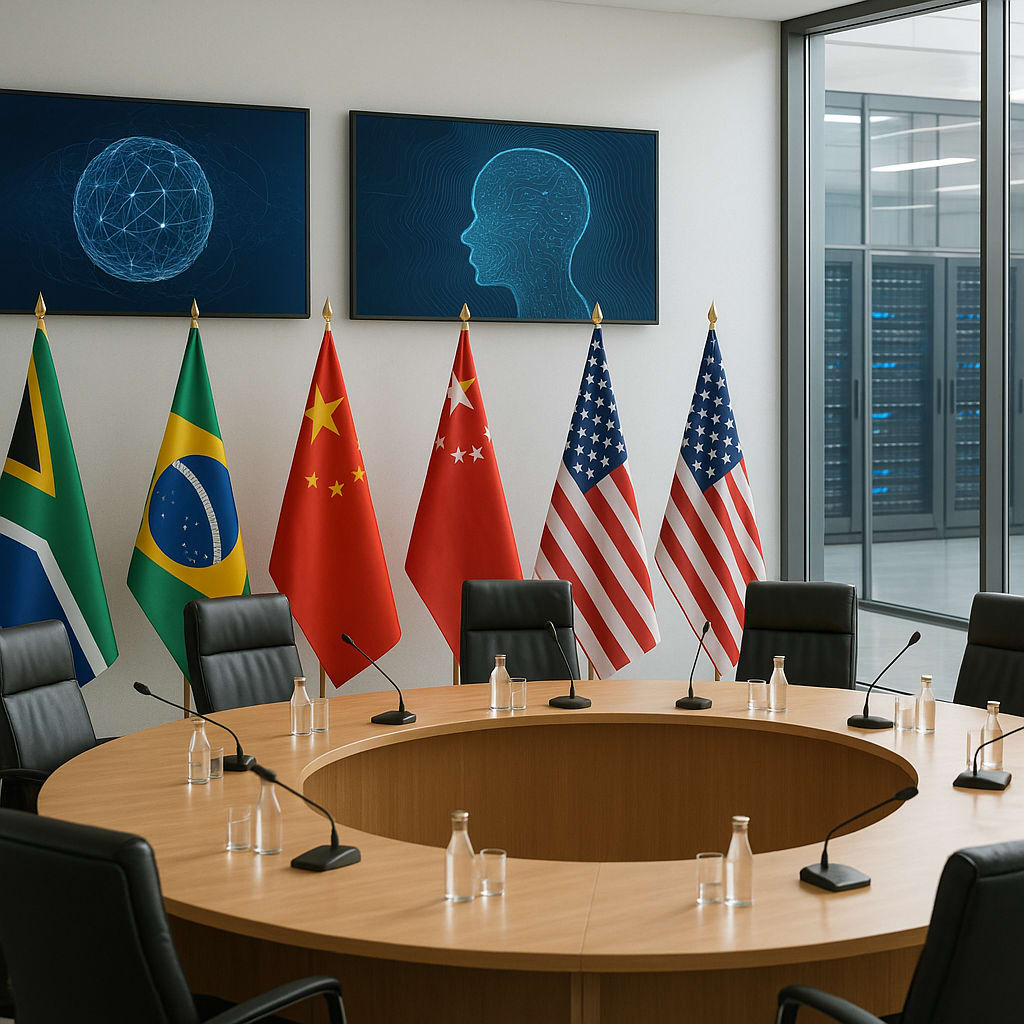
Beijing warns of AI security risks while rejecting U.S. tech leaders’ slowdown calls
Narrative Snapshot
Across outlets, Chinese officials are portrayed as pursuing two tracks at once: asserting leadership in global governance while rejecting Western industry proposals to “pace” development. Hong Kong and European coverage emphasizes Beijing’s call for “open, inclusive, universally beneficial and ethical” AI and its charge that “alarmism” would only hinder governance, paired with a preference to accelerate safety checks rather than pause progress (South China Morning Post; Clarin; ANSA; Al Jazeera English). Chinese commentators and state media are also depicted as viewing U.S. calls to slow AI as an attempt to entrench a U.S. lead, not a shared-safety agenda (South China Morning Post; NBC News).
U.S. and European reporting foreground the contrast between China’s public dismissal of “fearmongering” and its internal securitization of AI. The New York Times and The Hindu highlight Minister of State Security Chen Yixin’s framing of AI as a threat to Communist Party rule and a tool for foreign intelligence collection via “intelligent web crawlers,” data mining, and profiling of sensitive national and personal information (New York Times; The Hindu). BBC and NBC underscore Beijing’s rejection of narratives casting AI as a “malicious competition,” even as Chinese officials rebut specific U.S. tech leaders by name (BBC News; NBC News; Toronto Star).
Coverage from Brazil and Japan stresses that Chinese regulators nevertheless treat “loss of control” risks as real and are building rules and institutions to address them—an approach oriented toward state oversight rather than development pauses (Folha de S.Paulo; Japan Times). Latin American and Italian outlets link the debate to broader power competition and vulnerability of party control, while noting market jitters around “alarmism” (Clarin; La Repubblica). U.S. domestic pieces add a policy counterpoint: leading Republicans reject moratoria on grounds that China could “overlap” the U.S., and see parallel arenas for competition such as AI infrastructure expansion in Africa (Fox News).
What Happened
China’s Minister of State Security, Chen Yixin, warned that artificial intelligence poses rising risks to political and social stability, including exploitation by foreign intelligence agencies using automated collection and profiling tools to gather sensitive national data and citizens’ information (South China Morning Post; The Hindu; Folha de S.Paulo). His remarks followed a weekend Brics summit in India, where President Xi Jinping proposed an AI-related initiative while positioning China for a larger role in global AI governance (South China Morning Post). Around the same time, U.S. tech leaders called for an industry-wide slowdown or “pacing” of AI and tighter restrictions on China’s access to advanced AI. Beijing’s Foreign Ministry and state media rejected those appeals as “alarmism” and “fearmongering,” arguing they would cement a U.S. lead, while urging cooperation and faster safety evaluations instead (Toronto Star; NBC News; BBC News; ANSA; Al Jazeera English; Clarin).
Why It Matters
The episode illuminates an emerging split in global AI governance: whether safety is advanced by constraining the pace of frontier model development or by accelerating state-centered oversight without slowing deployment. China’s messaging couples a bid for leadership in international rule-making—including at Brics—with sharp resistance to U.S. industry-led “pacing” and to restrictions on Chinese access, which Beijing frames as technologically protectionist (South China Morning Post; Toronto Star; NBC News; Al Jazeera English). Simultaneously, Chinese security organs are formalizing AI as a domestic political-security issue, signaling heightened internal controls and risk-prevention frameworks (South China Morning Post; The Hindu; New York Times; Folha de S.Paulo; Japan Times).
For governments and multilateral bodies, this narrows the space for consensus on development pauses or access restrictions while keeping open negotiations on safety testing, audits, and cooperative norms. It also ties AI governance to broader strategic competition, from standards-setting to compute infrastructure—extending even to regions like Africa where U.S. and Chinese firms vie for data center deals (Fox News).
Diverging Narratives
One narrative, promoted by U.S. AI executives, argues that competitive dynamics risk overriding safety and that coordinated “pacing” is necessary; some proposals explicitly seek to limit China’s access to advanced AI technologies (Toronto Star; BBC News; Al Jazeera English). The counter-narrative from Beijing characterizes these appeals as “fearmongering” that would lock in American advantages, and instead calls for cooperative governance principles and expedited safety vetting without stalling innovation (NBC News; Clarin; ANSA; Al Jazeera English).
A second divergence concerns how safety is operationalized. Western coverage highlights proposals to slow model scaling, while Chinese and regional reporting points to expanded state oversight, technical safeguards, and rules to prevent models from “escaping human control,” all pursued without accepting a slowdown (Folha de S.Paulo; Japan Times; ANSA). A third tension sits within China’s own positioning: outwardly downplaying “threat narratives” while internally elevating AI to a matter of regime and social stability, with the security minister warning of Party-level risks and foreign intelligence exploitation (New York Times; The Hindu; Al Jazeera English). European and Latin American outlets situate this dual message within a broader concern that ceding algorithmic control to the U.S. would be strategically untenable for Xi, even as Chinese markets react negatively to heightened alarmism (La Repubblica; Clarin).
What Happens Next
Key decision points emerge on three fronts. First, in the United States, whether policymakers translate industry calls into formal restrictions on China’s access and broader “pacing” measures will hinge on congressional and executive signals; current Republican leadership rejects moratoria on competitiveness grounds while seeking “guardrails,” suggesting any constraints will be calibrated rather than sweeping (Fox News; Toronto Star). Second, in China, watch for concrete expansions of safety testing regimes, new guidance from security and cyberspace authorities, and movement on the Brics-linked AI initiative—steps consistent with calls for risk-prevention frameworks and accelerated checks (South China Morning Post; ANSA).
Third, internationally, expect intensified competition over standards and infrastructure. Indicators include Chinese efforts to anchor cooperative language in multilateral forums and U.S. moves to position American firms as the “gold standard,” including in African data center markets where competition with China is explicit (Al Jazeera English; Fox News). How these choices evolve will determine whether governance converges around shared safety tests or fragments along strategic fault lines.