
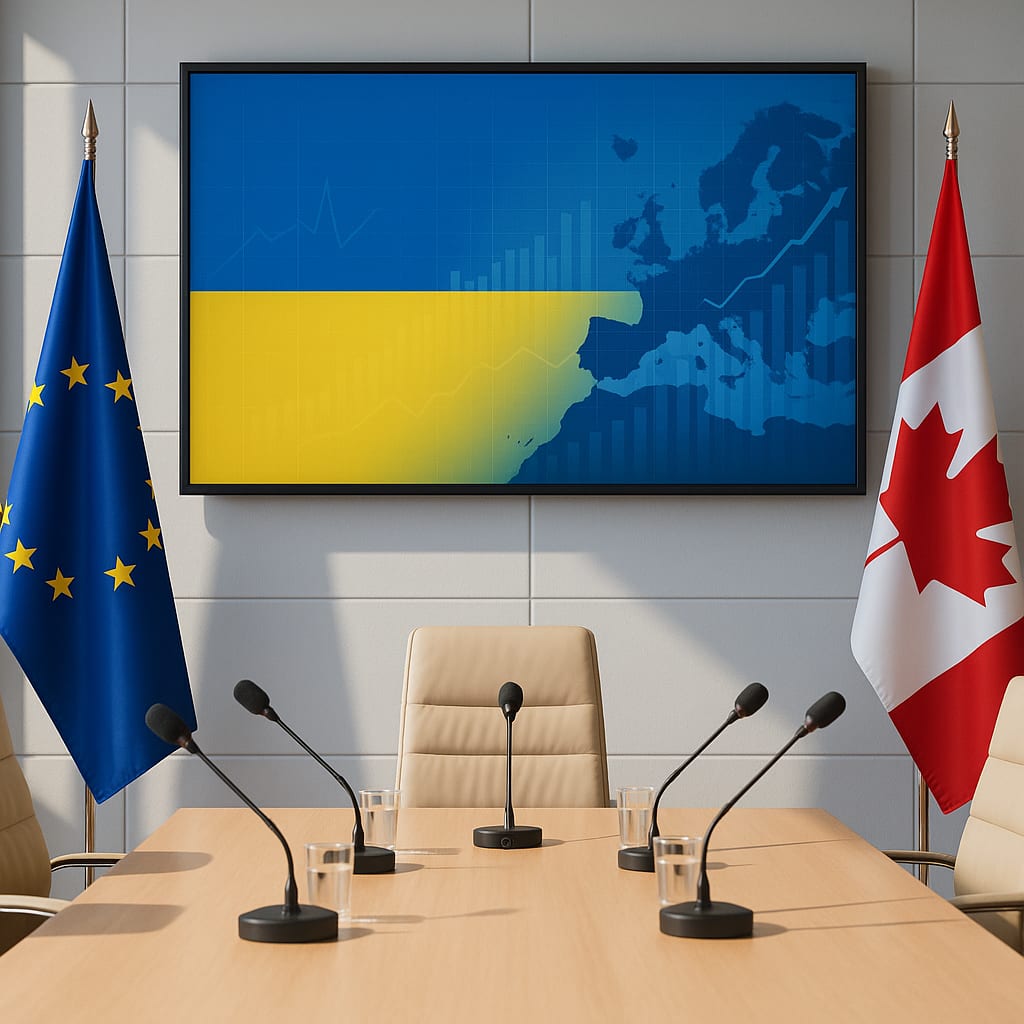
Canada pursues ‘unique alliance’ with EU as Ottawa readies contribution to EU loan for Ukraine
Narrative Snapshot
Across outlets, there is broad agreement that Ottawa is pursuing a novel, formally non-membership framework with the European Union. Canadian and German reporting emphasize Prime Minister Mark Carney’s clarification that Canada is not seeking EU membership but a “unique alliance” spanning multiple areas, a formulation presented by the Toronto Star and Deutsche Welle as Ottawa’s answer to speculation about “associate membership.” Coverage in Japan and Italy, citing the Wall Street Journal, highlights that the associate-membership idea was floated and that EU openness has been signaled by unnamed officials, while Argentine reporting underscores the Treaty-based constraint that only European states can join, pointing to the legal boundary Canada must navigate.
The stakes are framed differently by region. Thai coverage foregrounds a strategic hedge against a “hostile” United States, while France-based analysis situates Canada’s moves within a wider shift in U.S. foreign policy toward more transactional approaches, potentially weakening the traditional democratic alliance structure. Ukrainian and Russian outlets tie Ottawa’s European outreach to concrete policy—participation in an EU support loan for Ukraine—depicting closer Canada–EU ties as being operationalized through Ukraine-related financing. A second strand in Canadian media notes a domestic policy gap: the governing party promised a comprehensive foreign and security policy overhaul that has yet to be tabled, leaving Canadians with “scattered pieces” rather than a fully articulated strategy.
What Happened
Reports in mid-September detail a Canadian push for unprecedented closeness with the European Union under Prime Minister Mark Carney. The Kyiv Independent, citing the Financial Times, reported that Canada and the EU aim to finalize Ottawa’s contribution to an EU support loan for Ukraine ahead of an EU-Canada Summit in Montreal in late October. TASS, also citing the FT, linked the move to Carney’s broader effort to strengthen ties with Europe. Parallel reporting via the Japan Times said the Wall Street Journal described Carney pressing an “associate membership” concept, with unnamed officials in Ottawa and Brussels signaling openness, and La Repubblica noted a planned Carney address in Strasbourg on Thursday, 17 September. Carney publicly rejected EU membership, calling instead for a “unique alliance,” according to the Toronto Star and Deutsche Welle, with the Star adding that talks cover multiple areas. The Bangkok Post quoted Carney describing Canada as “the most European of non-European countries” and seeking to reduce dependence on a hostile United States. The Japan Times reported Australia’s trade minister said Canberra is “on the same page.” Clarin stressed EU treaty limits membership to European states, while France24 aired analysis by Anne Applebaum on changing U.S. foreign-policy dynamics.
Why It Matters
If realized, a Canada–EU “unique alliance” would test the EU’s capacity to craft bespoke partnerships beyond existing treaty categories while preserving the legal boundary that membership is limited to European states, as highlighted by Clarin. The initiative is already intersecting with hard security and fiscal policy through a planned Canadian role in the EU loan for Ukraine reported by the Kyiv Independent, signaling that any framework could be anchored in concrete joint actions rather than symbolism. Regional reactions suggest potential emulation: Australia’s stated interest, reported by the Japan Times, indicates that third-country democracies are watching whether the EU can operationalize deeper economic and political alignment without accession. The framing in Bangkok and analysis on France24 about a more transactional U.S. posture provide context for why allies might diversify alignments. For policymakers, the case implicates EU external governance design, Canada’s approach to alliance management, and burden-sharing mechanisms on Ukraine.
Diverging Narratives
Competing interpretations revolve first around feasibility versus form. The Japan Times relays that unnamed officials see openness to an “associate membership” idea, while the Toronto Star and Deutsche Welle emphasize Carney’s rejection of membership in favor of a “unique alliance,” suggesting Ottawa is steering away from labels that could clash with EU treaty constraints flagged by Clarin. Second, motivations are framed differently. The Bangkok Post emphasizes reducing dependence on a “hostile” United States, whereas TASS and the Kyiv Independent tie the initiative to relationship-building with Europe and to a practical vehicle—co-financing support for Ukraine—without the U.S. dimension. Third, there is uncertainty about scope. The Star reports both sides discussing a partnership “spanning multiple areas,” but specifics are not detailed, leaving ambiguity on trade, security, or regulatory components. Finally, domestic coherence is questioned in Canada: the Toronto Star notes promised overarching foreign and national security reviews remain untabled, creating a narrative gap between visible diplomatic moves and a consolidated national strategy.
What Happens Next
Several decision points will shape outcomes. First, the scale and terms of Canada’s participation in the EU support loan for Ukraine need to be finalized before the late-October EU-Canada Summit in Montreal, per the Kyiv Independent; agreement would signal that deeper ties are advancing through concrete financial coordination. Second, the framing and content of Carney’s Strasbourg speech noted by La Repubblica, and subsequent EU statements, will indicate whether Brussels and Ottawa converge on a bespoke legal-institutional construct versus shelving labels like “associate membership” in favor of practical arrangements. Third, watch for Canadian government delivery on the promised full foreign policy and national security review highlighted by the Toronto Star; tabling these would codify how a Europe pivot fits national strategy. Finally, monitor third-country interest: Australia’s posture, reported by the Japan Times, will be a barometer of whether an eventual Canada–EU model is seen as replicable by other partners.