
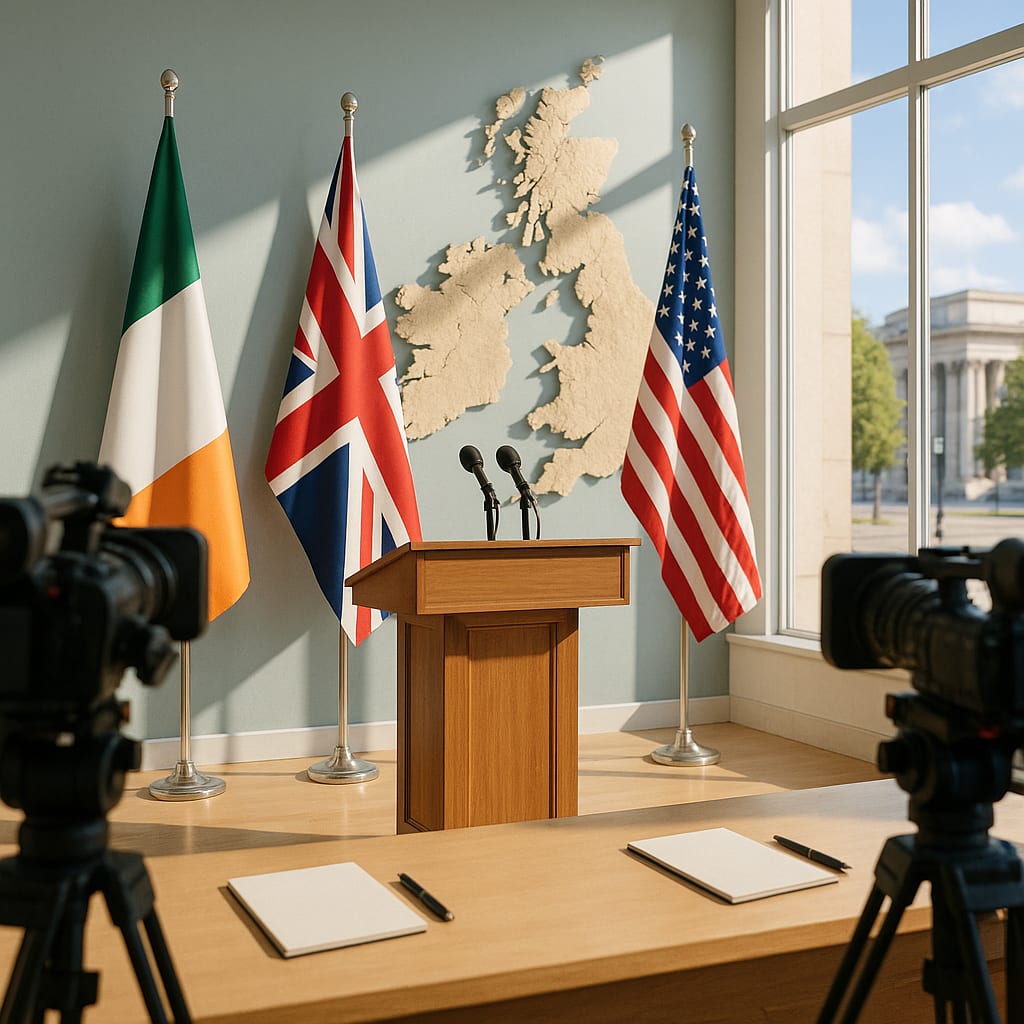
Trump’s open endorsement of Irish unification triggers U.K. pushback and questions over U.S. neutrality
Narrative Snapshot
Across outlets, coverage converges on two through-lines: the U.S. president’s unambiguous endorsement of Irish unification and the speed and breadth of British political resistance. Reporting in the United Kingdom highlights domestic backlash, from the Conservative Party leadership and Reform UK to a cabinet figure condemning the remarks as “completely wrong,” while The Guardian emphasizes that Trump publicly shrugged off Prime Minister Andy Burnham’s opposition to a referendum. International outlets, particularly in Japan and China, widen the aperture to the policy plane, noting that critics now question whether Washington is departing from a historically cautious posture on the issue.
Irish and European reporting injects tonal and contextual nuances. Dublin-focused coverage records a call from Taoiseach Micheál Martin for calm and continuity, and notes large protests during the visit. Several non-U.K. outlets foreground the setting—an Irish stop tied to a golf tournament on Trump’s own course—and, in Argentina’s Clarin, a unilateral announcement on Irish whiskey tariffs that sits apart from other accounts of the trip. India’s The Hindu captures a deliberate delimitation: Trump said he would not discuss Scotland “yet,” a distinction that U.K.-based pieces do not dwell on but that informs how different audiences parse the reach of his comments.
What Happened
During a two-day visit to Ireland, President Donald Trump said he would “love to see” the Republic of Ireland and Northern Ireland unified, adding it would “happen eventually” and “may as well happen now,” and that he saw “no good answer” on the controversy. He praised Taoiseach Micheál Martin, whom he called “the right man… to get it moving,” and later reiterated his stance, saying “many people agree” and dismissing British Prime Minister Andy Burnham’s opposition to a referendum with, “Everybody says that. Then things happen.” British reactions spanned senior Conservatives and Reform UK rejecting the idea and asserting Northern Ireland’s place in the U.K., while Robert Jenrick labeled Trump’s position “completely wrong.” Martin urged a calm response and noted Trump’s view was consistent with past remarks; protests of over 10,000 were reported in Dublin. Trump also said he would not discuss Scotland “yet.” One report said he announced eliminating tariffs on Irish whiskey during the visit.
Why It Matters
Reporting frames the episode as testing diplomatic baselines more than reshaping immediate policy. Japan-based coverage underscores that critics see potential movement away from a U.S. stance that has been mostly neutral on Irish unification, raising questions about how Washington positions itself on sensitive constitutional questions within allied states. In Britain, high-level rejection from government and opposition figures reinforces the political salience of territorial integrity, even as the Irish government counsels against overreaction and notes continuity in Trump’s past statements.
For transatlantic actors, the juxtaposition of a pointed constitutional comment with a visit anchored by a private golf event, and, per Clarin, a unilateral trade-related announcement on Irish whiskey, complicates the optics of statecraft. India-focused reporting highlights the explicit decision not to engage on Scotland, signaling that the rhetorical line-drawing across U.K. territorial issues is itself diplomatically consequential. For decision-makers, the issue now sits at the intersection of alliance management, domestic constitutional politics in the U.K. and Ireland, and perceptions of U.S. role discipline.
Diverging Narratives
U.K.-centered outlets emphasize national unity and process primacy. Conservative Party leader Kemi Badenoch and Reform UK’s Nigel Farage flatly rejected Trump’s position, while Robert Jenrick called it “completely wrong,” a through-line of British resistance that places constitutional authority in London and underscores Northern Ireland’s status within the U.K. The Guardian adds that Trump brushed off Burnham’s stated opposition to a referendum, accentuating a clash between London’s stated stance and the U.S. president’s public line.
By contrast, Irish and some international coverage stress de-escalation and continuity. Telesur English reports Taoiseach Micheál Martin urging a calm perspective and noting that Trump’s view aligns with past remarks, setting a tone distinct from the U.K. uproar highlighted by the Japan Times. RT and Fox News center Trump’s own framing—unification as “a great thing” that will “happen eventually”—with RT adding his suggestion that Martin is well positioned to “get it moving,” a characterization absent from British accounts. France24, focusing on the visit’s tie to a golf tournament on Trump’s course, and The Hindu’s note that he would not discuss Scotland “yet,” place his comments within a mix of personal, political, and regional boundaries that different audiences weigh differently. Clarin’s report of an announced elimination of tariffs on Irish whiskey introduces an economic facet not echoed elsewhere, creating an outlier thread on immediate policy deliverables.
What Happens Next
Key decision points will turn on formal positioning and procedural guardrails. First is whether Washington clarifies its stance: the Japan Times reports critics questioning a shift from mostly neutral U.S. positioning, so any State Department or White House statements affirming continuity or endorsing change will be pivotal. Second is London’s management of constitutional signaling: British reactions reported by Sky News, CGTN, and The Guardian indicate firm opposition, so watch for further ministerial language on referendums or Northern Ireland’s status that either hardens or modulates this line. Third is Dublin’s calibration: Martin’s call for calm suggests a preference to contain the diplomatic temperature; subsequent Irish government commentary will indicate whether it treats the episode as rhetorical or engages substantively.
Analysts should also track two ancillary indicators flagged in coverage: whether Trump maintains his stated reluctance to address Scotland, as noted by The Hindu, and whether Clarin’s report of an Irish whiskey tariff move is operationalized through concrete instruments or remains a trip-specific announcement.