
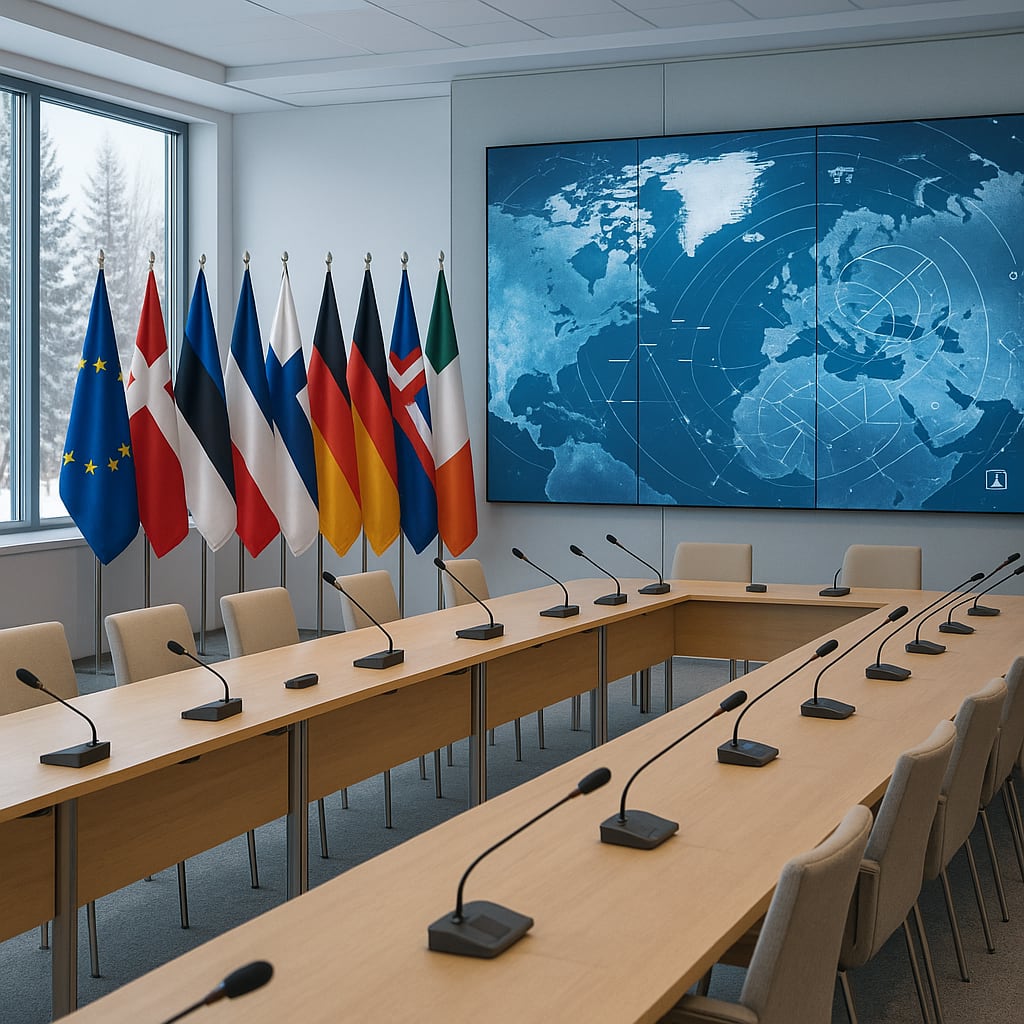
Twelve EU states press for stronger Arctic role at Finland summit
Narrative Snapshot
Across European outlets, coverage converges on a coordinated push by a coalition of EU governments at a summit in Rovaniemi to elevate the bloc’s Arctic posture, with Russia cast as the principal security concern and sea-ice retreat opening economic and strategic space. Deutsche Welle and France24 situate the move in a broader arc that includes Russia’s aggression and renewed U.S. pressure linked to Donald Trump and Greenland, while Al Jazeera and the Japan Times widen the frame to great‑power competition with China alongside the United States and Russia.
Two strands of emphasis run through the reporting. Security-centric accounts highlight concrete Russian military activity—reopening Soviet‑era bases and missile tests in the Far North—reported by Ukrinform and echoed in European pieces that call for “enhanced preparedness.” Economic‑industrial framing, prominent in Telesur’s summary of remarks by German Chancellor Friedrich Merz, underscores raw materials, energy, shipping, and even space capabilities, aligning with Deutsche Welle’s focus on critical raw materials.
A second axis concerns legitimacy and coalition breadth. Corriere della Sera and RT note that twelve EU states, not including Italy, signed the joint declaration, and RT stresses that only three EU members are Arctic states, two of which recently joined NATO. That point of emphasis differs from most European coverage, which treats the signatory group as a vanguard rather than a limitation, but it does surface a question about how far the initiative extends across the full EU.
What Happened
EU leaders convened the first European Arctic Summit in Rovaniemi, Finland, on September 13–14, hosted by Prime Minister Petteri Orpo. Twelve EU countries—Finland, Denmark, Estonia, France, Greece, Germany, Latvia, Lithuania, the Netherlands, Poland, Romania, and Sweden—issued a joint declaration calling for the Union to take a “more strategic and proactive role” in the Arctic, devote more resources, and reinforce its position through “enhanced preparedness,” according to RT and Corriere della Sera. Orpo said there was high demand for concrete EU action and a stronger shared assessment of threats and risks, Telesur reported. Germany highlighted security alongside opportunities in raw materials, energy, shipping, and space capabilities, Telesur added. European outlets linked the push to Russia’s aggression and Trump’s Greenland pressure, and to the race for critical raw materials, Deutsche Welle noted. Ukrinform reported Russia reopening Soviet‑era Arctic bases and conducting missile tests.
Why It Matters
The summit positions the Arctic higher on the EU’s strategic agenda, with implications across security, industrial, and infrastructure policy. The signatories urged the European Commission to embed maritime and spatial surveillance, intelligence sharing, protection of critical infrastructure, and responses to hybrid threats in the next Arctic strategy, according to Clarin. That points to deeper cross‑pillar coordination inside the EU—linking defense‑adjacent preparedness to economic resilience as melting sea ice accelerates access to resources and routes emphasized by the Japan Times and Al Jazeera.
For transatlantic and pan‑European security, the Rovaniemi push intersects with NATO’s evolving Arctic posture and with reported Russian military activity in the High North, per Ukrinform. It also signals EU intent to compete for critical raw materials and safeguard maritime connectivity, as Deutsche Welle and Telesur highlighted. Institutional follow‑through—resourcing, surveillance architecture, and information‑sharing mechanisms—will test the EU’s capacity to operationalize a geographically and politically complex file.
Diverging Narratives
European and Ukrainian outlets frame Russia as the central security driver. Deutsche Welle ties the agenda to “Russia’s aggression,” while France24 cites leaders seeking to tackle a Russian “threat.” Ukrinform asserts Moscow is reopening Soviet‑era bases and conducting missile tests, presenting concrete indicators of militarization. This security‑first reading sits alongside an economic‑industrial rationale—Germany’s emphasis on raw materials, energy, shipping, and space capabilities reported by Telesur, and Deutsche Welle’s stress on critical raw materials—suggesting dual‑track motives.
Russian state media disputes the premise of a Russia‑led threat. RT attributes rising tension to NATO’s expanding military activities in the Arctic and says Moscow rejects Western accusations, arguing NATO undermines traditional regional cooperation. That counter‑narrative also underscores that only three EU members are Arctic states, implicitly questioning the bloc’s Arctic standing.
A separate strand highlights U.S. pressure. Deutsche Welle and France24 reference Trump’s Greenland moves as part of the backdrop, and Clarin characterizes the EU as having “woken up” amid U.S. attention to Greenland and Russia’s expansionism. Al Jazeera and the Japan Times broaden the lens to depict a three‑way race involving Russia, China, and the United States, with the EU seeking to match their pace. Finally, intra‑EU alignment remains partial: Corriere della Sera notes Italy did not sign the declaration, indicating that the coalition leading this push is substantial but not unanimous.
What Happens Next
The immediate decision point is the European Commission’s drafting of the next Arctic strategy. Analysts should watch whether it incorporates the signatories’ requested elements—maritime and spatial surveillance, intelligence sharing, critical‑infrastructure protection, and hybrid‑threat response—as reported by Clarin, and whether budgetary lines and mandates are proposed to meet the summit’s call for “more resources” and “enhanced preparedness,” per RT and Telesur.
A second hinge concerns coalition breadth and implementation. Whether additional EU members join or endorse concrete measures will shape scale and legitimacy; Corriere della Sera’s note on Italy’s absence is a marker to track. Third, external military activity will condition EU choices: further Russian base reactivations or missile tests, highlighted by Ukrinform, and any shifts in NATO’s Arctic posture, flagged by RT, will influence resourcing and tempo. Finally, signals that the EU is linking Arctic policy to critical raw materials and maritime access, emphasized by Deutsche Welle and Telesur, would indicate movement from declaratory intent to operational planning.