
Nepal’s Himalayan Floods: Rising Toll, Power Shortfalls, and a $4.78 Billion Rebuild
Narrative Snapshot
Across outlets, the scale and human toll are uncontested even as figures vary. Human-centered reporting from the New York Times and its Spanish counterpart in Clarín foregrounds loss at the community level, echoed by survivor testimonies in The Hindu and Japan Times that detail prolonged entrapment and rescue. France24 widens the aperture by noting the large number of foreign nationals still unaccounted for, while numerical tallies diverge by outlet and date: Japan Times, TASS, and Le Monde each provide different but proximate death and missing counts as the situation evolves.
Other coverage locates the catastrophe within accelerating cryospheric change. The South China Morning Post links the event to a broader regional trajectory, highlighting research on “glacier bankruptcy” and an approach to “peak water” with implications for 2 billion people. Deutsche Welle and Mail & Guardian place the disaster within a climate justice frame, while The Hindu relays Nepal’s call for sustained international support for mountain adaptation.
Reporting also tracks the policy and infrastructure fallout. Al Jazeera English notes India’s commitment to deliver 654 megawatts daily to backstop Nepal’s power system after flood damage to hydropower assets, and The Hindu details the India–Nepal joint push to reach trapped workers in a key tunnel. The reconstruction bill appears consistent across Bangkok Post, Le Monde, and The Hindu at roughly $4.78 billion, as DW underscores a shift from rescue to recovery.
Information governance emerges as a cross-border variable. Japan Times contrasts Nepal’s and China’s responses to online rumors, finding Beijing more inclined to suppress footage and sanction challenges to official figures. SCMP’s account of casualties spanning Nepal and China’s Tibet underlines the shared geography of risk and the sensitivity of data flows around it.
What Happened
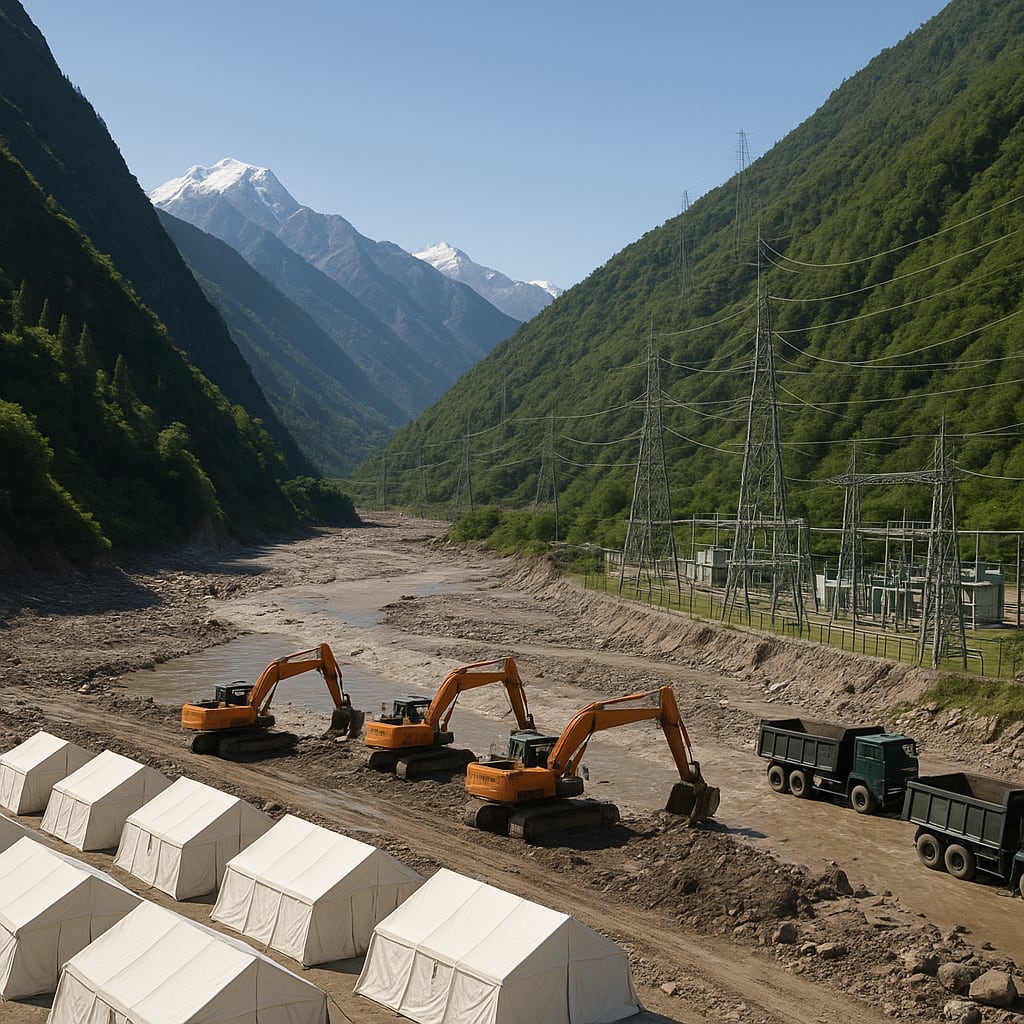
A late-August collapse of a Himalayan glacier near the Nepal–Tibet border triggered cascading landslides and flash floods that buried settlements and infrastructure. Death and missing counts differ by outlet and update cycle: Japan Times cites 1,386 dead and 5,130 missing in Nepal weeks after the collapse, TASS reports 1,396 dead with over 5,100 missing, and Le Monde lists 1,428 dead and 5,649 missing more than two weeks on. France24 reports nearly 1,400 confirmed dead and 5,130 missing, including about 600 foreign nationals from 35 countries, while SCMP notes at least 1,300 confirmed dead and more than 5,300 missing across Nepal and China’s Tibet. Rescue operations have continued, with The Hindu reporting India–Nepal teams nearing the final stage of clearing a blocked section in the Chilime tunnel. As Nepal moves from rescue to recovery, officials estimate a $4.78 billion reconstruction bill, reported by Bangkok Post, Le Monde, and The Hindu. With hydropower damaged, Al Jazeera English reports India will supply Nepal 654 megawatts of electricity daily to meet urgent needs.
Why It Matters
Outlets converge on systemic stakes that extend beyond Nepal’s immediate crisis. SCMP’s synthesis of new research underscores a rapid approach to “peak water” and accelerating glacier loss across the Himalayas, a trend that threatens long-term water security for approximately 2 billion people and complicates regional planning for hydropower, irrigation, and disaster risk reduction. The abrupt need for 654 megawatts of daily power imports from India highlights the fragility—and utility—of cross-border grid interdependence when mountain infrastructure fails, as reported by Al Jazeera English.
Policy frames coalesce around responsibility and capacity. Deutsche Welle’s account of mounting reconstruction needs ties to renewed calls for climate justice, a theme Mail & Guardian extends by linking Nepal’s disaster to broader governance gaps facing vulnerable states. The Hindu reports Nepal’s appeal for sustained international support to adapt to a rapidly changing mountain environment, while France24’s note of hundreds of missing foreign nationals points to the consular and multilateral coordination demands such disasters impose.
Diverging Narratives
Discrepancies in casualty and missing figures reflect different reporting windows and geographic scope. Japan Times, TASS, and Le Monde publish similar but non-identical tallies for Nepal as searches continue; France24 adds the dimension of foreign nationals; SCMP aggregates losses across Nepal and China’s Tibet, emphasizing the transboundary nature of the event. Terminology varies too, with TASS describing a devastating “landslide,” while others emphasize glacier collapse and flash floods.
Explanatory frames diverge in emphasis. SCMP situates the event within scientific assessments of accelerated ice loss and impending “peak water,” while Deutsche Welle and Mail & Guardian foreground equity and governance, framing the disaster through climate justice and the burden on vulnerable nations. Human-impact narratives from the New York Times, Clarín, The Hindu, and Japan Times concentrate on survival and loss, contrasting with policy-oriented pieces on reconstruction costs and power-system resilience from Bangkok Post, Le Monde, The Hindu, and Al Jazeera English.
Information control is treated unevenly. Japan Times reports that both Nepal and China moved against online misinformation, with Beijing taking more aggressive steps to suppress footage and penalize challenges to official figures. That framing intersects with SCMP’s cross-border casualty account, highlighting how state approaches to data and media can shape the public understanding of impact and accountability.
What Happens Next
Three decision points will shape trajectories tracked in the coverage. First, energy stabilization: Al Jazeera English reports India’s daily 654-megawatt supply to Nepal; whether that stopgap is extended, scaled, or tapered as hydropower assets recover will signal the depth and duration of infrastructure disruption and bilateral grid coordination. Second, the operational handoff from rescue to recovery: The Hindu’s reporting on the Chilime tunnel suggests an imminent milestone; subsequent updates to death and missing tallies from outlets like TASS and Le Monde, and France24’s figure for missing foreign nationals, will indicate the pace of transition and the scope of unresolved caseloads.
Third, reconstruction finance and adaptation: Bangkok Post, Le Monde, and The Hindu place the rebuild at about $4.78 billion, while DW and Mail & Guardian highlight climate justice arguments and Nepal’s call for long-term support. Analysts should watch for formal commitments or mechanisms responding to those appeals and for policy references to the “glacier bankruptcy” and “peak water” findings flagged by SCMP, as signals of whether disaster response links to longer-horizon water and climate risk planning.