
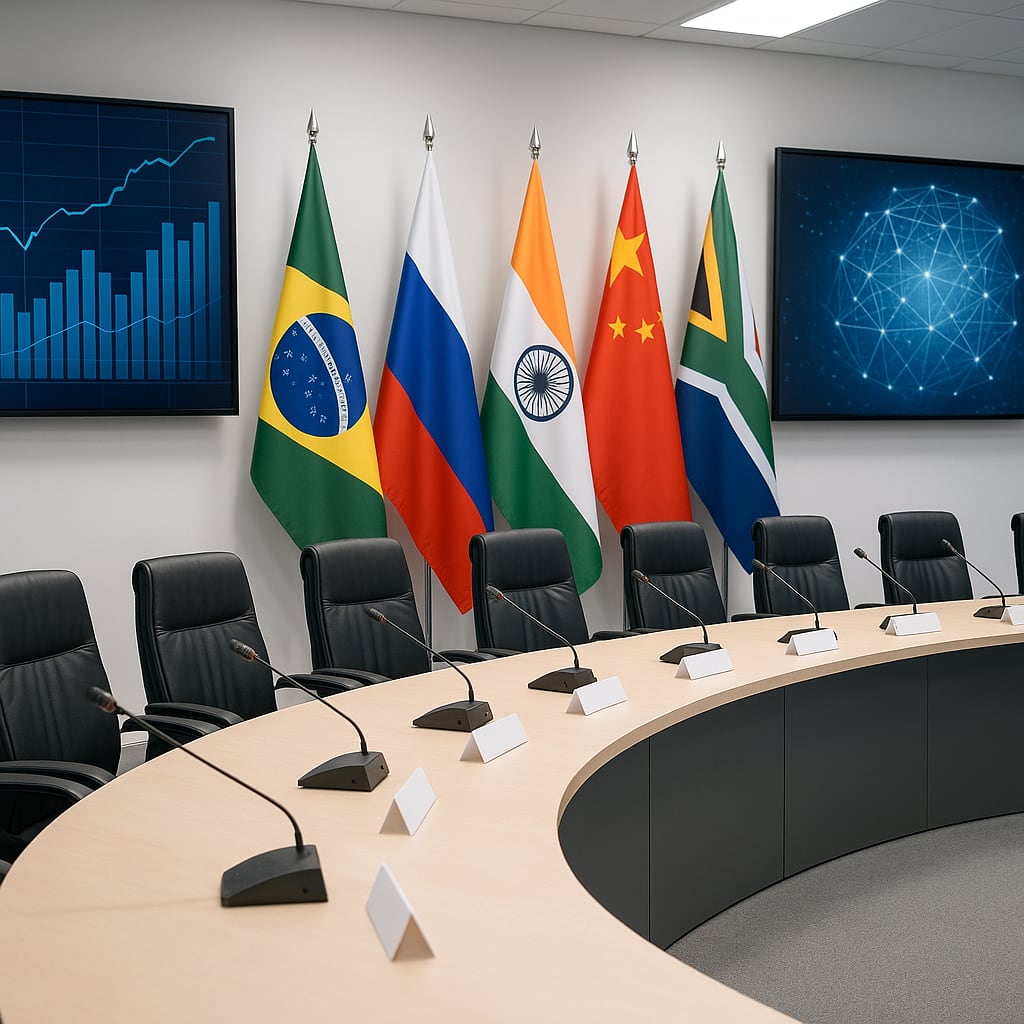
BRICS leaders in New Delhi adopt New Delhi Declaration, emphasize Global South agenda while sidestepping maximalist moves
Narrative Snapshot
Across Chinese, Iranian, and Russian-aligned outlets, the summit is framed as a consolidation of Global South leadership with China’s agenda at the center. Repeated emphasis falls on President Xi Jinping’s call to “unite the Global South,” proposals to drive “AI‑empowered” industrialization, and a narrative of resilience and self-reliance in multilateral reform. Chinese state media and partners foreground tangible cooperation—New Development Bank financing in India, science-and-technology linkages, and three cooperation pillars—while an in-house CGTN survey is cited to suggest rising global recognition of BRICS’ role.
Indian and several Western-oriented analyses stress diplomatic calibration rather than rupture. The Hindu presents the summit as a major diplomatic win for India that advanced reforms, trade cooperation, and dialogue among rivals, while The Diplomat and the South China Morning Post describe a cautious financial posture: no overt de-dollarization language, but endorsement of trade in national currencies and, in SCMP’s telling, a “hedge” against the dollar rather than a revolt. The optics of unity—captured by the family photo—are portrayed as compensating for the declaration’s limits.
African and Global South voices foreground institutional work and multilateralism. South Africa’s president publicly anchored outcomes in UN Charter principles and governance reform, while Mail & Guardian argues BRICS is carrying forward climate adaptation, early warning systems, and asset recovery work that Western-led forums have deprioritized. AllAfrica’s readout underscores consensus values in the New Delhi Declaration.
Coverage diverges most on geopolitics and scope. Al Jazeera flags divisions over wars in Iran and Ukraine; Telesur reports that expansion was not discussed while Russia backed Cuba’s aspirations. At stake are how far the 11-member “Greater BRICS” can translate optics and rhetoric into operational finance, technology coordination, and credible diplomatic influence without fracturing over conflicts or overreaching on currency architecture.
What Happened
Leaders of the 11-member BRICS grouping convened in New Delhi on September 12–13, 2026, adopting the New Delhi Declaration and underscoring Global South priorities. The summit featured Chinese President Xi Jinping, Russian President Vladimir Putin, Indian Prime Minister Narendra Modi, and Iranian President Masoud Pezeshkian; UN Secretary-General António Guterres attended. The declaration did not commit to de-dollarization but endorsed expanding trade in national currencies. Multiple outlets report no discussion of further expansion; Russia nevertheless voiced support for Cuba’s aspirations within the BRICS framework. Xi proposed a set of “greater BRICS” initiatives spanning AI-driven industrialization, digital industry, smart manufacturing, trade and investment facilitation, and talent development, coupled with calls to defend UN Charter principles and reform global governance. Modi warned that geopolitical tensions, supply chain disruptions, and climate impacts threaten global stability, while South Africa’s Cyril Ramaphosa urged a stronger, rules-based multilateral order. Chinese and partner coverage showcased project-level cooperation, including New Development Bank–financed transport infrastructure in India.
Why It Matters
The summit’s outcomes reinforce a structural trend toward diversified, non-Western coordination that aims to shape—rather than exit—core global rules and markets. SCMP’s account of “hedging” on currency issues and The Diplomat’s note that de-dollarization was absent from the declaration, even as national-currency trade gained backing, point to a pragmatic financial strategy designed to reduce vulnerabilities without triggering immediate systemic confrontation. The platform’s expansion to 11 members and a partner-country mechanism, highlighted by Chinese state outlets, augments representativeness while testing institutional capacity. Xi’s push to institutionalize AI cooperation and technology standard-setting positions BRICS to influence emergent governance domains where rules remain fluid. African coverage connects BRICS workstreams to operational gaps left by other forums, particularly on climate adaptation and early warning systems. For policymakers, the signal is twofold: BRICS is consolidating as a venue where major emerging economies coordinate on rules, finance, and tech; and its diplomatic bandwidth remains constrained on hard security issues even as members invoke UN Charter norms and governance reform.
Diverging Narratives
Financial architecture is cast in deliberately different terms. The Diplomat reports that the New Delhi Declaration omitted de-dollarization while supporting trade in national currencies; SCMP reads this as hedging rather than a revolt. East African coverage asks if a prospective BRICS “UNIT” could reshape cross-border trade, indicating broader interest in alternatives, even as formal summit language stayed cautious.
On geopolitics, Al Jazeera highlights divisions over the wars in Iran and Ukraine, suggesting limits to collective positioning. Telesur, by contrast, cites the Kremlin’s account that leaders showed interest in contributing to a political solution in Ukraine, while The Hindu frames India as facilitating dialogue among rivals. None of the sources point to robust, unified conflict language in the declaration, and SCMP’s observation that the family photograph “did the political work the summit’s final declaration could not” underscores the gap between optics and negotiated text.
Narratives also diverge on leadership and scope. Chinese and Iranian outlets elevate Xi’s critique of Western hegemony and his AI-centered agenda; Indian coverage emphasizes India’s bridge-building and diplomatic gains; South African voices stress defense of multilateralism and UN-centered reform. On membership, CGTN and SCMP describe an 11-nation “Greater BRICS,” while Telesur notes expansion was not discussed at New Delhi even as Russia publicly supported Cuba’s aspirations, signaling an open question about the timing and modality of any further enlargement.
What Happens Next
Three decision tracks emerge from the reporting. First, currency arrangements: with de-dollarization absent from the declaration but national-currency trade endorsed, watch for finance-minister communiqués, New Development Bank instrument design, or technical studies on a unit of account, given regional interest noted by the Daily Nation and the caution flagged by The Diplomat and SCMP. Second, technology governance: Xi invited BRICS members to a new World AI Cooperation Organisation and proposed a BRICS AI “community.” Indicators include formal member uptake, joint work on large language models, and references to AI standards in subsequent BRICS or UN processes. Third, institutional scope: expansion was not tabled in New Delhi, but Russia publicly backed Cuba’s bid; signals to watch are agenda-setting for future summits and use of the partner-country track referenced by RT and CGTN. On geopolitics, Peskov’s account of interest in a political solution on Ukraine and India’s facilitator role warrant monitoring for any working-level consultations or statements aligned with Ramaphosa’s UN Charter framing.