
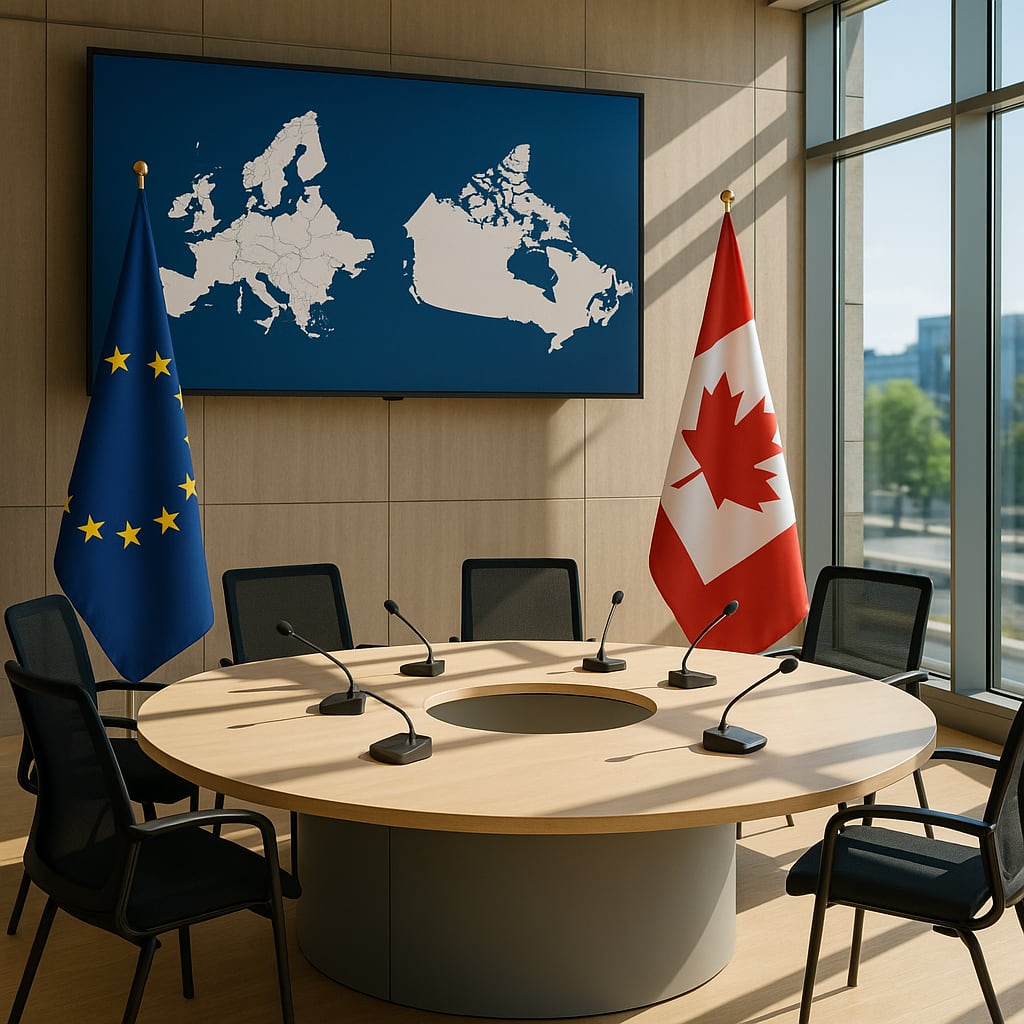
EU proposes ‘associate member’ path for Canada as Carney signals support amid US tensions
Narrative Snapshot
European coverage centers on values and institutional intent. Ursula von der Leyen’s framing of a “common future” with Canada, grounded in shared democratic values, leads the continental accounts, with multiple outlets underscoring her pitch for deeper cooperation on technology, defense, and energy and noting the enthusiastic reception in Strasbourg, including a standing ovation for Prime Minister Mark Carney. Some European commentary pushes on feasibility and purpose: one analysis argues the idea “sounds crazy” yet could be mutually beneficial and inject momentum into the EU, while an Italian account highlights right‑wing objections that cast the gesture as undue deference to Ottawa.
Anglophone and Canadian reporting more sharply ties the move to US pressures. UK and Canadian outlets link the overture to escalating tariffs under President Donald Trump, with one noting Trump’s repeated talk of making Canada the “51st state.” US and Canadian papers situate the proposal in a larger effort to navigate geopolitical headwinds, with Carney presenting the initiative as a route to resilience, sovereignty, and independence rather than EU accession.
Coverage also highlights an explicit US constraint. European and French outlets report Trump’s warning that treating Canada as an associate member could be deemed a “hostile act,” alongside a threat to halt trade with Europe, while UK television notes Carney’s implicit retort from the Parliament floor. Other international reporting portrays Canada as seeking unprecedented closeness with Europe to reduce reliance on a “hostile” United States, aligning with German public broadcaster language about an “openly hostile world.”
What Happened
In Strasbourg, European Commission President Ursula von der Leyen publicly invited Canada to become the European Union’s first “associate member,” saying the EU and Canada “see the world with the same eyes” and proposing intensified cooperation on technology, defense, and energy. The proposal was delivered with Prime Minister Mark Carney present and drew a standing ovation from members of the European Parliament. In remarks a day later, Carney welcomed the ambition, casting a deeper EU partnership as a means to strengthen Canada’s resilience and sovereignty and declaring that Europe and Canada are “stronger together.” The overture followed Carney’s earlier clarification that Ottawa sought a “unique alliance,” not full membership, and came amid US tariff pressure and rhetoric directed at Canada. President Donald Trump reacted by suggesting the move could be a “hostile act” and threatened to halt trade with Europe if the EU proceeded.
Why It Matters
If pursued, an EU–Canada “associate member” pathway would mark a first‑of‑its‑kind arrangement in the Union’s external architecture, signaling a new template for structured alignment with a like‑minded G7 partner. European coverage frames the offer as a bid to elevate a partnership on core strategic sectors, while Canadian and international outlets emphasize its function in reducing Ottawa’s vulnerability to US trade coercion. The initiative crystallizes two structural shifts: Europe’s search for renewed geopolitical leverage and dependable partners, and Canada’s active diversification away from a contested US economic anchor. It also tests transatlantic fault lines. Public threats from Washington to retaliate against Europe if it advances an associate status for Canada raise direct policy risks for EU trade, even as Brussels and Ottawa stress shared values and prosperity. For decision‑makers, the proposal opens a high‑salience channel for coordinating technology, defense, and energy policies under mounting external pressure.
Diverging Narratives
Accounts diverge on framing and feasibility. Several outlets, including German and Italian sources, stress von der Leyen’s values‑based rationale and a shared “vision of the world,” while UK and Canadian coverage foregrounds US‑driven catalysts—tariffs and provocative rhetoric—that have accelerated Ottawa’s European turn. A German magazine interrogates plausibility, arguing that while transatlantic expansion would be a stretch, it could nonetheless be advantageous for both sides, whereas an Italian daily reports domestic criticism from the right depicting the move as an “embarrassing bow” to Carney.
There is also a shift in Ottawa’s own rhetoric that coverage captures rather than resolves. Days before the Strasbourg address, Carney said Canada was not seeking membership but a “unique alliance.” After von der Leyen’s proposal, he welcomed the associate‑member concept, presenting it as a vehicle for “collective resilience” and national sovereignty. Finally, the US reaction functions as both a narrative and policy constraint: European and French outlets report Trump’s characterization of the proposal as a “hostile act” and a threat to halt EU–US trade if it advances. UK television emphasizes Carney’s pointed response from the Parliament floor, while international coverage portrays Canada as seeking protection from a “hostile” US environment—differing emphases that underscore whether the story is primarily about institutional innovation, strategic hedging, or transatlantic confrontation.
What Happens Next
Three decision points emerge. First, on the EU side, whether von der Leyen’s overture is operationalized into a concrete pathway and sectoral cooperation packages on technology, defense, and energy. Signals to watch include follow‑on Commission messaging in Brussels and the tenor of parliamentary and member‑state reactions, from supportive applause in Strasbourg to reported objections such as those voiced by Italy’s Fratelli d’Italia. Second, on Canada’s side, how Ottawa defines the scope of an “associate” relationship relative to its earlier “unique alliance” framing; indicators include Carney’s subsequent speeches and government statements specifying areas for deeper integration. Third, in Washington, whether rhetorical warnings translate into tangible measures. European and French outlets report threats to halt EU trade if the associate concept advances; analysts should monitor any new tariff actions or linkage to broader US–EU negotiations, given the explicit linkage drawn in coverage.