
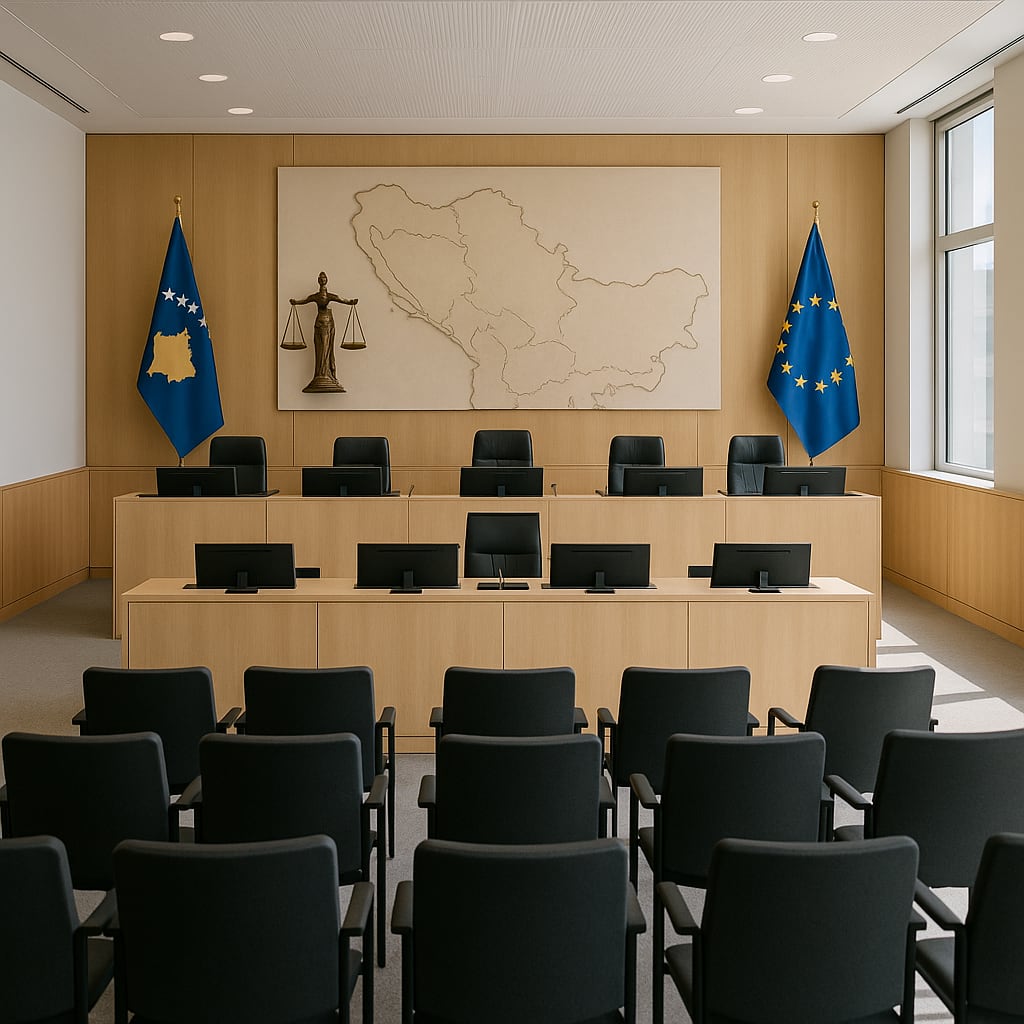
Hague tribunal sentences Kosovo’s former president Hashim Thaci to 25 years for war crimes
Narrative Snapshot
Across major European and North American outlets, the core contours are consistent: a Hague-based tribunal convicted former Kosovo president and ex-Kosovo Liberation Army commander Hashim Thaci of war crimes and sentenced him to 25 years in prison, citing murder, torture, illegal detention and cruel treatment. Reporting converges on the scale and character of abuses, including the murder of 96 people and the targeting of political opponents and perceived collaborators, while a few outlets published more granular counts of detentions and torture.
Where coverage diverges is in framing and emphasis. European outlets foreground the institutional provenance of the verdict and enumerate legally established offenses. Russian state media place the case within a narrative of NATO-backed separatism, describe Kosovo as “self-proclaimed,” and highlight violent protests, while regional reporting focuses on public mobilization around Thaci and security preparations both in The Hague and in Kosovo. Some coverage underscores prosecutorial demands for longer sentences, clarifying the gap between sought penalties and the court’s disposition. Italian and French outlets stress the tribunal’s findings on specific crimes, while Latin American and Asian reporting highlights victim categories and numbers, reflecting different editorial priorities on legal theory, public order, and the conflict’s historical context.
What Happened
On September 16, 2026, the Kosovo Specialist Chambers in The Hague found former Kosovo president and ex-KLA commander Hashim Thaci guilty of war crimes and sentenced him to 25 years’ imprisonment. Outlets report convictions for illegal arrests, torture, cruel treatment, and murder, with several noting that judges attributed 96 murders to the campaign against political opponents and perceived collaborators. Telesur adds that the judgment identified participation in a joint criminal enterprise and quantified at least 385 arbitrary detentions, 303 cases of torture, and 49 instances of cruel treatment. Three other former senior KLA figures—Kadri Veseli, Rexhep Selimi, and Jakup Krasniqi—were also convicted and sentenced. Prior to the verdict, police in The Hague prepared for large rallies, while protests were reported in Pristina; the Serb minority sought KFOR protection, and some outlets described clashes after the judgment. Prosecutors had previously requested 45-year sentences.
Why It Matters
The ruling signals the capacity of a European-backed tribunal to adjudicate complex wartime abuses by senior figures from Kosovo’s independence movement, expanding the scope of accountability beyond familiar perpetrator profiles and reinforcing legal standards on command responsibility and treatment of detainees. It tests institutional resilience in Kosovo and the EU’s security posture around the court, as authorities anticipated and managed protests in The Hague and Pristina and the Serb minority requested KFOR protection. Media framings—ranging from rule-of-law emphasis to geopolitical narratives about NATO’s 1999 intervention—shape the environment in which regional actors interpret the verdict. For decision-makers, the case underscores the need to calibrate security measures around sensitive judicial outcomes, maintain message discipline on the tribunal’s mandate and findings, and assess how the judgment’s victim profile—targeting political opponents and alleged collaborators—interacts with intra-societal cleavages as well as majority-minority relations.
Diverging Narratives
Outlets agree on the conviction, sentence length, and core offenses but diverge in interpretive framing. European and North American reporting centers on the tribunal’s findings, listing specific crimes and, in several cases, the number of murders attributed to the KLA campaign. Le Monde and the Guardian highlight convictions for illegal arrests, torture, cruel treatment, and murder, while France24 and Deutsche Welle stress that multiple former KLA leaders were sentenced alongside Thaci. Telesur adds legal theory—participation in a joint criminal enterprise—and provides detailed victim counts.
In contrast, RT situates the verdict within a narrative of NATO-backed separatism, refers to Kosovo as a “self-proclaimed” state, and foregrounds violent protests and attacks on EU premises after the ruling. La Repubblica reports protests in Pristina, including claims that “unjust verdicts” would not be accepted, and notes that Kosovo’s Serb minority asked KFOR for protection, highlighting a security angle less present in some Western coverage. Several outlets, including the South China Morning Post and the Guardian, emphasize that many victims were political opponents and perceived collaborators, a nuance that reorients the case from an exclusively interethnic frame. Al Jazeera and La Repubblica note prosecutors’ 45-year sentencing requests, contextualizing the court’s 25-year outcome.
What Happens Next
The near-term hinge points are security management and narrative control. Authorities in The Hague had pre-positioned for large rallies; analysts should watch whether public order measures remain proportionate and whether demonstrations persist or escalate. In Kosovo, the scope and discipline of protests—as reported by regional outlets and RT—will influence risk to public safety; any operational changes by KFOR in response to the Serb minority’s protection requests will be a key indicator of security posture. Domestically, how political actors and media in Kosovo characterize the judgment—given that the convicted are widely regarded as heroes in parts of society—will shape the reception of the tribunal’s findings. Internationally, whether outlets continue to emphasize legal specifics or broader geopolitical narratives will affect how the verdict is integrated into regional discourse on the 1990s conflict and post-conflict accountability.