
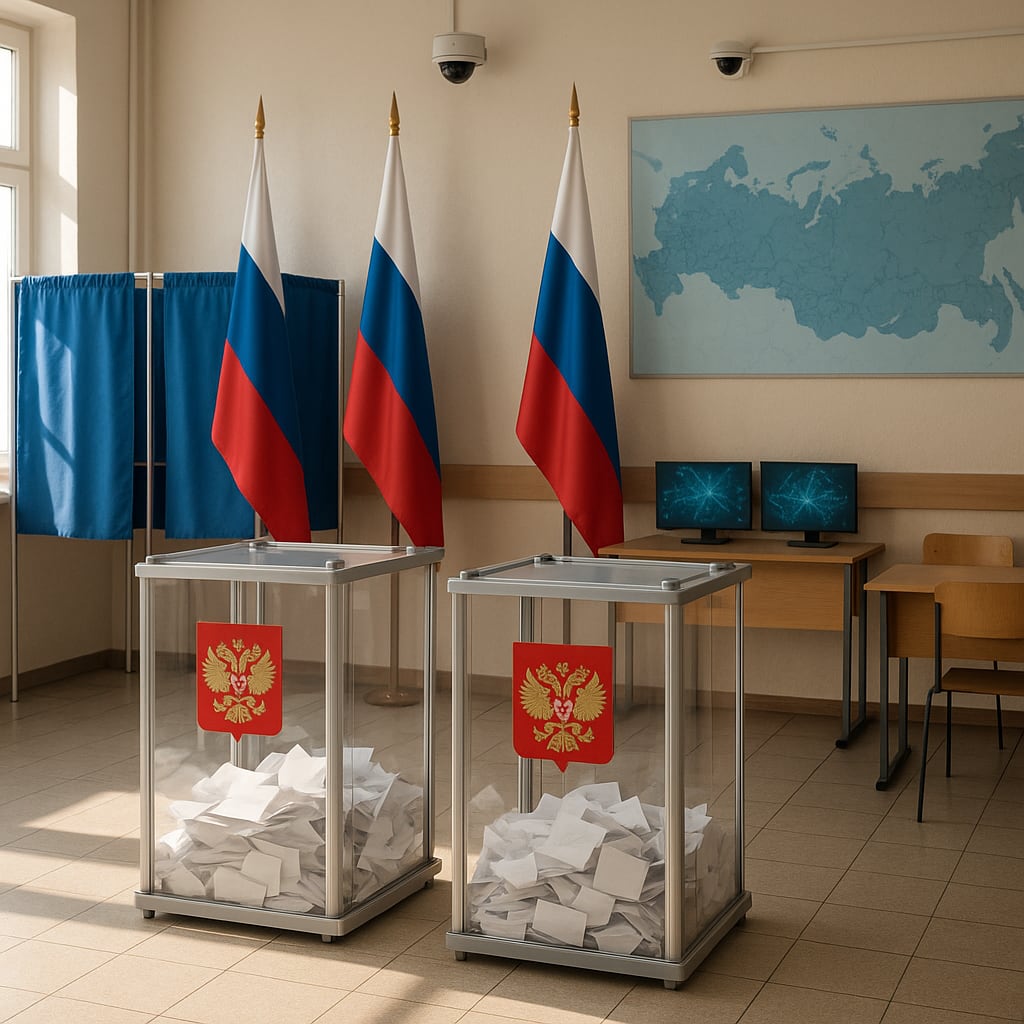
Russia holds three-day parliamentary elections, extending vote to areas seized from Ukraine
Narrative Snapshot
European and U.S. outlets largely frame the contest as tightly managed and outcome-safe for United Russia while probing domestic undercurrents shaped by a long war. Le Monde emphasizes that the vote is orchestrated by the Kremlin but notes efforts by antiwar Russians to use the process to register dissent, including tactical actions around balloting. The Guardian and France24 stress the removal of the only party that criticized the war from the ballot and the absence of meaningful competition, while RFE/RL and Deutsche Welle anchor their coverage in wartime fatigue, rumors of mobilization, and a slowing economy pressing in on voters.
State media and Global South outlets emphasize institutional continuity and political economy. TASS highlights the formal launch of the “single voting day,” reports on alleged Ukrainian attempts to disrupt the campaign with drones and missiles that “failed,” and flags constraints on voting for Russians in Germany. Telesur English centers the Duma’s role in balancing military spending, state enterprises, and social subsidies under sanctions, presents turnout data from the Central Election Commission, and frames first-time voting in “Donbass and Novorossiya” as integration into national processes.
Coverage diverges most sharply on voting in territories seized from Ukraine. Toronto Star and The Hindu describe balloting there as part of Moscow’s effort to cement gains and recount Kyiv’s denunciations and claims of coercion. Folha de S.Paulo argues the exercise is legally void under occupation. By contrast, Telesur portrays these votes as the first since “reuniting with Russia.” A second axis of divergence concerns process integrity: Fox News underscores the exclusion of OSCE observers, quoting the OSCE Parliamentary Assembly’s criticism, while Al Jazeera reports “powerful” cyberattacks during the vote and another report that “no party can be antiwar” in the current environment.
What Happened
Russia opened a three-day vote on September 18 to elect the 450-seat State Duma using a mixed system of 225 party-list seats with a 5% threshold and 225 single-mandate districts, its first parliamentary election since the 2022 invasion of Ukraine. United Russia is widely expected to prevail, with liberal antiwar competitors barred, as reported by The Guardian and France24. The Central Election Commission reported 29.43% turnout on day one and 32.58% by day two, including over three million remote votes and ballots cast in 152 countries, according to Telesur English. Voting was also conducted in areas seized from Ukraine, which Kyiv denounced as illegal and coercive per The Hindu and Toronto Star, while Folha de S.Paulo argued the process there is legally invalid. TASS cited alleged Ukrainian attempts to disrupt the campaign with drones and missiles as unsuccessful, and Al Jazeera reported “powerful” cyberattacks on day two. Fox News noted Russia did not invite OSCE observers.
Why It Matters
The election functions as a legitimacy exercise for the Kremlin even when competition is constrained, a dynamic the New York Times underscores. Institutional continuity also underpins Russia’s wartime political economy: Telesur English casts the Duma as a venue to reconcile military spending, state enterprise priorities, and social subsidies under sanctions. Extending the vote to territories seized from Ukraine seeks to consolidate political claims over those areas, as described by the Toronto Star, but collides with legal objections that an occupying power cannot run elections for its own legislature there, per Folha de S.Paulo, and with Kyiv’s denunciations reported by The Hindu. Process norms are at issue as well: the absence of OSCE observers drew formal criticism from the OSCE Parliamentary Assembly, cited by Fox News, while reporting on cyberattacks and domestic anxiety over war costs and mobilization (Al Jazeera, Deutsche Welle) points to pressures that the next Duma will have to manage.
Diverging Narratives
On competitiveness and dissent, Western European outlets and France24 emphasize a managed process with antiwar participation structurally excluded, while Le Monde and La Repubblica document attempts to repurpose the election as protest, including a call by opposition figure Karma-Murza for coordinated ballot nullification. Al Jazeera’s reporting that “no party can be antiwar” complements that picture of constrained political space. State-linked coverage instead highlights procedural normality and resilience: TASS notes the orderly start of voting and asserts Kyiv’s disruptive efforts failed, while also citing obstacles to diaspora voting in Germany due to reduced polling stations and “anti-Russian rhetoric.”
Territorial status creates sharper fault lines. Toronto Star and The Hindu describe voting in regions “illegally annexed” or “seized,” and Folha de S.Paulo deems such elections legally void under occupation law. Telesur English presents the same development as a first vote since “reuniting with Russia,” integrating those regions into national political routines alongside upbeat turnout reporting. Integrity standards are another split screen: Fox News foregrounds the non-invitation to OSCE observers and quotes the OSCE PA’s view that this breaches commitments, while other coverage concentrates on wartime conditions—fuel shortages, drone strikes, and war fatigue noted by Deutsche Welle—rather than on observation frameworks.
What Happens Next
Final turnout and seat allocations will clarify how the Central Election Commission’s interim figures translate into a parliamentary map, including the scale of single-mandate wins that typically favor United Russia, per the mixed system outlined by Telesur English. Analysts should watch whether reported protest tactics—such as ballot nullification at a set time referenced by La Repubblica—leave any detectable imprint on spoiled-ballot rates. Internationally, reactions will likely hinge on the inclusion of voting in areas seized from Ukraine; Folha de S.Paulo’s legal framing and Kyiv’s denunciations reported by The Hindu and Toronto Star point to continued contestation of legitimacy. Process signals to monitor include any official accounting of cyber incidents noted by Al Jazeera, claims of coercion in the seized regions (The Hindu), and how authorities characterize disruptions or foreign interference attempts, as TASS has already done. The policy lane inside the new Duma will be read against wartime fiscal and sanctions pressures highlighted by Telesur English and Deutsche Welle.