
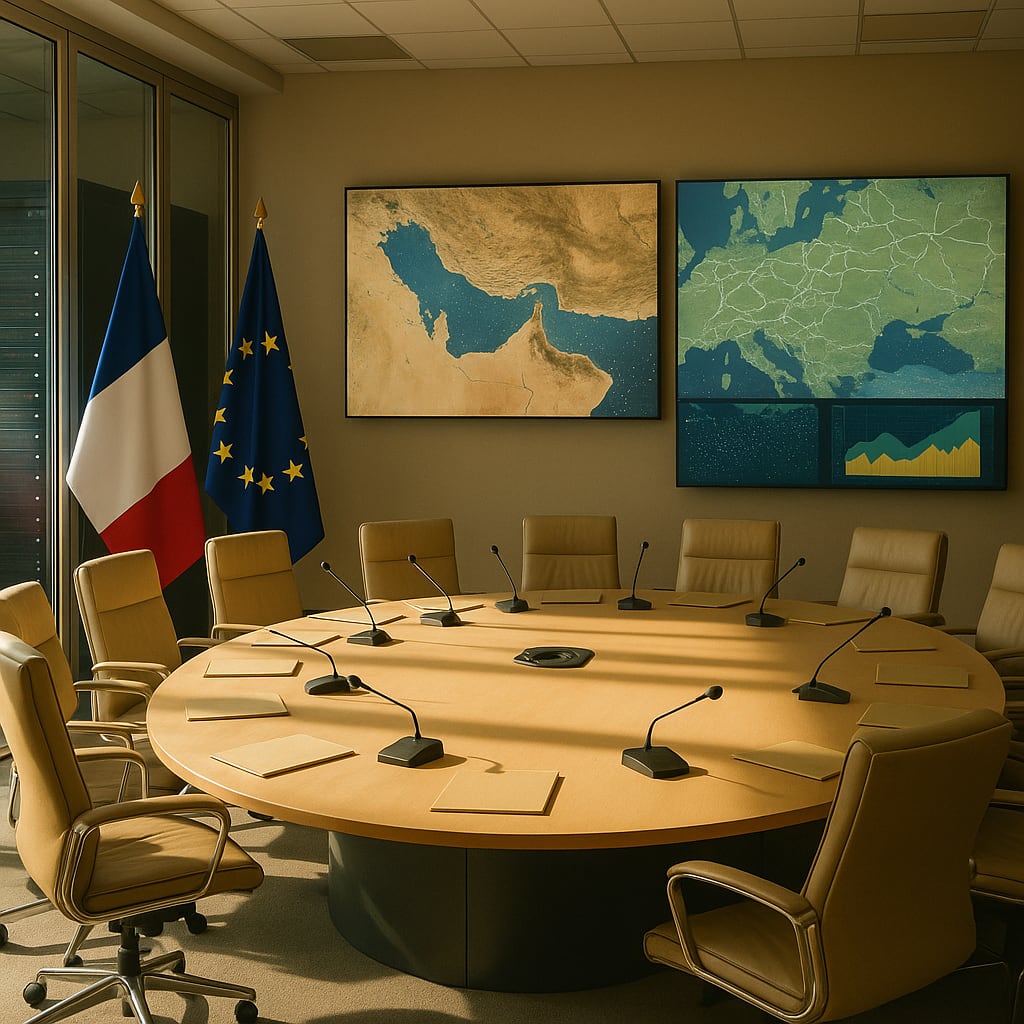
Macron orders defenses against Russian hybrid attacks, seeks G7 energy coordination as Hormuz risks deepen
Narrative Snapshot
European reporting coalesces around Emmanuel Macron’s directive to harden France against intensifying Russian “hybrid” activity, with German and British outlets emphasizing his instruction to protect critical infrastructure and defense-industry sites (Deutsche Welle; BBC). Italian coverage pairs the security message with a political appeal to unity and a call for a G7 energy meeting, quoting Macron’s warning that Moscow aims to divide Europeans (ANSA; Corriere della Sera). Ukrainian state media highlights deterrence, underscoring Macron’s pledge that hybrid attacks will not go unanswered (Ukrinform).
French outlets frame the moves within acute domestic energy pressures and electoral timing. Le Monde reports the Élysée convened presidential contenders and party leaders for a confidential threat briefing as incidents in Europe accumulate. France24 links Macron’s warning and energy posture to surging fuel costs driven by the wars in Iran and Ukraine and an incipient national crisis. Middle East Eye details the G7 agenda Macron wants—coordination on strategic stockpiles, export and production cooperation, and potential reserve releases—and his claim that France has worked since April with the International Maritime Organization on a post-agreement escort mission to facilitate reopening the Strait of Hormuz. It also notes Macron’s assessment that a US–Iran deal enabling that reopening appears unlikely in the short term.
Coverage of the maritime front is sharply split. Iranian state outlets and Tehran Times report successive downings of US-origin drones, expanded Iranian blacklists for “violating” vessels, strikes or detentions of tankers, and assertions that Iran holds the initiative in Hormuz (IRNA; Tehran Times; Telesur English). UKMTO records incidents and an “unknown projectile” strike without assigning blame, while the South China Morning Post notes the US military rejected Iran’s account that a mined route caused a tanker explosion. In contrast, US Central Command claims mine-clearance of primary lanes and a six-month high in shipping volumes, even as independent tracking cited by Middle East Eye shows volatile, often depressed transits.
What Happened
On 18 September, Macron said Russian hybrid threats had intensified and tasked the government with plans to protect critical infrastructure and defense industry facilities, warning attacks would draw a response (Deutsche Welle; BBC; Ukrinform). Italian reports added that he called for a G7 energy meeting (ANSA). Le Monde and France24 situated the moves amid rising fuel costs linked to the wars in Iran and Ukraine and noted a confidential Élysée briefing for presidential hopefuls and party leaders.
Simultaneously, maritime risks escalated. Iranian outlets reported multiple IRGC shootdowns of MQ‑1 drones; expansion of a blacklist to 77 ships; a supertanker explosion allegedly caused by mines; a Togo‑flagged tanker struck or halted for “illegal passage”; and claims that Iran retains the initiative in Hormuz (IRNA; Tehran Times; Telesur English). UKMTO flagged a security incident and a tanker hit by an unknown projectile, while the US military disputed Iran’s mine narrative and said mine-clearance enabled a six-month high in shipping, protecting over 2,000 vessels (South China Morning Post; Middle East Eye). Middle East Eye also reported Saudi Arabia had told European refineries not to expect crude next month and documented sharp drops in Hormuz transits on several days.
Why It Matters
The convergence of alleged Russian hybrid activity in Europe with tightening energy logistics underscores the vulnerability of European security to cross-domain pressure. Macron’s bid to align G7 policies on stockpiles, production, exports, and potential reserve releases points to a search for collective instruments to buffer price spikes and supply interruptions when both Eurasian pipelines and Gulf sea lanes are at risk (Middle East Eye). French outreach to party leaders suggests domestic political management of resilience measures ahead of elections (Le Monde; France24).
At sea, incompatible operational narratives—Tehran’s enforcement posture versus CENTCOM’s assurances—highlight contested control over a chokepoint central to global oil and LNG flows. China’s call for US–Iran talks to return to an “Islamabad memorandum” and reopen Hormuz indicates major-power interest in stabilizing supply chains (Middle East Eye). Regional partners such as South Korea signal intent to help restore free passage while ruling out troop deployments, reflecting caution about force commitments even as coalition architectures evolve (Japan Times; Middle East Eye). RT’s framing of Europe’s energy pain as “self-made” reinforces how information narratives are being leveraged alongside physical disruptions.
Diverging Narratives
On European security, France and allied outlets stress an intensifying Russian hybrid threat warranting protective measures and deterrent signaling (Deutsche Welle; BBC; Ukrinform; ANSA). Russian state media advances a different causality for Europe’s energy distress, blaming EU policy to phase out Russian supplies and presenting price and shortage indicators to support that line (RT). Within France, reporting ties the security posture to electoral context and domestic fuel anger, not to external blame-shifting, while still linking energy pressures to the wars in Iran and Ukraine (Le Monde; France24).
In Hormuz, Iranian sources depict a lawful enforcement regime: repeated downing of US-origin drones, blacklisting of noncompliant vessels, and action against tankers attempting “illegal” passages, all under a claim of Iranian initiative (IRNA; Tehran Times). Western and independent maritime reporting introduces uncertainty or outright contradiction. UKMTO notes incidents and an “unknown projectile” without attribution, and the South China Morning Post reports the US military rejected Iran’s mine narrative for a tanker explosion. US Central Command claims cleared lanes and record recent throughput, while Middle East Eye’s ship-tracking snapshots show days with sharply reduced transits and a weekend tally far below the prior one. These accounts diverge on both control of sea lanes and the degree of disruption. Meanwhile, Macron’s assertion that reopening Hormuz hinges on a US–Iran deal deemed unlikely in the short term contrasts with China’s push to revive talks promptly (Middle East Eye).
What Happens Next
Three decision points stand out. First, G7 energy coordination: Macron’s proposed agenda includes stockpile synchronization, export/production cooperation, and possible reserve releases (Middle East Eye). Analysts should watch for a meeting announcement, communiqués on coordinated stock policies, and any near-term reserve drawdowns as indicators of collective action.
Second, the Hormuz access question: Macron links reopening to a US–Iran deal that he judges unlikely soon, while China urges a return to the Islamabad memorandum and “substantive consultations” (Middle East Eye). Signals to track include any US–Iran contacts, references to the memorandum, and whether France’s IMO-associated escort concept advances contingent on an agreement.
Third, maritime risk management versus enforcement: Iran’s continued drone shootdowns, vessel blacklisting, and detentions (IRNA; Telesur English) face US claims of cleared lanes and a new coalition attack-drone unit (Middle East Eye). Key indicators include UKMTO advisories, daily transit counts, further IRGC actions against “illegal” passages, and whether partners like South Korea translate stated intent to help restore free passage into defined, non-combat contributions (Japan Times; Middle East Eye).