
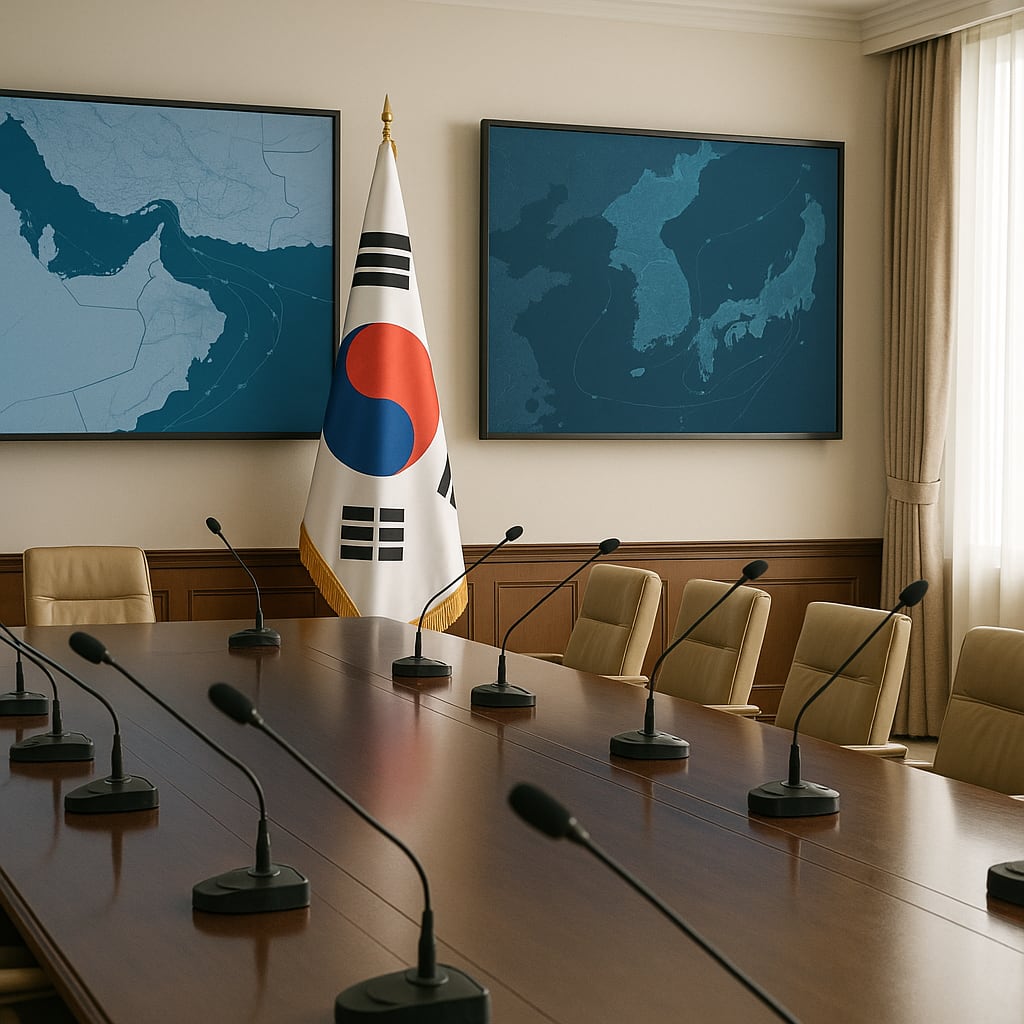
Seoul rules out troop deployment to Hormuz, signals willingness to facilitate U.S.–North Korea talks
Narrative Snapshot
Across outlets there is wide agreement that President Lee Jae Myung has drawn a firm line against sending South Korean troops or military assets into combat related to the Iran war, with differences emerging over emphasis and framing. Brazil’s Folha de S.Paulo, Iran’s Tehran Times, Venezuela’s Telesur, and the South China Morning Post stress rejection of U.S. pressure and describe the stance as a clear refusal to join a U.S.-led war against Iran. By contrast, China’s CGTN and the Japan Times center on Seoul’s assertion of a principled position against combat while preserving narrowly defined measures to safeguard shipping and “free passage,” noting existing maritime operations.
Several reports link the decision to domestic politics. The Tehran Times foregrounds anti-war sentiment and a rally in central Seoul rejecting U.S. demands, while the South China Morning Post cites mounting public opposition as context for Lee’s stance. CGTN highlights operational continuity and risk management, noting that a South Korean unit is already deployed for public-safety responses but will not be used to “engage or intervene in the war.”
Coverage also situates Seoul’s move within wider maritime-security diplomacy. Middle East Eye reports U.S. Secretary of State Marco Rubio’s discussions with Oman condemning Iranian attacks and reaffirming freedom of navigation in Hormuz, while Middle East Eye and Le Monde note Saudi and Egyptian calls to secure shipping in both Hormuz and Bab al-Mandab. Al Jazeera English and the Bangkok Post add a Korean Peninsula dimension, reporting that Seoul is prepared to facilitate U.S.–North Korea talks and that President Donald Trump “clearly” wants dialogue, pointing to a diplomatic offset to the military restraint in West Asia.
What Happened
On September 18, South Korean President Lee Jae Myung said there would be “no deployment that engages or intervenes in the war” around the Strait of Hormuz, reiterating that Seoul would not dispatch troops or military resources to join a U.S.-led war against Iran. He distinguished this from “minimal activities” to protect South Korean commercial shipping and crude oil routes, and noted the government was weighing ways to strengthen existing operations by a unit already deployed for public-safety threats (CGTN; Al Jazeera English; South China Morning Post; Telesur). A day earlier, South Korea’s foreign minister had said no decision had been made, underscoring how the president’s remarks clarified policy ahead of talks in Washington (Middle East Eye, Sept. 17; Japan Times). Al Jazeera English and the Bangkok Post reported that Lee would facilitate U.S.–North Korea talks and that Trump “clearly” wants dialogue. Meanwhile, Middle East Eye and Le Monde detailed parallel regional calls to secure Red Sea and Hormuz shipping, and Middle East Eye reported Rubio’s condemnation of Iranian attacks.
Why It Matters
Seoul’s stance tests alliance management norms by separating support for U.S. strategic objectives—freedom of navigation and deterrence—from direct participation in combat operations. That differentiation, emphasized by CGTN and echoed by the Japan Times’ reference to helping ensure free passage, indicates a middle-power approach that prioritizes sovereignty, domestic constraints, and narrowly framed maritime protection while maintaining core alliance cooperation. It also reflects energy-security imperatives—protecting crude oil transport routes—without committing to warfighting roles (CGTN; South China Morning Post).
Regionally, simultaneous U.S.–Oman consultations on Hormuz incidents and Saudi–Egypt calls to secure Red Sea lanes situate South Korea’s decision within an expanding, multi-theater maritime risk environment (Middle East Eye; Le Monde). The willingness to facilitate U.S.–North Korea talks offers a diplomatic contribution at a moment when Washington is pressing partners on maritime security, suggesting Seoul is rebalancing its alliance portfolio toward political mediation while capping military exposure (Al Jazeera English; Bangkok Post; Japan Times).
Diverging Narratives
Outlets diverge on whether South Korea’s move is primarily a defiant rejection of U.S. demands or a consistent application of a non-combat principle paired with limited maritime protection. Folha de S.Paulo, the Tehran Times, Telesur, and the South China Morning Post frame the announcement as resisting U.S. pressure to join a war against Iran, with Telesur adding that Trump criticized Seoul and affected planned joint exercises. CGTN, by contrast, foregrounds policy continuity and technical guardrails: no combat involvement, but minimal, safety-focused activities and potential strengthening of an already deployed unit.
There is also a sequencing contrast. On September 17, South Korea’s foreign minister said no decision had been made on any Hormuz deployment; by September 18, the president publicly ruled out combat involvement, clarifying the policy line before ministerial-level talks in Washington (Middle East Eye; Japan Times). Risk calculations run in both directions: Middle East Eye reports Tehran warning of “serious consequences” if Seoul participated, while U.S. rhetoric has emphasized Iranian attacks and freedom of navigation. Finally, while Al Jazeera English and the Bangkok Post highlight Seoul’s offer to facilitate U.S.–North Korea talks and Trump’s apparent openness to dialogue, the extent to which that diplomatic role might offset frictions over Hormuz is left implicit in most coverage.
What Happens Next
Key decisions will likely center on how Seoul operationalizes “minimal activities” at sea. Indicators include any announced adjustments to the existing unit’s rules of engagement or mission scope to protect commercial vessels without “engaging in the war,” as emphasized by CGTN. The tenor of U.S.–South Korea diplomacy will be visible in follow-on readouts after the top diplomats’ meetings noted by the Japan Times, including whether Washington channels requests toward non-combat maritime support rather than troop deployments.
Analysts should watch for concrete steps on the facilitation of U.S.–North Korea talks flagged by Al Jazeera English and the Bangkok Post, such as proposed venues or envoy exchanges. Regionally, statements following U.S.–Oman engagement and Saudi–Egypt calls for secure shipping will signal whether a broader, non-combat maritime coordination framework gains traction (Middle East Eye; Le Monde). Domestic pressure remains a constraint: further mobilization like the Seoul rally reported by the Tehran Times would reinforce political costs for any shift toward a more expansive posture.