
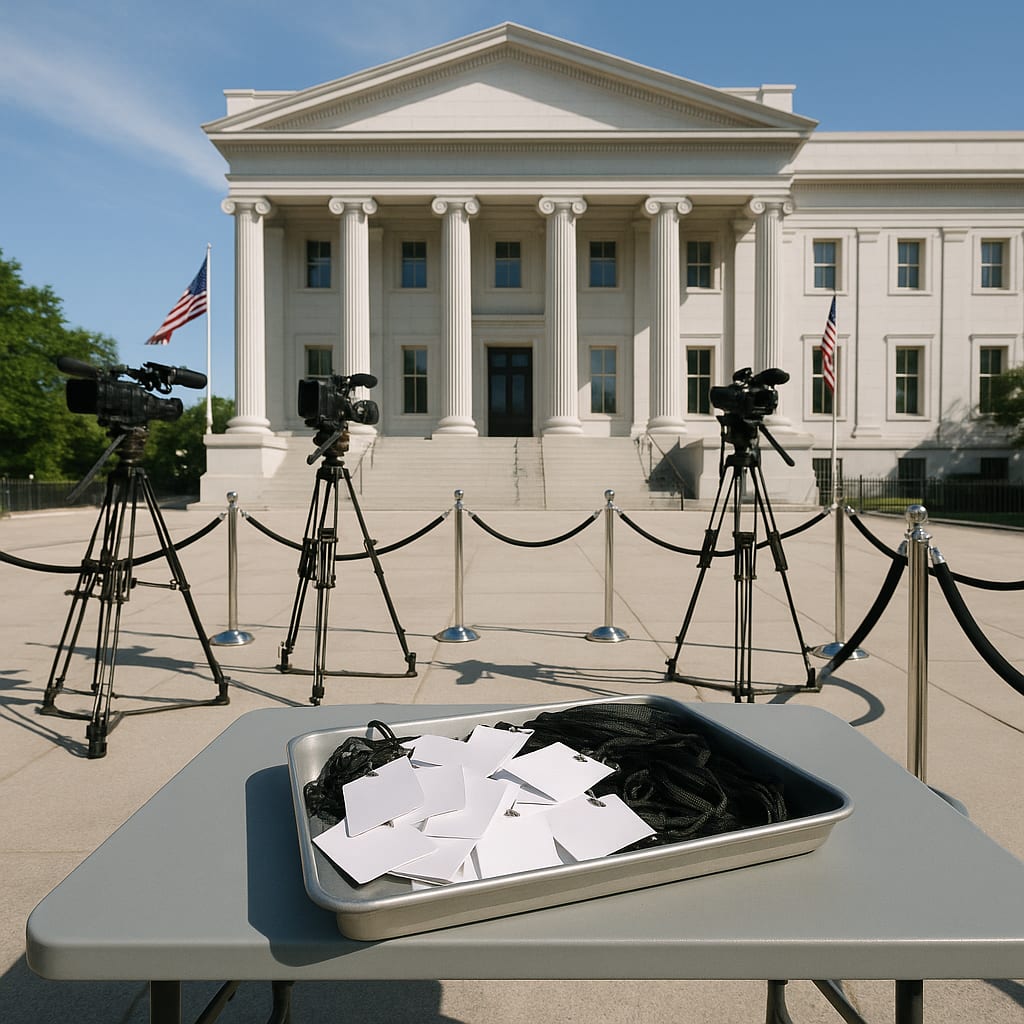
Trump announces and enforces White House ban on CNN, MS NOW and Politico; reporters turned away and press passes seized
Narrative Snapshot
Across international and U.S. outlets, reporting converges on two points: the president’s announcement on Friday and the swift operational enforcement on Saturday. Multiple organizations describe reporters from CNN, MS NOW and Politico being denied entry and having their White House credentials confiscated, underscoring that the ban was not merely rhetorical but implemented on the complex grounds within hours (The Guardian; BBC News; CBC News; Deutsche Welle; South China Morning Post; Toronto Star; Le Monde; Bangkok Post; The Times of Israel).
Coverage diverges most clearly over framing and legitimacy. Several outlets foreground President Trump’s stated rationale and verbatim claims, including accusations of “fake news” and an allegation that Politico received an “illegal” $8 million government subscription under President Biden—an assertion presented as Trump’s allegation rather than as established fact (Fox News; CGTN; Middle East Eye; The Hindu). Others emphasize constitutional and press freedom concerns, citing reactions from the White House Correspondents’ Association and affected outlets that label the move an unlawful assault on First Amendment protections, and note expectations of legal challenges (TASS; Japan Times; France24; Clarin; Al Jazeera English).
A number of reports situate the ban within ongoing political dynamics. The New York Times links the move to a broader pattern of using governmental levers against perceived enemies and quotes Democrats calling it an effort to control the press amid difficult midterm terrain for Republicans. Fox News, by contrast, highlights long-standing pool logistics, noting CNN’s role in the rotating broadcast pool and its selection to lead network pool coverage of Monday’s United Nations General Assembly—an operational wrinkle as the White House enforces the ban on its own grounds.
International outlets broadly interpret the action as an escalation in Trump’s adversarial stance toward the media, with some characterizing the move as intensifying tensions and likely to be tested in court (France24; Le Monde; Telesur English; Al Jazeera English; Folha de S.Paulo).
What Happened
On Friday, September 18, President Donald Trump announced on Truth Social that CNN, MS NOW and Politico were banned “effective immediately” from the White House, accusing them of “reporting fake news” and warning that other outlets could follow (Fox News; The Hindu; Middle East Eye; CGTN; Al Jazeera English). He amplified the point in remarks to reporters, citing “cumulative stories” and denying any intent to intimidate the press, saying “you get sick of it” (Fox News). Trump also alleged, without substantiation in the reporting, that Politico received an $8 million government subscription under President Biden (Middle East Eye; CGTN). By Saturday morning, journalists from the three outlets reported being blocked from entering the grounds and having press badges confiscated by the U.S. Secret Service (The Guardian; BBC News; CBC News; South China Morning Post; Toronto Star; Deutsche Welle; Le Monde). CNN called the action an “illegal assault” and outlets signaled possible legal challenges (Japan Times; South China Morning Post; France24). Fox News noted CNN had been slated to lead pool network coverage of Monday’s UN General Assembly session.
Why It Matters
Press access to the White House is a core institutional arrangement in U.S. governance, administered through long-standing norms, the credentialing system, and rotating pool coverage that allows a small number of journalists to represent the broader press at presidential events; CNN’s scheduled role in the UN General Assembly pool, reported by Fox News, highlights the operational friction the ban creates. Press freedom advocates and the White House Correspondents’ Association point to First Amendment protections against government interference with the press, framing the ban as a constitutional test of executive authority over media access to federal facilities (TASS; Clarin; Japan Times). France24 and other outlets anticipate legal challenges that could clarify the boundaries of permissible access restrictions. The episode feeds into broader international debates about erosion of democratic norms and the use of administrative tools to favor or punish media actors, with implications for how other governments and multilateral bodies assess U.S. commitments to press freedom (France24; Le Monde; Al Jazeera English).
Diverging Narratives
The president’s stated justification centers on combating what he calls persistent misinformation, explicitly labeling CNN, MS NOW and Politico as “fake news” and asserting that their “cumulative” coverage crossed a line; he denies seeking to intimidate journalists and warns other outlets could face similar action (Fox News; Middle East Eye; CGTN). He also alleges specific wrongdoing by Politico regarding an $8 million government subscription under the prior administration—an allegation carried in coverage as his claim rather than as a verified fact (Middle East Eye; CGTN).
The affected outlets and press advocates frame the ban as unconstitutional viewpoint discrimination and an “illegal assault” on press freedom, describing confiscated credentials and denied entry as concrete evidence of government interference (Japan Times; BBC News; The Guardian; Deutsche Welle). The White House Correspondents’ Association stresses that the Constitution protects press freedom from government interference (TASS). Political context appears in U.S. reporting: some Democrats argue the ban is an attempt to control coverage and distract voters amid Republican challenges in the midterms, and the New York Times situates it within a pattern of using state apparatus against perceived adversaries (New York Times). An immediate operational tension persists between enforcement at the White House complex and established pool obligations away from the building, with Fox News noting CNN’s slated UNGA pool role even as its reporters are barred from the grounds.
What Happens Next
Three decision points emerge from the reporting. First, legal recourse: CNN called the move illegal, and outlets indicated they may appeal; France24 expects challenges, and the Times of Israel reports expectations of an appeal on press freedom grounds. Analysts should watch for filings seeking emergency relief and the government’s legal rationale for restricting access (Japan Times; France24; The Times of Israel; South China Morning Post). Second, operational policy: whether the administration extends enforcement to off-campus presidential events or honors established pool rotations, including CNN’s slated role at the UN General Assembly, will signal the scope of the ban’s application (Fox News). Third, escalation risk: Trump warned other outlets could follow, making any additional credential revocations or Secret Service procedures key indicators of trajectory, as well as responses from the White House Correspondents’ Association and other media organizations (Middle East Eye; CGTN; TASS; New York Times).