
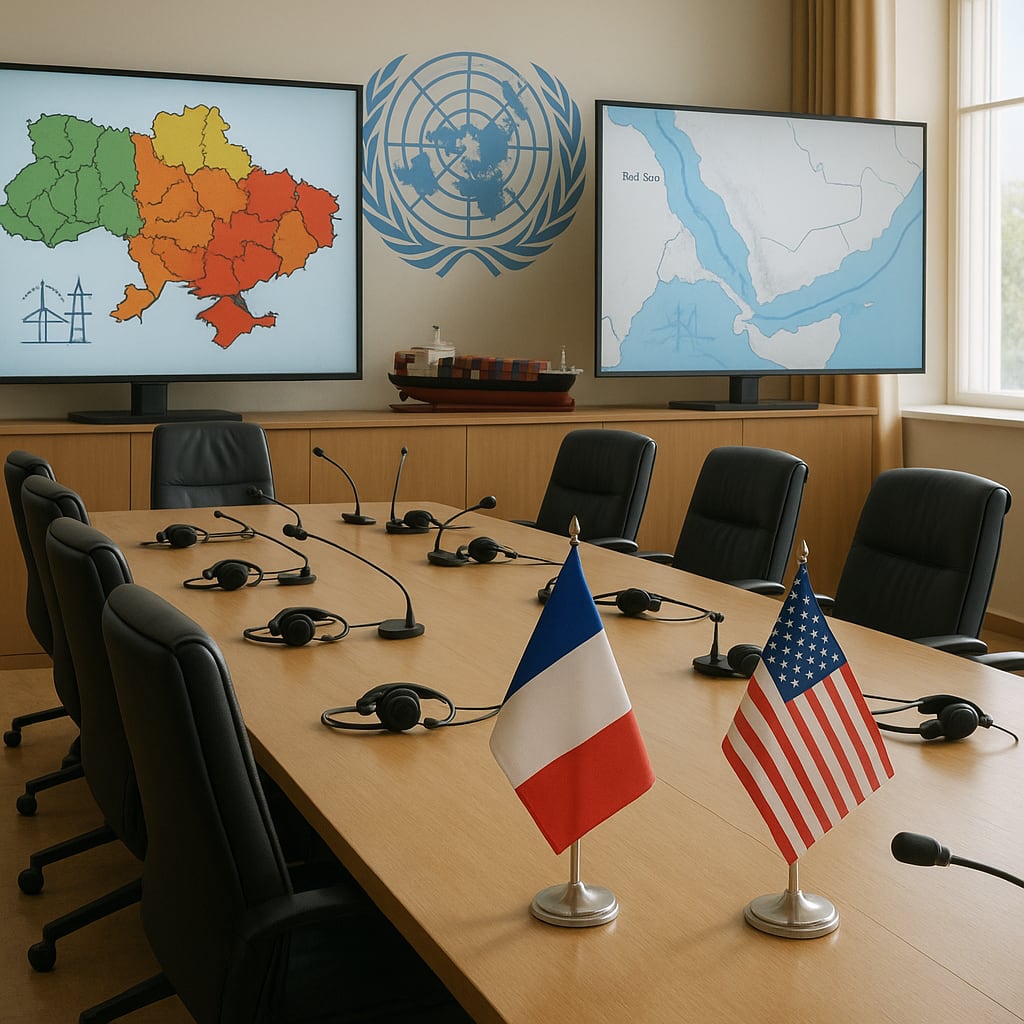
Macron calls Trump talks on Ukraine and Red Sea ‘constructive’ as Paris links air defense, energy ceasefire ideas, and maritime security
Narrative Snapshot
French, Ukrainian, and Russian-state outlets converge on the content of Emmanuel Macron’s New York meeting with Donald Trump: continued support to Kyiv and specific attention to air defense, including “interceptors,” were on the table, alongside proposals to reduce strikes on energy infrastructure (Le Monde; Kyiv Independent; TASS). French media and France24’s analysis underscore Macron’s effort to harden Trump’s posture toward Russia and to protect Ukrainian sovereignty, while Argentine coverage extends the economic angle, highlighting proposals to cool oil prices and a UN resolution to reopen the Strait of Hormuz (Le Monde; France24; Clarín).
Coverage of the Red Sea emphasizes rapid Houthi territorial gains around key chokepoints and the resulting pressure on Saudi Arabia. Regional and international outlets report the seizure of strategic islands, disruption at Saudi energy terminals, Riyadh’s call with Cairo for secure navigation, and Saudi efforts to convene a multinational naval coalition, while multiple reports register US reluctance to intervene militarily (France24; The Guardian; Middle East Eye; Al Jazeera English; South China Morning Post; The Times of Israel). RT highlights Houthi statements pledging to avoid targeting non-Saudi vessels, a framing that contrasts with warnings about broader shipping and oil risks (RT; The Guardian).
A second thread is great-power positioning along the Red Sea littoral. The US lifted sanctions on Eritrean entities “with Red Sea in focus,” and a Fox News report cites concern over expanded Chinese surveillance capabilities near the US base in Djibouti. An AllAfrica commentary amplifies Ethiopia’s interest in Red Sea security, reflecting how littoral access and chokepoint control are drawing in regional and extra-regional actors (Middle East Eye; Fox News; AllAfrica.com).
What Happened
Macron met Trump for roughly 30 minutes at Trump Tower on the UN General Assembly sidelines, describing “very constructive” talks focused on Ukraine and Red Sea security (Le Monde; Bangkok Post; Clarín). The French president said they discussed bolstering Ukraine’s air defenses, including supplies of interceptors, and floated de-escalation ideas such as a moratorium on Ukrainian and Russian strikes against energy infrastructure, framed by Kyiv Independent as an energy-infrastructure truce (Le Monde; Kyiv Independent; TASS). France24 reported Macron has been trying to convince Trump to take a harder line on Vladimir Putin. Macron also met Volodymyr Zelensky in New York (Ukrinform), while Clarín reported he proposed to Trump measures to curb oil prices, including a UN resolution to reopen the Strait of Hormuz. The meetings unfolded amid Red Sea turmoil marked by Houthi seizures of strategic islands, disrupted Saudi oil logistics, and a Saudi-hosted multinational naval coalition meeting (France24; Middle East Eye; Al Jazeera English).
Why It Matters
The exchanges link European efforts to sustain Ukraine’s air defense with a broader bid to stabilize energy and maritime domains under simultaneous stress. French readouts that pair interceptor supplies with an energy-infrastructure “moratorium” indicate an attempt to balance battlefield resilience with civilian-energy protection norms, a potential de-escalatory instrument if accepted by both Kyiv and Moscow (Le Monde; Kyiv Independent). France24’s framing of Macron pressing Trump suggests Paris is testing whether transatlantic alignment on Ukraine can be reinforced even as Washington shows no appetite to police Red Sea chokepoints militarily (France24; South China Morning Post; The Times of Israel).
Red Sea instability is rippling through oil and trade corridors, with suspended loadings at Yanbu, constrained Hormuz traffic, and price volatility documented across outlets (Middle East Eye; France24). Parallel moves—US sanctions relief for Eritrean entities and concern over China’s upgraded footprint in Djibouti—signal intensifying competition over littoral access and logistics nodes critical to global shipping (Middle East Eye; Fox News). For decision-makers, the interplay between Ukraine assistance, maritime security coalitions, and UN-centric energy proposals will shape both deterrence credibility and economic resilience.
Diverging Narratives
On US posture, reporting diverges between France24’s portrayal of Macron seeking a firmer US line on Russia and multiple outlets citing Trump’s lack of interest in a Red Sea intervention, including remarks that the crisis affected “only one country” (France24; South China Morning Post; The Times of Israel). European and Ukrainian outlets stress practical deliverables—air defense systems and interceptors—while French reporting adds a civilian-protection angle via an energy infrastructure “moratorium”; that framing could be read as a constraint on Ukrainian strike options, though Kyiv Independent presents it as a truce concept without endorsing it (Le Monde; Kyiv Independent; TASS).
Red Sea risk assessments split. The Guardian and France24 emphasize systemic threats to shipping and oil supply from Houthi control of chokepoints, while RT highlights Houthi assurances that non-Saudi vessels will be spared, reframing operations as preserving broader navigation (The Guardian; France24; RT). Policy responses also differ: Clarín focuses on a UN path to reopen Hormuz and macro oil-price stabilization, whereas Al Jazeera and France24 detail a Saudi-led naval coalition and regional security coordination with Egypt (Clarín; Al Jazeera English; France24). Market signals themselves are mixed across time, with reports of oil spikes alongside subsequent price easing after Saudi offers via Oman (France24; Middle East Eye).
What Happens Next
Three decision points emerge. First, whether Washington and Paris translate discussion of “interceptors” and air defenses into announced deliveries or financing; TASS and Kyiv Independent flag these talks, so official statements or procurement notices will be key indicators (TASS; Kyiv Independent). Second, whether France’s proposed energy-infrastructure moratorium or truce idea gains traction—watch for references in Ukrainian, Russian, or UN fora, given Le Monde’s description of the initiative and Clarín’s separate reporting on UN-focused oil and strait measures (Le Monde; Clarín).
Third, Red Sea security choices will hinge on Riyadh’s coalition-building and Washington’s stance. Al Jazeera reports Saudi hosting a multinational naval meeting, while South China Morning Post and The Times of Israel describe US reluctance to intervene; participation lists, rules of engagement, and any renewed Saudi appeals to the US will be determinative (Al Jazeera English; South China Morning Post; The Times of Israel). Additional indicators include the status of Yanbu loadings, traffic through Hormuz and Bab al-Mandab, Eritrea’s external engagement after US sanctions relief, and developments around China’s Djibouti footprint cited by Fox News (Middle East Eye; Fox News).