
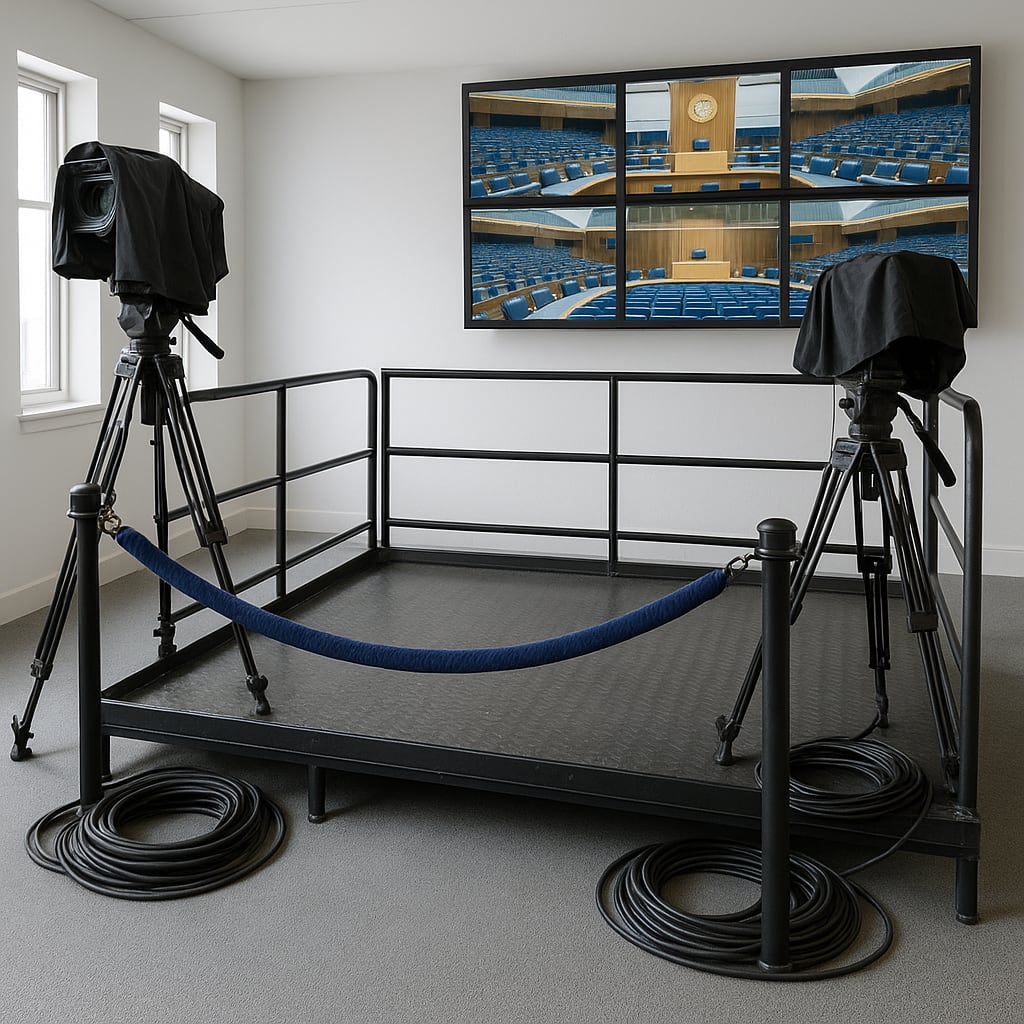
US networks halt White House pool after bans; CNN, MS NOW and Politico sue as ‘Trump TV’ debuts
Narrative Snapshot
Across outlets in the United States and abroad, coverage converges on the unusual step by the full White House television pool—ABC, CBS, Fox News, CNN and NBC—declining to carry pooled video after the administration barred CNN, MS NOW and Politico. US, European and Israeli outlets alike report the joint statement objecting to retaliation over coverage, while Canadian, British and Indian explainers foreground how the pool underpins day-to-day access and equal distribution of footage (Fox News; The Guardian; France24; Le Monde; The Times of Israel; BBC; Toronto Star; The Hindu).
There is less agreement on the practical impact. The New York Times notes the president still reached audiences when many networks aired his UN speech via the UN’s in‑house feed, even as the pool boycott “deprives” him of routine screen time. By contrast, The Guardian and The Times of Israel stress gaps created by networks refusing to backfill CNN’s pool duty and cite inaudible White House audio at a helipad event. Latin American coverage highlights potential blind spots during UNGA bilaterals, with Telesur warning of limited independent footage from meetings.
Legal framing is consistent: multiple outlets carry the plaintiffs’ First Amendment claim and request for an emergency order restoring access, while Fox News features a First Amendment advocate’s view that the administration is unlikely to prevail and also reports the White House’s refusal to back down. International wire and state-backed outlets supply spare confirmations of the pool freeze (TASS) and the lawsuit’s defendants and venue (CGTN; Telesur).
Reactions to the administration’s “Trump TV” YouTube stream split along lines of emphasis. RT and Folha de S.Paulo describe the 24/7 format and opening with a Mount Rushmore speech, whereas France24, citing the Guardian’s Washington bureau chief, foregrounds criticism likening the channel to state propaganda. Local political context also appears: Fox News reports New York City Mayor Zohran Mamdani inviting all media to a joint appearance with the president during his New York visit.
What Happened
On Friday before UN General Assembly week, President Donald Trump announced a ban on CNN, MS NOW and Politico from the White House, accusing them of “fake news” (Fox News; Telesur English). When CNN’s turn came to serve as Monday’s designated White House TV pool broadcaster, the remaining networks—ABC, CBS, Fox News, CNN and NBC—refused to assume pool duties, issuing a joint statement rejecting restrictions based on reporting (Fox News; The Guardian; France24; Le Monde; Times of Israel). CNN, MSNOW and Politico filed suit in the U.S. District Court for D.C., naming President Trump and senior officials, including Communications aide Steven Cheung, Secret Service Director Sean Curran, and Chief of Staff Susan Wiles, and sought emergency relief restoring access (CGTN; Telesur English; The Guardian; The Hindu). The White House launched a continuous YouTube stream, “Trump TV,” compiling administration highlights and archived speeches, opening with a Mount Rushmore address (RT; Folha; ANSA; Telesur English). The UN’s in‑house broadcaster carried Trump’s UNGA address amid the ongoing pool suspension (New York Times).
Why It Matters
The dispute tests long‑standing access norms that underwrite executive branch transparency. The rotating TV pool is a backbone arrangement that lets a small, in‑place contingent gather footage and redistribute it universally; its suspension removes a neutral, shared feed at precisely the moment of high‑stakes multilateral diplomacy around UNGA (BBC; Toronto Star; The Guardian). While the UN’s in‑house system can carry formal remarks, pool cameras are often the only practical way to document informal availabilities and bilateral photo‑ops; outlets warn that coverage of side meetings may be constrained (New York Times; Telesur English).
Legally, the case reopens questions about constitutional limits on viewpoint‑based press restrictions once the White House “opens its doors to the press,” as a First Amendment advocate told Fox News, and could set precedent on accreditation and retaliatory bans (Fox News; CGTN; The Hindu). Institutionally, the administration’s turn to a 24/7 official stream changes the information environment: some international coverage frames it as a curated alternative to independent newsgathering, raising concerns about reliance on government‑produced content by default when pooled access is disrupted (RT; Folha; France24).
Diverging Narratives
The administration frames the revocations as a response to “fake news” and downplays the boycott’s effect; President Trump told reporters in New York he was not worried and pointed to large press interest at a city event (Fox News, Sept. 22; ANSA). Networks and many outlets characterize the action as impermissible retaliation against disfavored reporting and an attack on independent scrutiny, quoting the pool’s statement that access should not be conditioned on viewpoints (Fox News; France24; The Guardian).
Accounts differ on how much the boycott constrains visibility. The New York Times emphasizes that while the pool withdrawal reduces routine exposure, the president still reached audiences via the UN’s in‑house feed. By contrast, The Guardian and The Times of Israel stress operational gaps, such as inaudible audio on a White House stream of a helipad event and the absence of a TV pool at moments when CNN would normally have provided a shared feed. Telesur underscores potential blind spots for bilateral meetings during UNGA.
Descriptions of “Trump TV” also diverge. RT and Folha de S.Paulo detail its mechanics as a 24/7 YouTube stream of past and new administration content, while France24 relays criticism from the Guardian’s Washington bureau chief comparing it to state propaganda channels. Some European coverage focuses on the coordinated stance of all five major US networks, including Fox, as the salient fact (Le Monde; France24).
What Happens Next
The immediate hinge is the federal court’s response to the plaintiffs’ request for a temporary restraining order restoring credentials (CGTN; The Guardian; The Hindu). If granted, the ruling could enable an immediate resumption of pool coverage and reestablish the rotation; if denied, networks have signaled they will continue to withhold pooled video, keeping reliance on official or third‑party feeds (Fox News; The Guardian; France24). Analysts should watch the D.C. District Court docket, any scheduling of a preliminary injunction hearing, and whether the administration modifies its position or processes around credentialing noted in the filings.
A second decision point is media strategy around UNGA and beyond. The White House has launched “Trump TV” and used venue‑provided feeds to reach audiences; the breadth of its use, and whether independent outlets adopt or reject government‑produced footage, will shape practical transparency (RT; New York Times; France24). Locally, signals from New York officials welcoming all press may create alternative access points during the president’s trip; whether similar accommodations emerge elsewhere will indicate how coverage gaps are mitigated (Fox News, Sept. 22; Telesur English).