
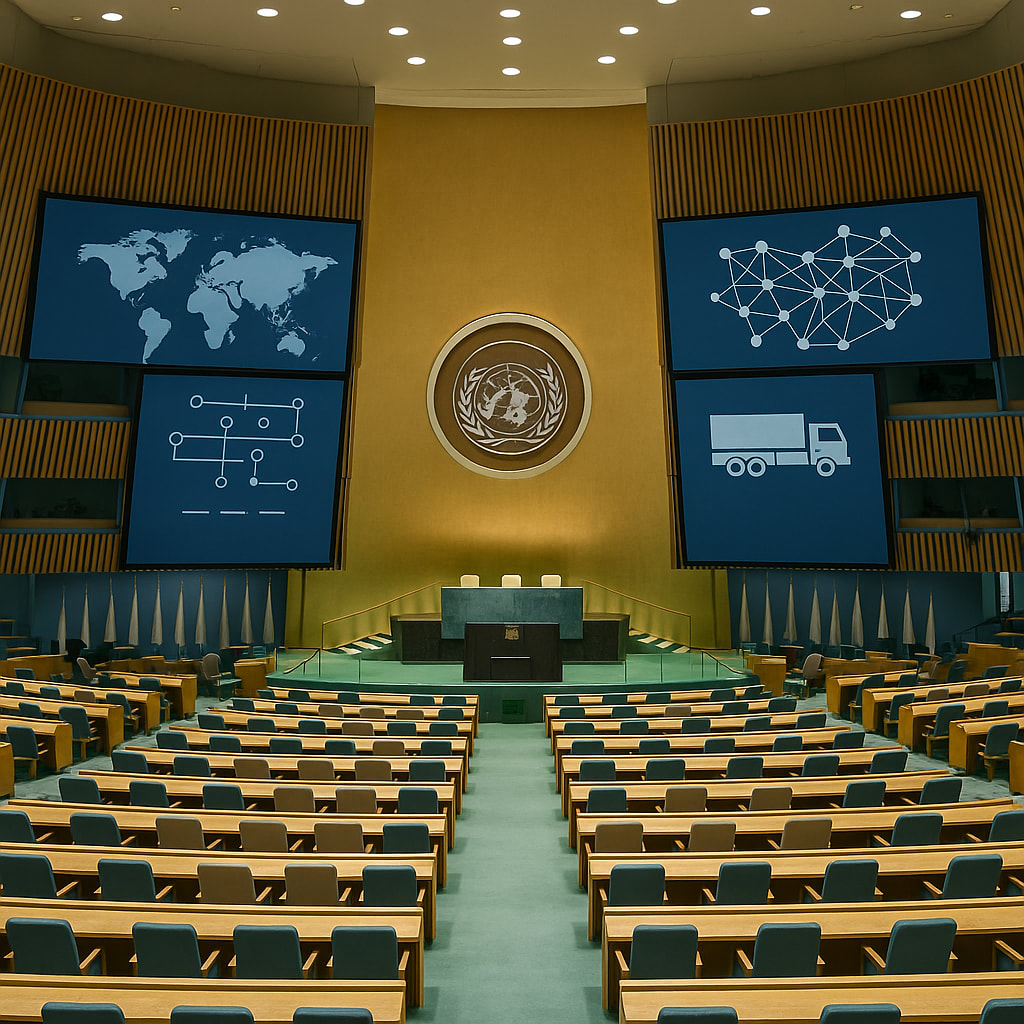
At the UN, Macron’s farewell presses multilateral resolve, Gaza accountability, and AI independence amid open rifts on Ukraine and Iran
Narrative Snapshot
French, Asian, and Middle Eastern outlets converge on Emmanuel Macron’s core message—recommitment to the UN over a resurgent “law of the jungle”—while emphasizing different stakes. French coverage highlights a principled defense of multilateralism and contrasts it with the U.S. president’s approach earlier the same day, framing Macron’s address as a counterpoint that warned of a “new age of barbarism” and urged adherence to international law and the International Court of Justice (Le Monde; France24; Middle East Eye; The Hindu; Bangkok Post). Latin American reporting spotlights his appeal for humanitarian restraint in Gaza and a pause in military attacks, and his proposal for a collaborative, open-source frontier-AI model outside U.S.-China control (Clarín; France24).
Coverage from Qatar and Kenya centers the political consequences. Al Jazeera stresses Macron’s insistence that the “coalition of the willing” will not yield on support to Ukraine, placing his stance within ongoing warfighting dynamics (Al Jazeera English). Kenya’s Daily Nation frames his Gaza remarks as an indictment of Washington’s diplomacy, underlining stalled humanitarian access and treating his farewell as a normative challenge to U.S. policy (Daily Nation). French reporting also records a misstep—Macron’s erroneous claim that Hamas had never operated in the West Bank—which Israel’s leadership quickly used to deflect criticism of settlement policy (Le Monde).
Parallel speeches puncture any aura of consensus. Ukraine’s Volodymyr Zelensky explicitly rejected a moratorium on strikes against energy infrastructure, even as he called for de-escalation before a harsh winter (Le Monde). Iran’s president charged that the United States and Israel “respect no rule of international law,” presenting images of victims, including children, and casting Iran as a target rather than a sponsor of terrorism; U.S. and Venezuelan outlets reported the same accusatory thrust, with added detail on alleged attacks inside Iran (Le Monde; NBC News; Telesur English). The institutional backdrop—visa denials for the Palestinian Authority president despite EU appeals, the UN’s veto-bound power structure, and a broader crisis of credibility—frames Macron’s plea as one bid among many to arrest a slide away from rules-based cooperation (Le Monde; Folha de S.Paulo; Al Jazeera English).
What Happened
In his final address to the UN General Assembly, French President Emmanuel Macron urged states to “stand firm” with the UN against a return to the “law of the jungle,” condemned inaction in Gaza as a “spectacle that shames us all,” backed the International Court of Justice, and called for a moratorium on strikes against civilian and energy infrastructure in the Russia-Ukraine war. He paired this with unwavering support for Ukraine and proposed a collaborative, open-source model for frontier AI outside U.S. and Chinese control (France24; Middle East Eye; Al Jazeera English; Clarín). Le Monde contrasted his message with the U.S. president’s earlier speech, while also noting Macron’s factual error about Hamas’s activity in the West Bank and Israel’s swift rebuttal (Le Monde). Zelensky then rejected any moratorium on energy-targeted strikes, even as he urged de-escalation steps (Le Monde).
Why It Matters
Macron’s intervention lands amid an openly stressed multilateral system. Reporting across outlets underscores a UN constrained by great-power vetoes and credibility challenges, even as conflicts—from Gaza to the Russia-Ukraine war and fighting involving Iran—dominate the agenda (Al Jazeera English; Folha de S.Paulo; NBC News). Calls to privilege international law and the ICJ directly test whether humanitarian access and accountability can be advanced when major combatants signal few concessions, as Zelensky’s refusal of a strike moratorium illustrates (Le Monde; Middle East Eye). Participation rules are themselves geopolitical: the United States issued visas for Iran’s delegation but denied the Palestinian Authority president, despite EU appeals, shaping who can contest narratives on the UN stage (Le Monde; Clarín; Folha de S.Paulo). Parallel initiatives—including a Brazil-Canada-EU-Kenya manifesto for multilateralism and debates over AI governance and the next UN secretary-general—show states probing institutional fixes even as power politics intensify (Folha de S.Paulo; Clarín).
Diverging Narratives
Outlets align on Macron’s multilateral framing but diverge on its implications. French and Asian reporting foregrounds his defense of the UN-centered order and legal institutions, while Kenyan coverage casts his Gaza remarks as a direct censure of U.S. diplomacy amid stalled humanitarian access (Le Monde; The Hindu; Bangkok Post; Daily Nation). On Ukraine, Macron’s appeal for a moratorium on strikes sits opposite Kyiv’s position; Zelensky’s categorical rejection underscores that humanitarian restraint proposals confront operational priorities on both sides of the front (France24; Le Monde). In the Middle East file, Macron’s support for the ICJ and condemnation of impunity meet an Iranian narrative that paints Tehran as a victim of U.S.-Israeli “terrorism” and lawlessness, reinforced by vivid imagery at the UN; Western and Venezuelan outlets report the same thrust, though with differing tone and granularity (NBC News; Le Monde; Telesur English). Process questions add another layer: the U.S. decision to deny a visa to Mahmoud Abbas—despite EU requests—highlights how state controls over access collide with claims of universal representation, a tension that anchors broader critiques of UN legitimacy and P5 veto dominance (Le Monde; Al Jazeera English). Macron’s factual error on Hamas’s presence in the West Bank, seized upon by Israel, also shows how misstatements can rapidly reshape diplomatic lines of attack (Le Monde).
What Happens Next
Several decision points emerge from stated positions. First, any movement toward a humanitarian strike moratorium in the Russia-Ukraine conflict hinges on whether Kyiv or Moscow adjust operational doctrines; Zelensky’s refusal signals no near-term alignment with Macron’s appeal, so watch for allied consultations that might revisit targeting policies or propose narrower de-escalation steps (France24; Le Monde). Second, on Gaza, monitor concrete measures to restore humanitarian access and support for ICJ processes; Macron tied credibility to action, and Kenyan reporting emphasizes that access remains constrained, making donor coordination and legal filings key indicators (Middle East Eye; Daily Nation). Third, U.S. visa policy will reveal whether EU requests gain traction on Palestinian participation; any reversal or accommodation would be a notable signal on inclusivity norms (Le Monde). Finally, on global governance, track whether states coalesce around an open-source frontier-AI framework outside U.S.-China poles and whether the Brazil-Canada-EU-Kenya multilateralism manifesto translates into proposals relevant to the secretary-general succession and Security Council constraints (France24; Folha de S.Paulo; Clarín; Al Jazeera English).