
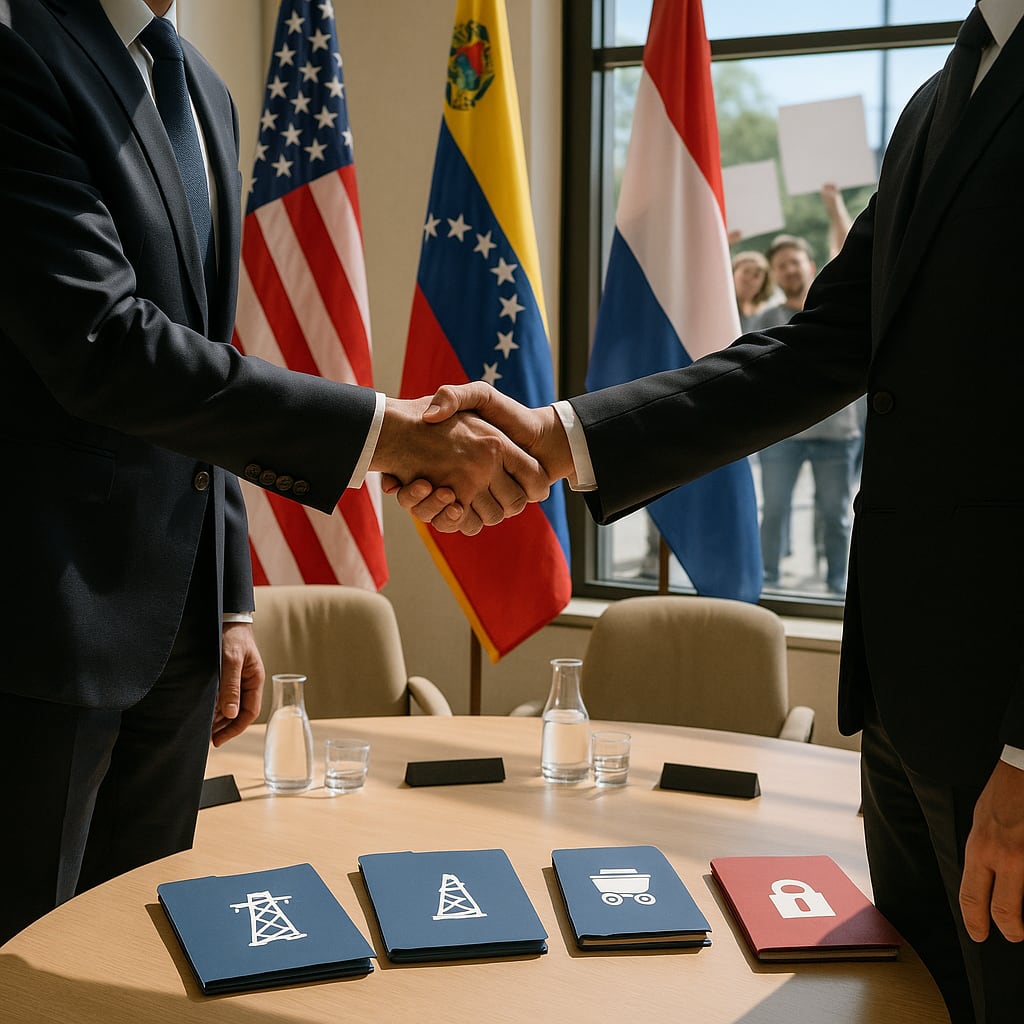
Trump meets Venezuela’s acting president at UN as NBC cites Maduro arrest and oil deal; protests, opposition travel attempts, and energy outreach frame Caracas’s agenda
Narrative Snapshot
Across outlets, the meeting between U.S. President Donald Trump and Venezuela’s acting president Delcy Rodríguez is uncontested, with sources in Brazil and Thailand citing the White House and Rodríguez’s own readout to confirm it occurred on the UN sidelines and centered on energy and security. Venezuelan state-aligned coverage centers collaboration, multilateralism, and sovereignty language, while U.S. reporting foregrounds Trump’s framing of a January U.S. military operation to arrest Nicolás Maduro and a subsequent oil deal. The public sphere appears bifurcated by geography: Al Jazeera English highlights protests against Rodríguez in New York, whereas Telesur English describes a pro-government rally in Caracas backing her UN role. Regional and extra-regional diplomacy also feature: Telesur English reports a Rodríguez meeting with the Dutch prime minister focused on energy integration, situating Venezuela’s outreach beyond the United States.
What Happened
U.S. President Donald Trump and acting Venezuelan President Delcy Rodríguez held their first in-person meeting on September 22 on the sidelines of the 81st UN General Assembly, with the White House confirming the encounter and Rodríguez calling it “historic.” Her statement said the agenda sought to strengthen bilateral ties and advance cooperation in energy, mining, and security, and she thanked Washington for assistance after June 24 earthquakes and support for Venezuela’s reintegration into multilateral spaces. In his UN address, Trump highlighted a U.S. military operation in January to arrest then-President Nicolás Maduro and a subsequent lucrative oil deal with Venezuela’s current leadership. Outside the UN, Venezuelans protested Rodríguez’s participation, while in Caracas, pro-government groups rallied in her support. Separately, opposition figure María Corina Machado attempted three times in 24 hours to re-enter Venezuela but was unable to complete the trip. Rodríguez also met Dutch Prime Minister Rob Jetten on energy integration, and the government resumed dialogue in Caracas with former 2015 Assembly deputies earlier in September.
Why It Matters
The reported U.S.–Venezuela cooperation agenda in energy, mining, and security, coupled with NBC’s reference to a new oil deal, signals a pragmatic channel for engagement after a leadership transition marked by a U.S. operation to arrest Maduro. That framing intersects with UN Charter principles—sovereign equality, self-determination, and rejection of coercive measures—which Venezuela’s delegation emphasized in New York, underscoring a normative tension likely to echo in multilateral forums. Domestic political management remains pivotal: talks between the government and former 2015 deputies suggest an institutional track, while protests abroad and a blocked high-profile opposition return attempt point to contested authority that could affect external partners’ risk calculus. Venezuela’s separate outreach to the Netherlands on energy integration reflects efforts to diversify international economic ties beyond Washington, relevant for European energy stakeholders and multilateral financing discussions.
Diverging Narratives
NBC News reports Trump spotlighting a U.S. military operation to arrest Nicolás Maduro and a lucrative follow-on oil deal, foregrounding decisive action and material outcomes. Venezuelan state-aligned coverage does not engage that chronology; instead, it emphasizes adherence to UN Charter principles and frames the Trump–Rodríguez meeting as a step toward cooperation in strategic sectors, gratitude for disaster assistance, and support for reintegration into multilateral arenas. Latin American outlets echo the meeting’s significance: Folha de S.Paulo cites the White House confirmation, and Clarín highlights Rodríguez’s description of a “historic” milestone. Public reception is split by venue: Al Jazeera English reports Venezuelan protests in New York against Rodríguez’s UN participation, while Telesur English describes organized demonstrations in Caracas backing her representation and sovereignty message. Concurrently, the opposition story arc advances through logistics rather than podium statements: Japan Times and the South China Morning Post detail María Corina Machado’s unsuccessful attempts to enter Venezuela during Rodríguez’s overseas trip, underscoring operational constraints on opposition activity not addressed in official Venezuelan accounts.
What Happens Next
Key decisions will center on whether Washington and Caracas translate their stated energy, mining, and security cooperation agenda into concrete instruments; analysts should watch for joint communiqués, working-group announcements, or commercial frameworks following the UN meeting. Venezuela’s parallel engagement with the Netherlands on energy integration bears monitoring for follow-up technical talks or investment signals that indicate scope and sequencing relative to U.S. ties. Domestically, the resumed dialogue with former 2015 deputies provides an institutional channel; progress markers would include published agendas, agreed timelines, or issue-area outcomes from the Jorge Rodríguez–Dinorah Figuera-led process. The opposition’s mobility remains an indicator: further attempts by María Corina Machado to enter the country—or official statements clarifying conditions for return—will shape assessments of political openness. Public mobilization trends, from diaspora protests to pro-government rallies, will inform readings of the government’s legitimacy narrative across audiences.