
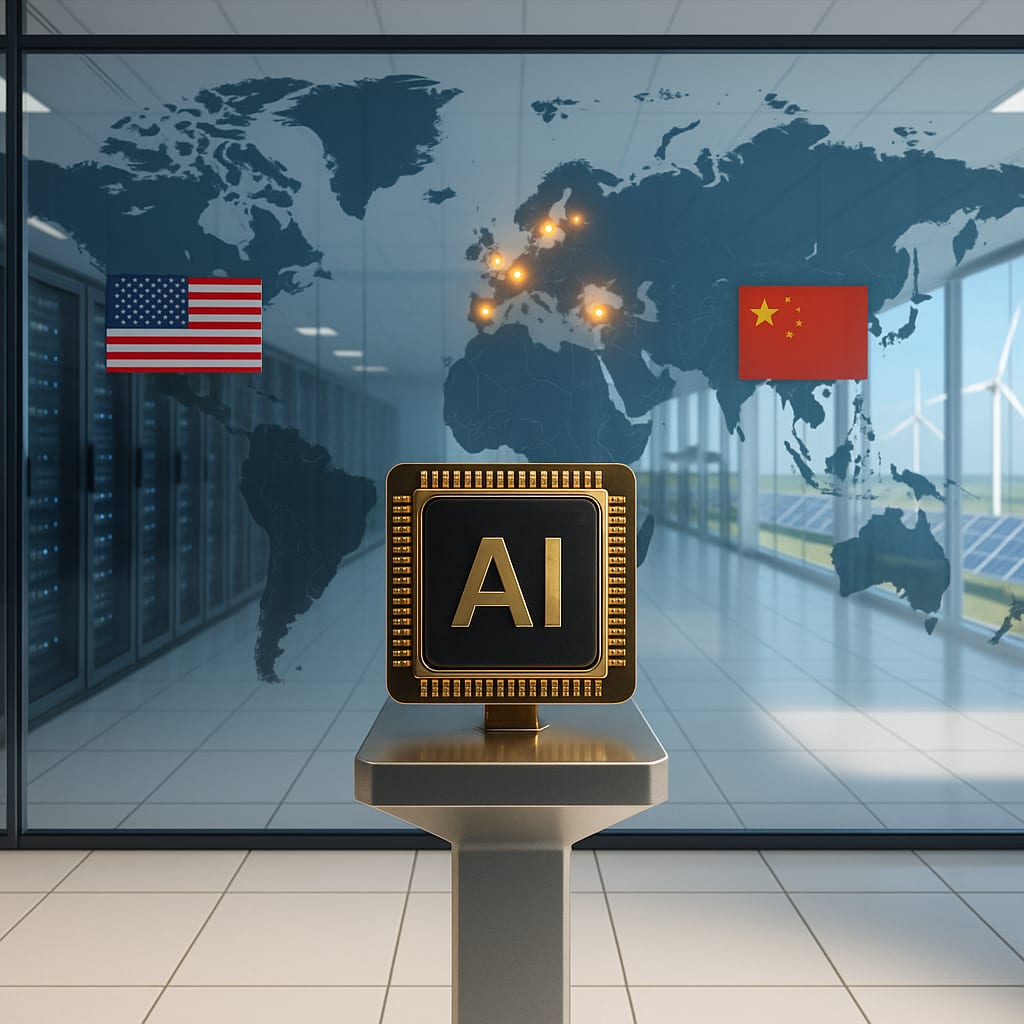
Alibaba’s new AI chip and global data center expansion collide with political, security, and community pushback
Narrative Snapshot
International outlets converge on Alibaba’s technical and infrastructure announcements while diverging on what they imply. Asian and Latin American coverage treats the move primarily as a market and capability story: reporting on a chip Alibaba describes as China’s most powerful and a planned rollout of more powerful models, a 5% rise in its share price, and concrete expansion zones in Turkey, Finland, and the Netherlands toward a 20‑gigawatt global capacity target by 2032, alongside claims that the new chip triples the performance of its predecessor (Japan Times; Toronto Star/AP; Clarín). In that framing, the timing ahead of a Chinese–U.S. leaders’ meeting is notable but not determinative of the news itself (Toronto Star/AP).
U.S. reporting centers the domestic political and security consequences of where AI infrastructure is built. Multiple Fox News pieces argue that the physical footprint of AI is a national security asset, cite foreign incentives and investments to warn of strategic risk if the United States falls behind, and foreground a letter from senior House Republicans alleging pro‑China funding streams may be mobilized to slow U.S. data center construction (Fox News, Sept. 18, 22, 23). That emphasis sits alongside new polling showing strong “not in my backyard” sentiment and Republican candidates signaling siting should remain a local, not federal, decision (Fox News, Sept. 22).
European and Brazilian coverage elevates energy, water, and community impacts as the central policy trade‑offs. La Repubblica highlights public backlash tied to heavy resource consumption and localized heat effects around data centers, while Folha de S.Paulo reports a World Economic Forum assessment that AI‑related optimism will be tempered by local resistance as utilities costs rise (La Repubblica; Folha, Sept. 22). Folha also surfaces a financing angle largely absent elsewhere: big techs’ growing use of guarantees to back AI chips and data center build‑outs, with up to $300 billion in commitments recorded mostly off balance sheet (Folha, Sept. 21). The Diplomat adds a regional governance lens, warning that Southeast Asian dependence on external capital and capacity could make Chinese‑backed data centers consequential for ASEAN’s AI norms (The Diplomat).
What Happened
Alibaba announced new artificial intelligence chip technologies and plans for more powerful models, describing one chip as China’s most powerful, and its shares rose 5% following the news (Toronto Star/AP; Japan Times). The company also outlined international infrastructure growth, planning new data center zones in Turkey, Finland, and the Netherlands this year and targeting 20 gigawatts of global capacity by 2032; it said the new chip triples the performance of its prior version (Clarín). The timing comes days before a meeting between Chinese and U.S. leaders (Toronto Star/AP). In the United States, the House of Representatives passed a bill aimed at shielding families from electricity price increases linked to data center expansion (Folha, Sept. 17). Debate intensified over security and community impacts, including a Fox News poll finding 71% oppose local AI data centers, and a GOP letter urging Treasury and the IRS to probe alleged foreign‑linked funding behind anti‑data‑center activism (Fox News, Sept. 22, 23). Analysts flagged broader environmental and governance risks (La Repubblica; Folha, Sept. 22; The Diplomat).
Why It Matters
The announcements and reactions illuminate how AI power is increasingly tied to control over compute, siting, and standards rather than algorithms alone. U.S. commentary links data center location to national security and economic sovereignty, with arguments that foreign incentives and massive planned investments—such as reported Chinese commitments through 2030 and policy inducements in India and South Korea—could shift advantage if U.S. build‑out lags (Fox News, Sept. 18). Policymaking is already adjusting: the U.S. House passed a bill to cushion power‑price impacts from data center growth, while leading Republicans emphasize local control over siting (Folha, Sept. 17; Fox News, Sept. 22). Abroad, The Diplomat warns that reliance on external providers may let Chinese‑backed facilities shape ASEAN’s AI norms (The Diplomat). Financing practices reported by Folha—hundreds of billions in off‑balance‑sheet guarantees—signal rising systemic exposure that regulators and investors will need to track (Folha, Sept. 21). Environmental and social license constraints identified in European and Brazilian reporting could become binding for cross‑border capacity plans (La Repubblica; Folha, Sept. 22).
Diverging Narratives
Coverage splits on whether Alibaba’s move primarily signals technological ascent or intensifies a strategic competition over infrastructure. AP reporting via the Toronto Star relays the company’s characterization of its chip as China’s most powerful and situates the launch ahead of leader‑level diplomacy, while Clarín emphasizes concrete expansion zones and a 20‑gigawatt capacity target, signaling execution priorities (Toronto Star/AP; Clarín). U.S. pieces in Fox News frame the broader issue as a multi‑front contest over compute location and control, asserting that adversaries can undercut proprietary advantages through open‑source offerings and model extraction, and warning that the United States risks forfeiting standards‑setting power if data centers are built abroad (Fox News, Sept. 18, 22).
Domestic politics add another layer. A Fox News poll shows strong local opposition to AI data centers even as remote siting draws more support, and Republican candidates argue siting should be decided locally rather than by Washington (Fox News, Sept. 22). Simultaneously, two House Republican chairs ask Treasury and the IRS to examine whether overseas funds linked to pro‑China groups are backing anti‑data‑center activism—an allegation presented as a set of questions for investigation rather than established fact (Fox News, Sept. 23). European and Brazilian reporting foreground environmental externalities—energy, water, and heat island effects—as the primary community fault line, contrasting with market‑ and security‑oriented framings elsewhere (La Repubblica; Folha, Sept. 22).
What Happens Next
Key decisions will hinge on siting and permitting. In the United States, Republican figures publicly favor leaving approvals to local authorities even as polling shows widespread local opposition; analysts should watch municipal and state proceedings to see whether community resistance delays or redirects projects to remote locations, and whether the House‑passed energy‑cost bill advances or is revised in the Senate (Fox News, Sept. 22; Folha, Sept. 17). Internationally, Alibaba’s planned zones in Turkey, Finland, and the Netherlands will test host‑country tolerance for AI data center externalities highlighted in European coverage; permitting outcomes and utility arrangements are immediate indicators (Clarín; La Repubblica).
Financing transparency is another hinge point: growing use of guarantees for AI infrastructure, with up to $300 billion in off‑balance‑sheet commitments, may prompt regulatory or investor scrutiny; disclosures and accounting guidance will signal direction (Folha, Sept. 21). In Southeast Asia, dependence on foreign providers could shape AI governance; watch for government partnerships and regulatory alignments with Chinese‑backed operators (The Diplomat). In Washington, any response by Treasury or the IRS to lawmakers’ inquiries will indicate how far national security concerns will penetrate civil society oversight (Fox News, Sept. 23).