
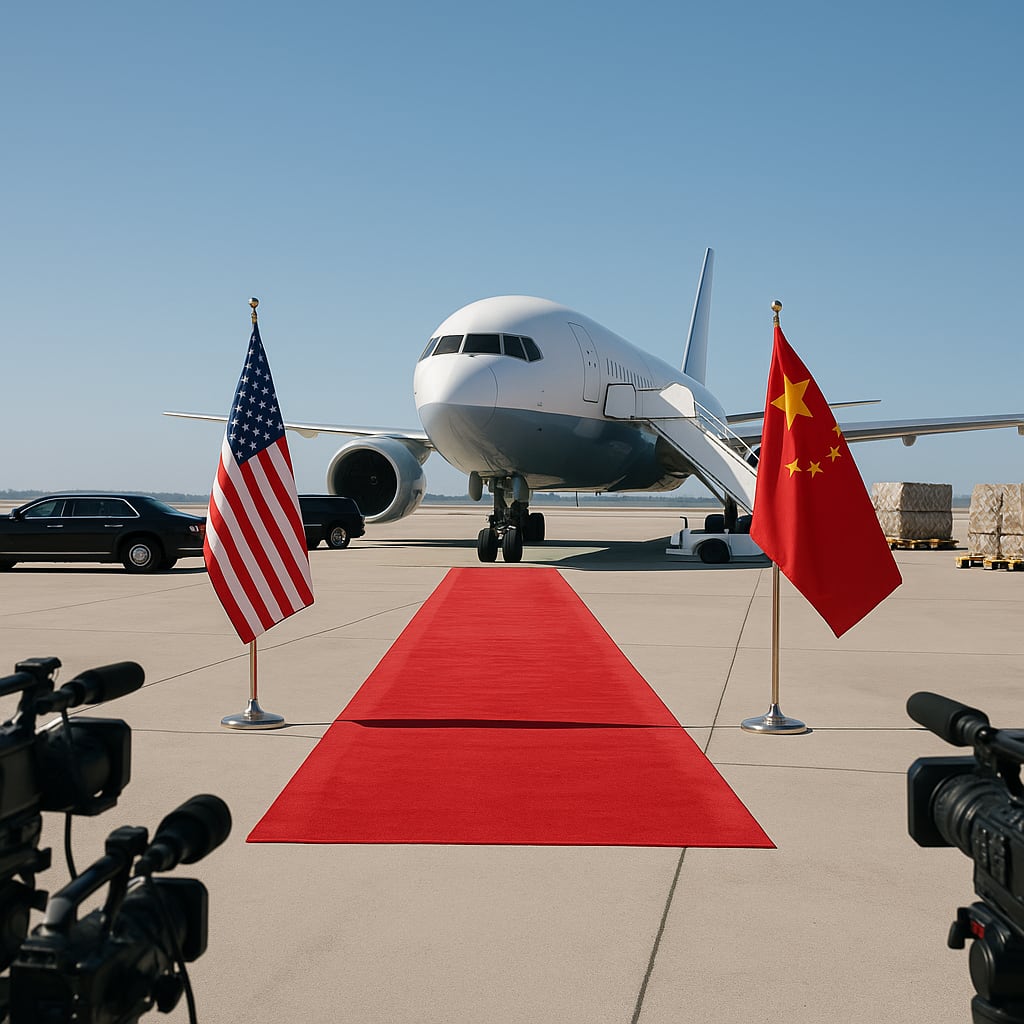
Trump greets Xi on tarmac in Washington as state visit opens with talks on trade, AI, and Taiwan
Narrative Snapshot
Across outlets, there is striking convergence that the reception was unusually personal and elaborate. US and international coverage notes President Donald Trump greeting Xi Jinping planeside at Joint Base Andrews with a red carpet, honor guard, national anthems and a gun salute, a courtesy multiple reports describe as rare for visiting leaders. Chinese and international outlets alike underscore that this is Xi’s first US state visit in more than a decade and that the meeting carries a weighty agenda spanning trade, technology and security.
Where narratives diverge is in emphasis and framing. Chinese state media highlight Xi’s written message that the two countries should be partners rather than rivals and call for “cooperation as the mainstay” with manageable differences, positioning the visit as a stabilizing step. Several US and European outlets stress the high-stakes nature of the talks, with the race over artificial intelligence, tariffs and Taiwan prominent. Conservative US coverage frames the encounter through strategic competition and domestic critique, including lawmakers foregrounding human rights abuses. Asian and European papers capture both the pomp and the boundary-setting: Japan Times cites Beijing’s “red lines” on Taiwan and human rights, while Italian and Argentine outlets describe Washington’s lavish protocol as a bid for “constructive stability” despite persistent tensions.
Substantively, some outlets report an immediate confidence-building move: an extension of the existing trade truce, conveyed by the US Treasury secretary to Fox News and reported as lasting until January 10. Others stick to the opening optics without confirming negotiating outcomes. Coverage also captures domestic optics management, from online backlash over troops fussing with the red carpet to China hawks’ discomfort with the ceremonial warmth, revealing how symbolism is being read against lingering mistrust.
What Happened
Xi Jinping arrived at Joint Base Andrews on Wednesday for a US state visit and was greeted on the tarmac by President Donald Trump and First Lady Melania Trump, with a red carpet, honor guard, national anthems and a gun salute. Chinese and international outlets describe the reception as a rare honor. The ceremony featured a military flyover, and ancillary coverage fixated on details such as Trump’s overcoat and gloves and the first ladies’ interaction. In a written statement on arrival, Xi said China and the United States should be partners, not rivals, and called for a relationship centered on cooperation with manageable differences. Outlets across regions say talks will span trade, tariffs, artificial intelligence, Taiwan and Iran; Russian state media add fentanyl precursors, rare earths, China’s access to advanced AI chips and US arms to Taiwan. US media report an extended trade truce, relayed by Treasury Secretary Scott Bessent to Fox News and cited as running until January 10.
Why It Matters
The visit tests whether Washington and Beijing can operationalize “managed competition” by carving out guardrails where interests overlap while constraining areas of contention. Reported agenda items map directly onto structural levers of power: export controls and market access in AI chips and other high-tech goods; tariff architecture and “non-strategic” trade; critical minerals supply; and coercive toolkits touching Taiwan and Iran. If the reported truce extension holds, it sets a near-term negotiating window and a tariff freeze that could de-escalate commercial friction while talks proceed. Beijing’s framing of cooperation as the mainstay, paired with “red lines” on Taiwan and human rights, signals a bid to stabilize ties without conceding on sovereignty or internal governance. For multilateral bodies and allies, the outcome will shape supply-chain risk, technology standards and sanctions coordination. For law enforcement and health agencies, any movement on fentanyl precursors could become a practical confidence-building measure with measurable domestic impact.
Diverging Narratives
Chinese state media anchor the visit in partnership language, quoting Xi’s call for the two countries to be partners and to keep competition moderate and differences manageable. Southern and European coverage notes the grandeur of the welcome as a deliberate signal of engagement. In contrast, US and allied outlets repeatedly frame the summit as high stakes, foregrounding strategic rivalry in AI and trade, with Fox News emphasizing an “AI supremacy” contest and previewing talks on possible tariff reductions on non-strategic goods. Domestic US skepticism surfaces in reports of China hawks’ discomfort with the lavish protocol and a bipartisan effort by senators to spotlight the Chinese Communist Party’s human rights record as Trump and Xi meet. Japan Times highlights Beijing’s “red lines” on Taiwan and human rights, underscoring limits to any détente. On substance, some outlets report an immediate extension of the trade truce—relayed by the US Treasury secretary to Fox News and described by RT as running to January 10—while others do not corroborate this, producing an uneven early read on deliverables. Agenda expectations also vary in specificity: Russian state media list fentanyl precursors, mutual moratoriums, rare earths, access to advanced AI chips and US arms to Taiwan, suggesting granular bargaining topics that are less detailed elsewhere.
What Happens Next
Three decision tracks will determine trajectory. On trade, watch whether the reported truce extension is formalized in joint readouts and whether talks yield defined tariff relief on “non-strategic” goods, as referenced by a senior US official. Concrete timelines, product scopes and verification mechanisms would signal momentum; ambiguity would suggest a holding pattern. On technology, indicators include any language on China’s access to advanced AI chips or adjustments to US export controls, an agenda point cited by Russian state media; even process commitments or licensing pathways would be meaningful signals. On security and governance, look for formulations around Taiwan, US arms supplies, and human rights—the areas Beijing labeled “red lines” and that US lawmakers elevated ahead of the summit. Additional deliverables to watch include commitments on fentanyl precursors, references to mutual moratoriums raised in Russian reporting, and any statements on rare earth supply stability. The balance of symbolism versus specific, monitorable steps will reveal whether stabilization is procedural or substantive.