
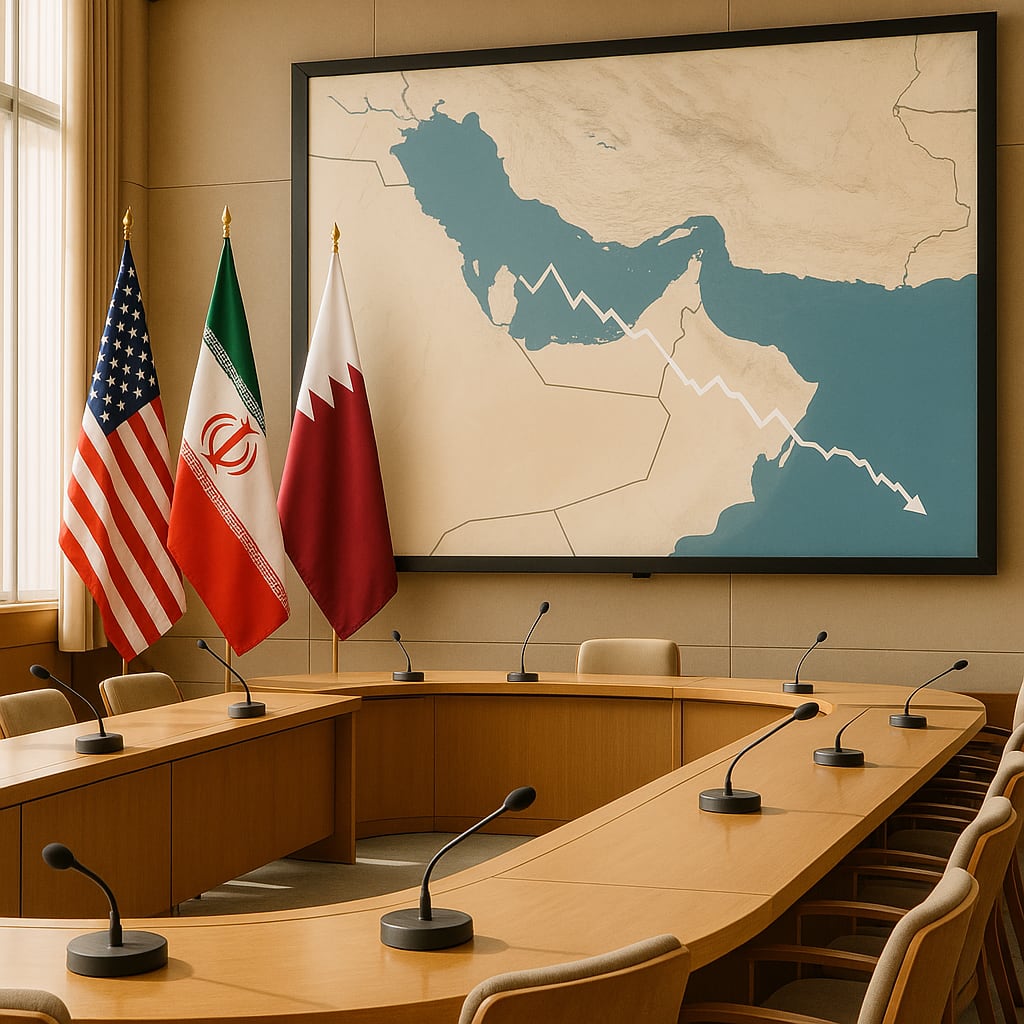
Qatar-mediated UNGA contacts put US–Iran back in a negotiating channel as Tehran reiterates conditions for reopening Hormuz
Narrative Snapshot
Across outlets, there is broad acknowledgment that senior US and Iranian representatives engaged on the sidelines of the UN General Assembly in New York, with reporting converging on a three-hour session linking any reopening of the Strait of Hormuz to specific Iranian conditions. Coverage diverges on form and framing. Iranian state media and Qatari-linked reporting stress that contacts were conducted through Qatari mediation and used to convey Iran’s “decisive positions,” while US and some international outlets foreground President Donald Trump’s characterization of a “very good” meeting and the prospect of near-term follow‑ups.
Regional facilitation is a second through-line. Middle East Eye cites Gulf officials crediting Qatar with organizing the Witkoff–Araghchi encounter and notes broader Gulf efforts to enable a leader‑level “bump‑in,” alongside public calls from Qatar and the UAE for de‑escalation. European and Asian diplomacy appears as parallel tracks in Iranian readouts, with IRNA documenting a dense sequence of bilateral meetings by President Masoud Pezeshkian and Foreign Minister Abbas Araghchi, suggesting Tehran’s effort to broaden support while shuttle contacts with Washington proceed.
A notable stake is energy market sensitivity to diplomatic signaling. The Guardian reports Brent crude falling below $100 following Trump’s upbeat tone about further talks, even as Iranian officials publicly rejected claims that Tehran had softened preconditions. Russian coverage underscores the messaging contest: TASS relayed Iran’s ambassador in Moscow denying any negotiations and accusing the US leader of using statements to balance energy prices, while also carrying US envoy Steve Witkoff’s subsequent description of mediator-led consultations as successful.
What Happened
US President Donald Trump said his envoys Steve Witkoff and Jared Kushner held a three-hour meeting with Iranian officials in New York, calling it “very good” and indicating another meeting could occur soon. Multiple outlets report that Iranian Foreign Minister Abbas Araghchi was the interlocutor on Tehran’s side. Iranian and Qatar-based reporting frames the engagement as Qatar-mediated shuttle talks, with IRNA stating that Iran clearly conveyed its conditions for resuming diplomacy, and CGTN citing Iranian state media that those terms for reopening the Strait of Hormuz include lifting a US naval blockade, releasing frozen assets, and ending the war on all fronts. Middle East Eye attributes facilitation to Qatar and says Gulf states sought a leader‑level encounter, though logistics were difficult. The Guardian adds that oil prices fell on expectations of further talks. In contrast, TASS quoted Iran’s ambassador to Russia denying negotiations even occurred, while later reporting Witkoff’s positive assessment of mediator‑led consultations.
Why It Matters
The contacts link the world’s most vital energy chokepoint to concrete diplomatic steps, tying maritime access at Hormuz to sanctions relief and military de‑escalation. Public positioning by Qatar and the UAE for engagement, alongside Qatar’s reported facilitation role, highlights a regional brokerage model that can complement or substitute for traditional great‑power mediation. For policymakers, the episode tests whether a mediated, issue‑sequenced channel can bridge maximalist demands—Tehran’s conditions on blockades, assets, and conflict cessation—without formal negotiations.
Market reaction, as reported by The Guardian, underscores how statements alone can move prices, raising the premium on message discipline for leaders and envoys. The dense slate of IRNA‑reported bilaterals with European and Asian counterparts signals that any process will be embedded in wider coalition management, including European interlocutors and neighboring states affected by shipping risks. Institutional venues like UNGA provide political cover for shuttle contacts, but sustainability will hinge on whether parties can codify steps through regional or multilateral mechanisms.
Diverging Narratives
The central fault line is over definitions and optics: whether this was a negotiation, a mediator‑led consultation, or merely a venue to restate positions. IRNA and Al Jazeera describe a Qatar‑mediated meeting where Iran “conveyed” conditions; The Hindu characterizes it as shuttle talks; Trump, via CGTN and The Guardian, elevates the session as “very good” with quick follow‑ups implied. TASS quotes Iran’s ambassador to Russia insisting Iran “is not holding any negotiations with the US,” while also carrying Witkoff’s claim that consultations through mediators were successful, revealing competing narratives even within proximate reporting windows.
There is also a contest over flexibility. Middle East Eye reports Iran’s terms to reopen Hormuz are hardening, and The Guardian quotes Iranian denials that preconditions were dropped, even as US envoys labeled the exchange “encouraging, constructive and successful.” Substantively, conditions cited across CGTN, Clarin, and Al Jazeera—lifting a naval blockade, unfreezing assets, and ending the war on all fronts—frame a high bar for maritime de‑escalation. Rhetorically, Trump’s stark “greatness or obliteration” formulation at UNGA, reported by CGTN and Middle East Eye, contrasts with Gulf calls for de‑escalation and helps explain, alongside The Guardian’s price reporting, why some Iranian officials accuse Washington of using statements to manage energy markets.
What Happens Next
Two decision points will shape trajectory. First is whether the hinted follow‑up meeting materializes “in the very near future,” as Trump suggested. Signals to watch include confirmations from Qatari mediators and further statements from Witkoff, who told TASS mediators would continue their work. Second is whether Washington addresses Tehran’s stated conditions: any movement on lifting shipping blockades, steps toward releasing frozen assets, or concrete measures tied to ending the war on all fronts, as outlined by CGTN, Clarin, Al Jazeera, and IRNA. Absent such steps, Iranian officials have, per The Guardian and Middle East Eye, rejected suggestions of softening.
Regional facilitation is another hinge. Middle East Eye and ANSA highlight planned US–Gulf leader discussions around UNGA; readouts that reference Hormuz, blockade posture, or de‑escalation frameworks would indicate alignment behind a mediated track. Market sensitivity, reflected in The Guardian’s oil price reporting and the charge relayed by TASS that rhetoric affects prices, remains an external indicator of perceived progress or impasse.