
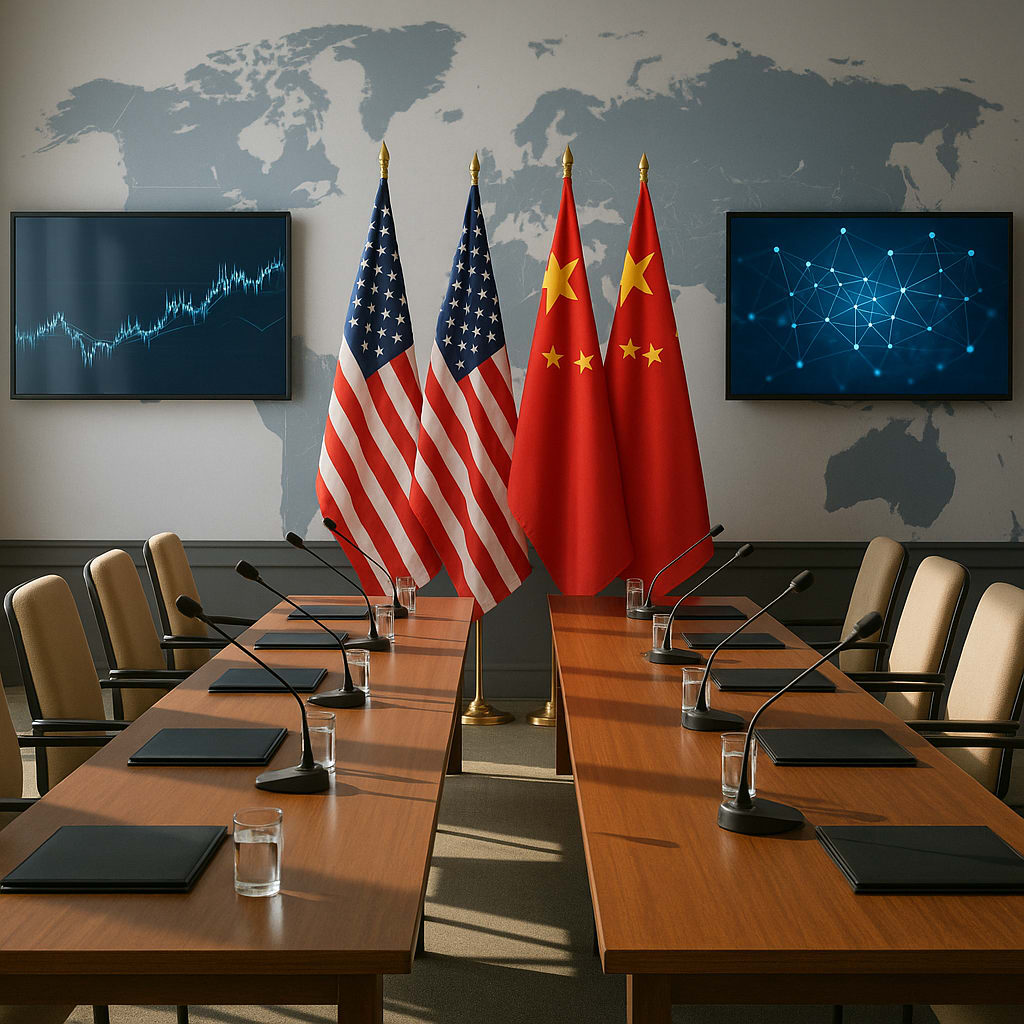
Trump welcomes Xi Jinping to Washington in first U.S. state visit by a Chinese leader in more than a decade
Narrative Snapshot
Across outlets, the optics are foregrounded while expectations for policy movement are kept low. France24 and CBC describe a meticulously choreographed welcome that signals a desire to project stability despite rivalry, but both caution that the summit is “light on substance” with no breakthroughs emerging from closed-door talks on trade, AI, Taiwan, or the Iran war. The BBC similarly situates the agenda around trade and AI, while South China Morning Post details the pageantry on the South Lawn, underscoring how ceremony has become part of the diplomacy itself.
Chinese state media casts the visit as a vehicle for “strategic stability.” CGTN points to incremental economic understandings since the May summit in Beijing—such as establishing boards of trade and investment, reciprocal tariff reductions, and agricultural market access—as the scaffolding for this week’s consultations. Telesur echoes Beijing’s framing that head-of-state diplomacy provides “irreplaceable” strategic guidance and aims at “peace, stability and prosperity.”
U.S. and European analyses are more conditional. The New York Times argues Xi is seeking to prolong a tactical truce with a U.S. president constrained by war and domestic politics, while Corriere della Sera reports that Trump seeks help on Iran as Beijing asks for concessions on Taiwan and trade. Meanwhile, Fox News platforms a sharply hawkish view via Gordon Chang that Xi is “preparing for battle,” in contrast to The Diplomat’s rights-focused call for Trump to confront China’s “ethnic unity” law. Regionally, South China Morning Post notes that Xi’s Washington visit overshadowed Trump’s meeting with Japan’s Prime Minister Sanae Takaichi, an indicator of how allied consultations are intertwined with U.S.-China signaling.
What Happened
Xi Jinping’s U.S. state visit runs September 23–25, confirmed by Beijing and reported across outlets including ANSA, Bangkok Post, and CGTN. Trump greeted Xi on arrival at Joint Base Andrews, an uncommon gesture not seen in 11 years, before a formal White House welcome with nearly 500 military personnel, anthems by the U.S. Marine Band, and opening remarks in the Rose Garden, according to France24 and South China Morning Post. The day included a working session and a state dinner, as noted by Clarin. Outlets agree the agenda spans trade, AI, Taiwan, and the war with Iran, with Clarin also flagging Chinese autos and the BBC emphasizing trade and AI. CBC reports no sign of breakthroughs from the leaders’ private meeting. The visit follows September 19–23 economic consultations led by Chinese Vice Premier He Lifeng in Washington, per CGTN.
Why It Matters
The summit tests whether the two governments can stabilize relations through high-level choreography while quietly maintaining functional channels on trade and technology. CGTN portrays recent steps—boards of trade and investment, reciprocal tariff reductions, and agricultural market access—as evidence of a working economic architecture since May that both sides could consolidate. Beijing explicitly seeks “strategic stability,” as reported by CGTN, while Telesur highlights head-of-state diplomacy as the locus of guidance. U.S. and allied calculations hinge on whether Washington’s broader security posture, including an ongoing war with Iran referenced by CBC, can coexist with guarded economic engagement with China. The New York Times frames Xi’s objective as extending a truce amid domestic economic fragility and a U.S. president constrained by war and politics. Outcomes will reverberate across alliances—South China Morning Post underscores how Japan-U.S. coordination sits in the summit’s shadow—and shape how issues like AI governance, Taiwan, and supply chain dependencies are managed.
Diverging Narratives
A core throughline in Western coverage is that the summit is heavy on symbolism and light on outcomes: France24 and CBC emphasize ceremony and the absence of policy breakthroughs. South China Morning Post deepens the focus on optics with detail on the military review and, separately, with reporting on Trump’s eagerness to showcase a new White House helipad and Marine One, a flourish Toronto Star also highlights. In contrast, Chinese state media and aligned reporting stress constructive momentum: CGTN’s explainer catalogs incremental, “generally balanced and positive” economic understandings since May; Telesur stresses the summit’s role in promoting “peace, stability and prosperity.”
Analysts diverge on strategic intent. The New York Times reads Xi’s approach as a tactical truce given constraints on both sides, while Corriere della Sera reports that Beijing wants concessions on Taiwan and trade as Trump looks for help on Iran. Fox News presents a stark warning from Gordon Chang that Xi is preparing China “for battle,” citing broader concerns about Chinese alignment amid tensions with Iran; this sits alongside The Diplomat’s recommendation that Trump put China’s “ethnic unity” law—and its extraterritorial implications—on the table. South China Morning Post’s coverage of Trump’s prior meeting with Japan’s Sanae Takaichi underscores allied calibration as an integral backdrop rather than a separate track.
What Happens Next
Watch for whether Washington and Beijing formalize or restate elements cited by CGTN—such as the boards of trade and investment, reciprocal tariff reductions, and agricultural market access—as a signal that the economic channel remains insulated from wider friction. On Taiwan, Corriere della Sera’s reporting that Beijing seeks concessions makes the language in any joint readouts or press remarks a key indicator of redlines or flexibility. AI and technology governance are on the agenda per the BBC and CBC; the presence or absence of new working groups or guardrails will indicate whether technical talks advance. With the Iran war in the background per CBC, any linkage—or deliberate non-linkage—between U.S.-China dialogue and Middle East dynamics will matter for crisis management. Finally, The Diplomat’s call to raise the “ethnic unity” law sets a clear test: explicit mention would signal willingness to prioritize rights concerns despite potential diplomatic cost; silence would suggest compartmentalization.