
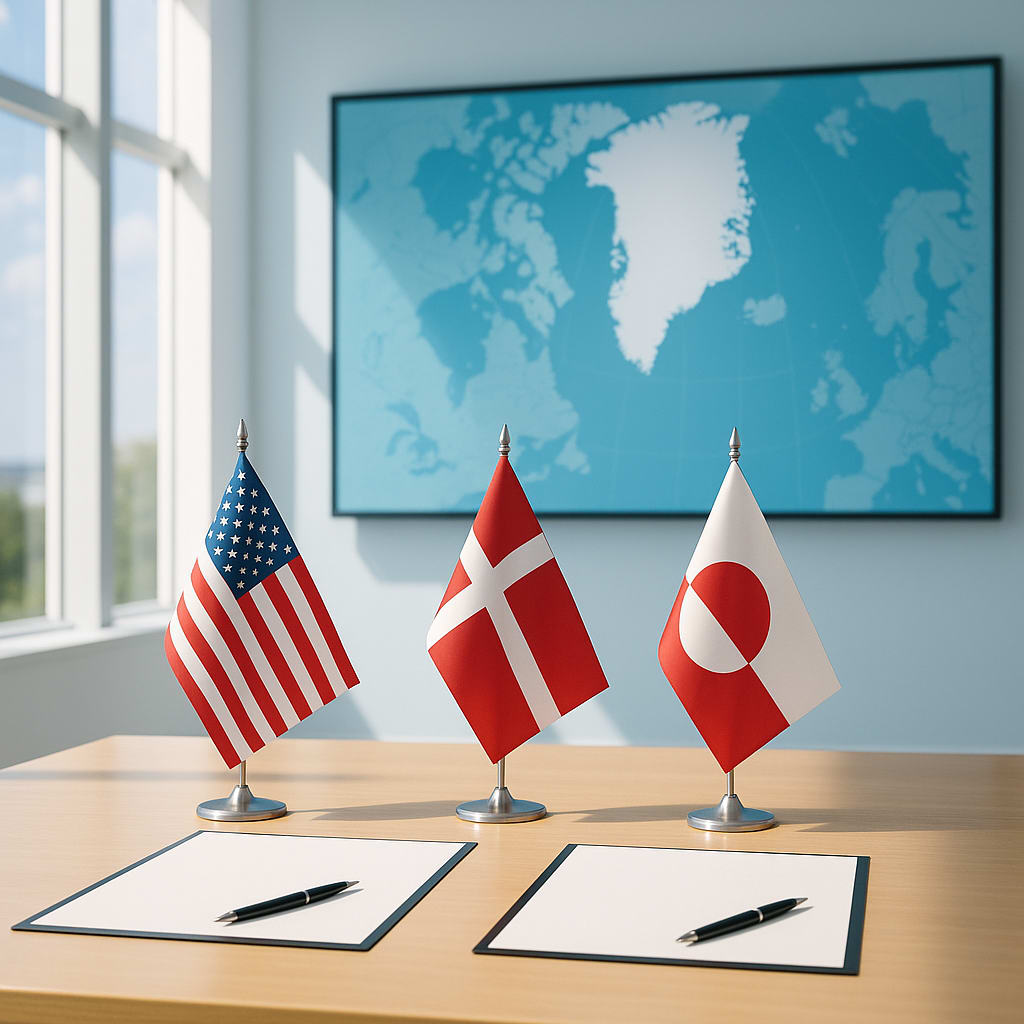
U.S., Denmark and Greenland sign Arctic security pact reasserting Danish sovereignty and adding two U.S. bases
Narrative Snapshot
Across outlets, there is broad alignment that the agreement was concluded on the margins of the UN General Assembly and that it both enables an expanded U.S. military footprint in Greenland and explicitly reaffirms Denmark’s sovereignty over the territory. European and Latin American coverage emphasize the reassurance element: Danish and Greenlandic officials underscore that autonomy and territorial integrity “red lines” were respected and that the text is legally binding with U.S. presidential backing, while British and French reports pair that with specifics on new basing and modernization plans.
U.S. and Russian outlets diverge more sharply on framing. The New York Times casts the deal as a retreat from earlier ambitions to acquire Greenland, while TASS highlights criticism that prior rhetoric damaged trust and portrays the outcome as Washington gaining “partial control.” Canadian coverage focuses on Greenland’s agency, suggesting the episode could translate into greater autonomy and influence, even as it cautions that promised investments may not fully materialize. The Hindu likewise reads the pact as an opportunity for the U.S. president to climb down from threats, while ANSA situates the signature within a crowded UNGA agenda rather than a standalone strategic pivot.
What Happened
On Tuesday, on the sidelines of the UN General Assembly in New York, the United States, Denmark and Greenland signed a legally binding security agreement. President Donald Trump touted the pact as beneficial “for Europe and for the United States and for all,” adding that it would be “incredible” for Greenland, according to Clarin. The deal reaffirms Denmark’s sovereignty over its semi-autonomous Arctic territory and, per Danish and Greenlandic officials cited by Clarin, respects autonomy and territorial integrity “red lines,” with U.S. presidential support, according to Frederiksen. The BBC and Le Monde report that the United States will build two new military bases in Greenland and modernize an existing site. Le Monde adds that investments in strategic sectors will be reserved for actors originating from allied countries. The New York Times notes this outcome falls short of Trump’s earlier push to turn Greenland into a U.S. territory.
Why It Matters
The agreement recalibrates Arctic security arrangements by anchoring a larger U.S. military presence in Greenland within a framework that explicitly reaffirms Danish sovereignty. This both deepens a key NATO geostrategic position and addresses alliance sensitivities highlighted by earlier acquisition rhetoric, with European coverage noting relief in Copenhagen and Nuuk and emphasis on respected “red lines.” By reserving strategic-sector investments for actors from allied countries, the deal also signals tighter alignment between security policy and economic screening in a sensitive theater, as reported by Le Monde.
For decision-makers, the pact offers a template for balancing enhanced posture with host-nation autonomy—salient for NATO basing and burden-sharing debates. It also interacts with broader great-power narratives: Russian press characterizations of “partial control” and references to hampered strategic dialogue fold the Greenland move into a wider confrontation frame, which allied policymakers will need to manage alongside implementation.
Diverging Narratives
Coverage splits over whether to view the deal primarily as a U.S. retrenchment, an expansion of presence, or a host-nation safeguard. The New York Times emphasizes that the agreement “falls well short” of turning Greenland into U.S. territory, contrasting current terms with earlier acquisition talk. The Hindu similarly argues it provides a chance for the U.S. president to scale down threats. European reporting strikes a different note: the BBC foregrounds the construction of two new U.S. bases and the formal reaffirmation of Danish sovereignty, while Le Monde reports relief in Denmark and Greenland and details on base modernization and allied-only investment in strategic sectors.
Clarin stresses that the pact respects Denmark’s and Greenland’s “red lines” and is legally binding with backing from Washington, framing the outcome as a negotiated assurance. Russian coverage highlights costs to trust from prior threats and, in a broader press review, depicts the United States as gaining “partial control” of Greenland—an interpretation at odds with the sovereignty reaffirmations cited by the BBC, Le Monde, and Clarin. The Toronto Star adds a distinct angle, suggesting Greenland could be the pragmatic beneficiary through a step toward greater autonomy and influence, while warning that promised investments and contracts may not fully materialize.
What Happens Next
Several decision points will shape implementation. First, base construction and modernization schedules will test whether U.S. commitments translate into funded projects; analysts should watch for appropriations, contracting milestones, and joint planning announcements referenced by BBC and Le Monde. Second, Denmark and Greenland will need to operationalize the investment provisions reserving strategic sectors for allied actors; clarity on sector definitions, screening criteria, and the scope of “allied countries,” as flagged by Le Monde, will indicate how tightly economic access is linked to security aims.
Political signaling bears monitoring. If, as The Hindu suggests, the agreement enables a de-escalation from earlier threats, sustained emphasis on sovereignty and autonomy—highlighted by Clarin and the BBC—would confirm that trajectory. Conversely, Russian media narratives depicting “partial control” (TASS) and U.S. domestic critiques about the costs of past rhetoric (also cited by TASS) point to scrutiny that could complicate execution. The Toronto Star’s caution about delivery on investments provides a practical benchmark: whether promised economic components arrive will influence perceptions in Nuuk and Copenhagen.