
U.S. releases pre-midterm election security plan as states act, AI ads spread, and DHS data draw scrutiny
Narrative Snapshot
Across outlets, there is broad alignment that multiple, overlapping election integrity fronts are in play: a late-breaking federal plan to support state systems, assertive state-level legal measures, a rapidly evolving information environment, and contested federal claims about voter eligibility. International and regional sources frame these elements differently. Canadian and Hong Kong coverage emphasizes the federal plan’s content and timing, while an Argentine outlet centers the plan’s tardiness and prior resource cuts. A UK report spotlights California’s bid to wall off state processes from federal interference linked to Donald Trump, contrasting with Hong Kong reporting that portrays the Trump administration as seeking to bolster state defenses.
Two stress points dominate: institutional capacity and informational trust. Capacity questions appear in complaints about delayed federal support and in Israel’s decision to shift election influence monitoring from the security service to police lacking appropriate tools. Trust questions surface in Nevada’s rejection of DHS non-citizen identifications and in concern that unregulated AI-generated political ads are reshaping campaign communications. What is at stake across these perspectives is less a single procedural fix than the alignment of authorities, tools, and timelines needed to protect both infrastructure and public confidence.
What Happened
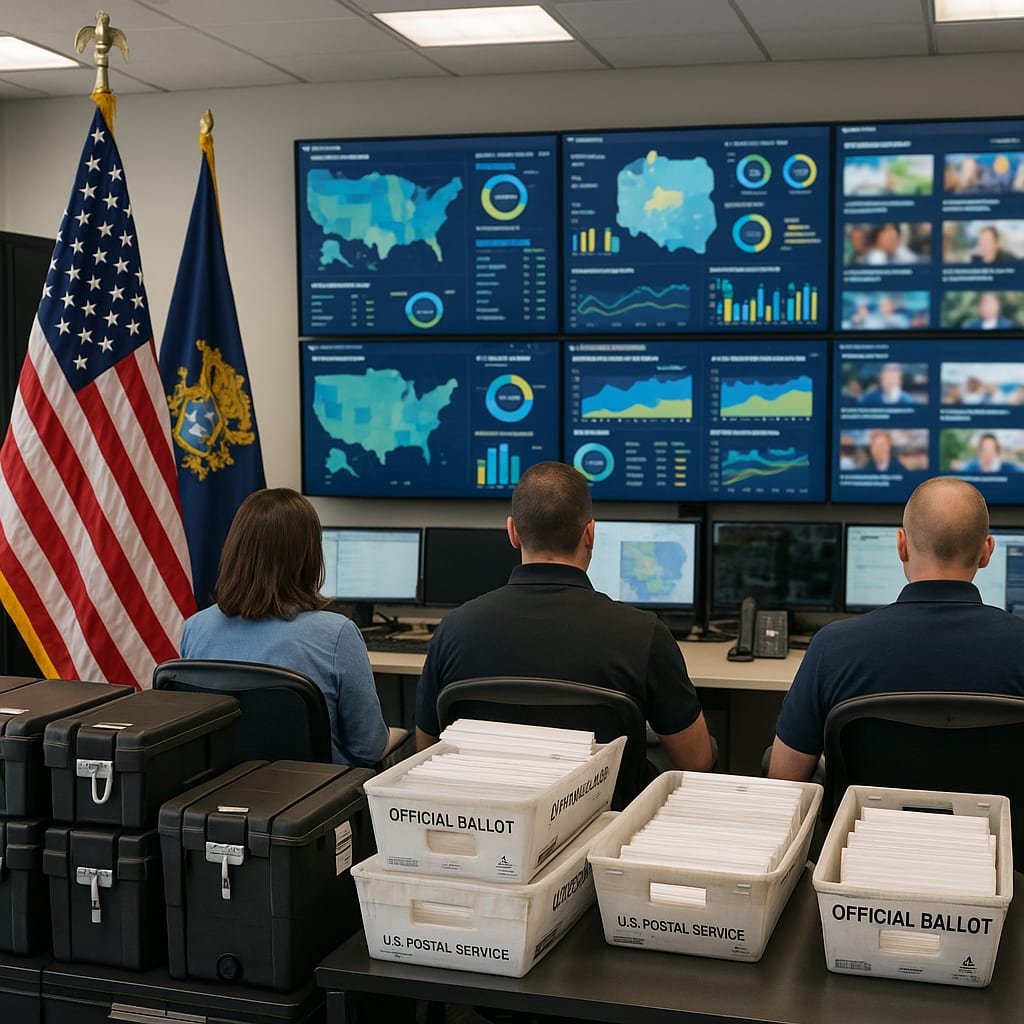
Forty days before the U.S. midterms, the nation’s cybersecurity agency released an election infrastructure security plan outlining potential threats and services it will offer to election officials, a document Homeland Security Secretary Markwayne Mullin had earlier promised by mid-August, according to reports from the Associated Press and the South China Morning Post. The SCMP adds that the Trump administration has been trying to jumpstart state protection efforts. Clarin reports local officials’ criticism that the plan arrived too late and notes earlier agency cuts that left states turning to private providers.
At the state level, the Guardian reports California enacted measures to safeguard vote-by-mail, extend drop-off hours, and criminalize seizing ballots or election records, framed as thwarting federal political interference by Trump. Separately, the Guardian details Nevada officials’ finding that DHS wrongly flagged 185 registered voters as non-citizens. The Japan Times highlights growing use of largely unregulated AI-generated political ads. Haaretz reports Israel’s Shin Bet chief declined to monitor internal election-related influence operations, shifting responsibility to police despite lacking suitable tools.
Why It Matters
The coverage collectively underscores structural tensions in election governance: vertical coordination between federal assistance and state control, the boundary between security services and civil authorities, and the adequacy of rules for a transforming information ecosystem. The late federal plan touches longstanding questions about whether Washington can provide timely, trusted support to decentralized state systems; California’s new laws reflect a state-level attempt to insulate procedures from perceived federal overreach. Nevada’s correction of DHS data points to the systemic importance of evidentiary standards and communications discipline for national agencies whose assertions can rapidly shape public narratives.
Internationally, Israel’s reassignment of influence-monitoring responsibilities highlights institutional design choices about domestic political operations and the trade-offs when specialized capabilities sit outside law enforcement. The unregulated proliferation of AI-generated political advertising flagged by the Japan Times adds another structural layer, testing whether existing election and platform governance frameworks are sufficient without new statutory guardrails.
Diverging Narratives
Outlets diverge on the framing of federal action. The AP and SCMP focus on the release of the U.S. cybersecurity plan and its promised services, treating it as a substantive step, while Clarin emphasizes timing concerns and previous cuts that, in its telling, pushed states toward private vendors ahead of the vote. The Guardian’s coverage of California portrays state laws as bulwarks against federal interference associated with Trump, whereas the SCMP depicts the Trump administration as seeking to catalyze state defenses—contrasting interpretations of federal intent and effect.
Information integrity is another split screen. Nevada officials’ determination, reported by the Guardian, that 185 individuals flagged by DHS were citizens challenges earlier rhetoric, including Trump’s July assertion that DHS found hundreds of thousands of non-citizens across several states; subsequent DHS letters softened those claims. Meanwhile, the Japan Times frames AI-generated campaign ads as widespread and unregulated, suggesting a policy gap rather than immediate remedial action. Haaretz introduces a different institutional debate: whether national security services should monitor internal election influence at all, with Israel’s Shin Bet refusing and police inheriting a role they are reported to be ill-equipped to perform.
What Happens Next
Key decisions now hinge on uptake and execution. The federal agency’s plan outlines services for election officials; analysts should watch whether jurisdictions adopt these offerings at scale given the timing concerns raised by Clarin, and whether any resource constraints impede deployment. California’s new laws will test enforcement and intergovernmental boundaries; signals to monitor include legal challenges, guidance to local officials, and any federal-state friction over records handling.
On data integrity, Nevada’s findings put pressure on DHS methodologies and public communications; further state reviews or federal clarifications would indicate how such processes are being tightened. The Japan Times’ reporting on AI-generated political ads suggests administrators and campaigns are operating without clear regulatory constraints; the practical indicator will be whether election officials or platforms adjust guidance or practices during the remaining pre-election window. In Israel, Haaretz’s account raises a capacity watchpoint: whether police secure tools or partnerships to monitor influence operations after Shin Bet’s refusal, and how that affects detection and response.