
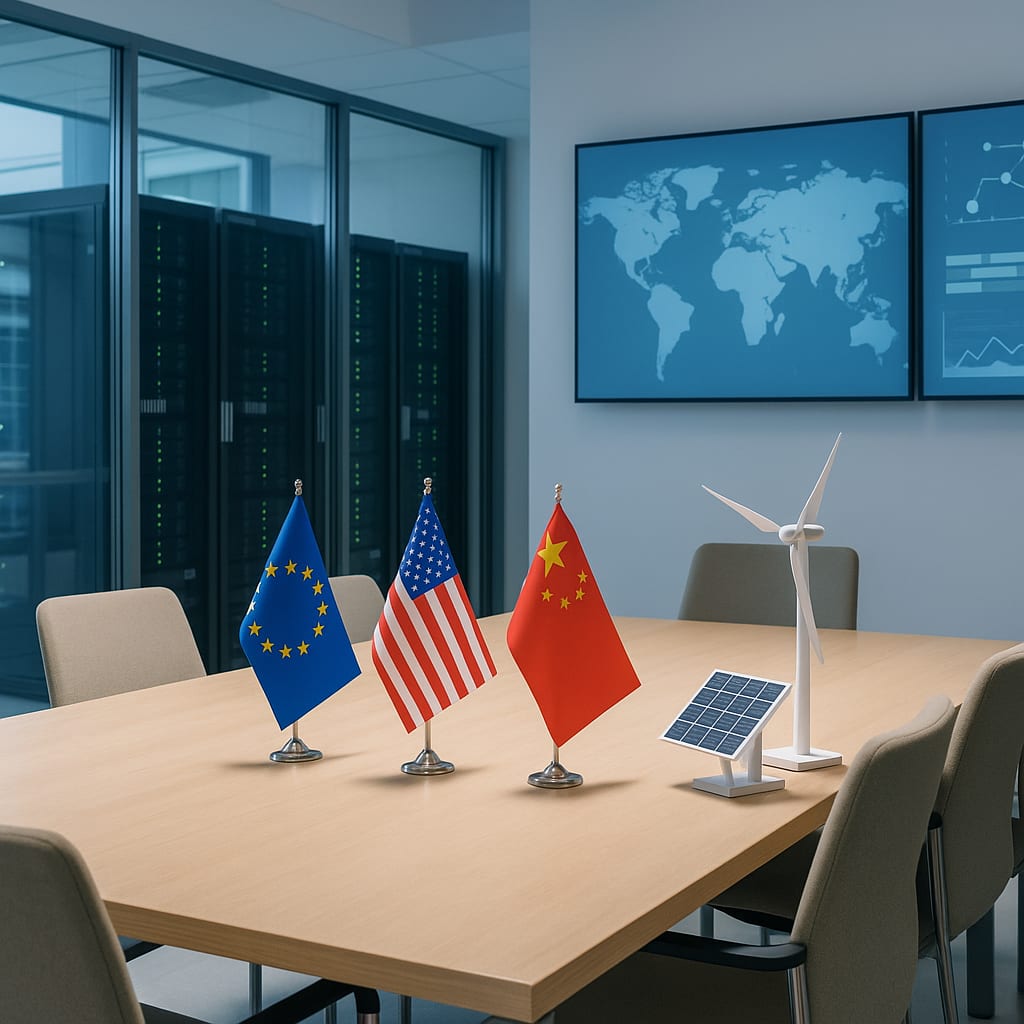
EU moves on ‘Made in Europe’ as trade gap with China widens; US weighs broader tech blacklist while China pledges easier market access
Narrative Snapshot
Across outlets there is alignment that trade imbalances with China are intensifying and prompting policy recalibration. European coverage ties a stark data point to policy momentum: EU customs data showed a July deficit with China exceeding €1 billion a day, while ministers pushed to define a “Made in Europe” framework before year-end to counter competitive pressure (The Guardian; Le Monde). In parallel, Hong Kong reporting notes the European Commission is pressing Beijing for near-term progress on the imbalance while contemplating new protective measures if talks falter (South China Morning Post).
U.S. narratives diverge sharply on tools and traction. One view emphasizes leverage and progress, citing a falling bilateral deficit and “quiet wins” from sustained pressure (Fox News). Another stresses structural limits: persistent Chinese overcapacity and difficulty converting confrontation into concessions (New York Times). A Latin American outlet frames tariffs as costly and ineffective at reversing global manufacturing shifts (Telesur English). Chinese state-aligned coverage underscores mutual gains and institutionalized channels since a May leaders’ summit, presenting cooperation and market opening as the path forward (CGTN).
Technology security is a hinge issue where reporting converges on tightening U.S. scrutiny. A House bill to expand the FCC’s Covered List and a concurrent Lenovo patent dispute illustrate how trade, IP, and security are being braided into broader restrictions on Chinese tech (South China Morning Post). Beijing, by contrast, foregrounds facilitation—easing market access and cross-border e-commerce and deepening ASEAN linkages—as evidence that partners can share in China’s scale advantages (ECNS).
Climate and exposure add crosscurrents to Europe’s debate. Brazilian reporting highlights that China’s clean-tech exports avoided emissions larger than the UK’s annual output, complicating arguments for blunt barriers on green goods (Folha de S.Paulo). Separate modeling cited in Brazil points to the UK and Germany as among the most exposed to economic coercion from Beijing, sharpening Europe’s calculus over defensive industrial policy and supply-chain de-risking (Folha de S.Paulo). A U.S.-based Asia outlet notes that some partners, like Egypt, are prioritizing Chinese investment’s potential to reconfigure production capacity despite deficits (The Diplomat).
What Happened
New EU data showed the bloc’s July trade deficit with China running above €1 billion per day, amplifying pressure for an industrial response (The Guardian). EU industry ministers in Brussels advanced work on a “Made in Europe” definition, seeking agreement by year-end, while France argued the UK should be excluded from the policy’s protections (Le Monde; The Guardian). In Washington, House lawmakers introduced a bill to broaden the FCC’s Covered List beyond communications gear, and Lenovo faced a memory-device patent dispute, adding to tech-sector headwinds (South China Morning Post). The White House prepared for a Xi-Trump meeting as U.S. coverage split on leverage: some tout a narrowing deficit, others note enduring Chinese overcapacity (Fox News; New York Times). Beijing, meanwhile, pledged to ease market access and boost digital trade, sent a vice premier for U.S. economic consultations, and showcased deeper ASEAN engagement (ECNS; CGTN).
Why It Matters
The week’s developments crystallize overlapping shifts in trade governance, industrial policy, and technology security. In the EU, translating “de-risking” into a legally operable “Made in Europe” standard—while deciding whether non-members like the UK qualify—tests the coherence of single-market instruments under competitive pressure from Chinese industry (Le Monde; The Guardian). U.S. consideration of a wider FCC Covered List signals a broader template for tech-related restrictions, with spillovers to supply chains and allied coordination (South China Morning Post). Chinese pledges on market access and e-commerce frame an alternative to defensive measures, while ongoing bilateral mechanisms since May indicate institutional channels that could absorb friction if substantively resourced (CGTN; ECNS). Climate and exposure metrics complicate blunt protectionism: Chinese clean-tech exports’ emissions impact and Europe’s vulnerability to coercion raise trade-offs for procurement, standards, and diversification strategies (Folha de S.Paulo).
Diverging Narratives
On effectiveness, U.S. outlets pull in opposite directions. One asserts that sustained pressure is lowering the bilateral deficit, positioning Washington better for a long game, with specific figures attributed to the USTR for 2024–2026 (Fox News). Another emphasizes that successive administrations have struggled to counter China’s excess capacity, suggesting limits to tariff leverage against structural industrial dynamics (New York Times). Telesur characterizes U.S. protectionism as a costly response to long-term shifts in global manufacturing shares, arguing it has not reversed those trends and has raised domestic costs (Telesur English).
Europe’s framing toggles between market defense and system design. Reporting highlights a rapid push to codify “Made in Europe,” with France seeking to exclude the UK, while other analyses underscore both the bloc’s significant exposure to Chinese coercion and the climate benefits associated with importing Chinese clean-tech (Le Monde; The Guardian; Folha de S.Paulo). From Asia, SCMP’s editorial stance posits that China’s industrial strengths should translate into shared gains for partners, while its news coverage details fresh U.S. moves to widen technology blacklists and related legal disputes, underscoring the tightening U.S. perimeter around Chinese tech (South China Morning Post). Chinese state media, for their part, stress mutually beneficial trade metrics—like two-decade growth in U.S. goods exports to China—and recent mechanisms set up after the May summit, positioning cooperation and reciprocal market steps as the viable pathway (CGTN).
What Happens Next
Key decisions cluster around three fronts. In Europe, ministers aim to settle the “Made in Europe” definition by year-end; whether the UK is formally excluded will signal the policy’s scope and its interaction with single-market preferences. Observers should track whether the Commission’s push for Chinese steps to narrow the imbalance by next month is met, since failure could accelerate new EU protective measures (Le Monde; The Guardian; South China Morning Post). In the United States, watch the trajectory of the House bill expanding the FCC Covered List and any parallel agency actions that widen the universe of restricted Chinese products; the Lenovo patent case is a bellwether for how IP disputes entangle with policy (South China Morning Post). From Beijing, monitor implementation details on easing market access and cross-border e-commerce, and whether bilateral mechanisms described since May generate concrete deliverables after the latest consultations and the Xi-Trump meeting (ECNS; CGTN).