
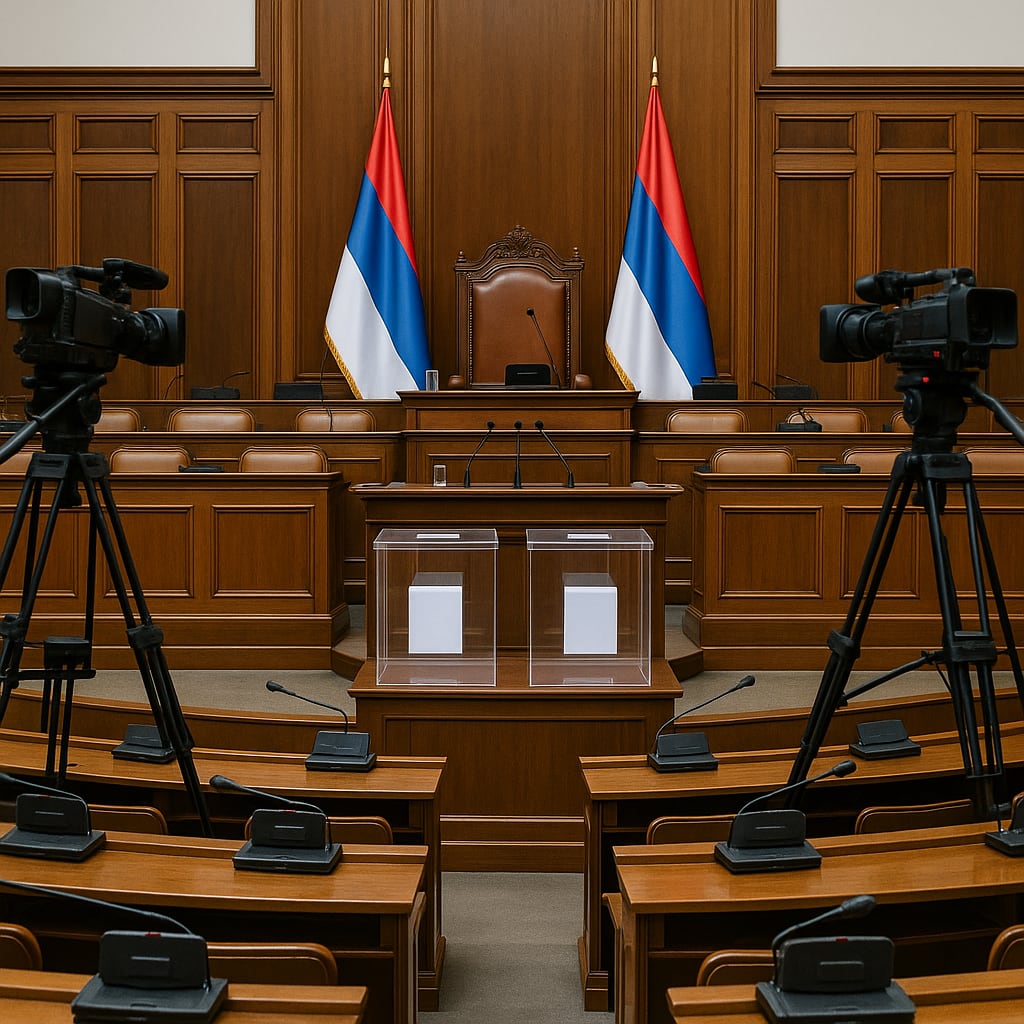
Vučić resigns as Serbia’s president to seek premiership in Oct. 25 snap elections
Narrative Snapshot
Across outlets, there is broad agreement that Aleksandar Vučić’s resignation is calibrated to lead his party into the October 25 snap parliamentary vote as its prime ministerial candidate, but emphasis varies. Several Western outlets foreground the protest backdrop and stress-tests to his authority: the Guardian and BBC link the development to nearly two years of demonstrations, including corruption allegations, while Bangkok Post and Le Monde highlight the student-led character of the movement since late 2024. The Toronto Star’s report on thousands welcoming a student cycling tour in Kragujevac offers a granular glimpse of youth mobilization in the campaign atmosphere.
Coverage splits on institutional mechanics and framing. CGTN details a constitutional handover to parliamentary speaker Ana Brnabić as acting president and a mandated presidential election within three months, while South China Morning Post reports Vučić’s own statement that a presidential vote will be held by year-end. Telesur, by contrast, characterizes the resignation as “triggering early presidential elections” and suggests a sequence in which the new parliament will appoint a new president—an account that diverges from CGTN’s legal description.
Foreign policy lenses also shape how the story is read. Kyiv Independent tags Vučić as “Russian-friendly,” Telesur ties Serbia’s stalled EU track to Belgrade’s refusal to sanction Moscow, and the Times of Israel underscores Belgrade’s closeness to Israel. South China Morning Post frames the move as echoing Vladimir Putin’s office-switch strategy, while Bangkok Post’s profile situates it in Vučić’s long arc from the Milosević era to dominant statecraft.
What Happened
Aleksandar Vučić resigned as Serbia’s president on September 27 to lead the Serbian Progressive Party (SNS) into snap parliamentary elections on October 25 as its candidate for prime minister, after being constitutionally barred from seeking a third presidential term, according to multiple outlets including the Guardian, CBC, DW, and TASS. CGTN reports that under Serbian law, the resignation takes effect upon receipt by the National Assembly, with Speaker Ana Brnabić assuming presidential duties for up to three months and required to call a presidential election within that period. CGTN adds that parliament was dissolved on September 9, that the SNS nominated Vučić as head of its list and PM candidate on September 5, and that the outgoing government remains in a caretaker role. Western outlets situate the move amid prolonged, student-driven protests; Le Monde dates the student movement to November 2024, while the Toronto Star notes pre-election student mobilization in Kragujevac.
Why It Matters
The move tests Serbia’s institutional capacity to manage overlapping executive transitions and snap polls while navigating pressure from a sustained protest movement documented by European and international outlets. It also bears on regional and external alignments. Telesur links Serbia’s stalled EU accession to Belgrade’s refusal to sanction Russia, and Kyiv Independent describes Vučić as “Russian-friendly,” signaling how campaign choices could recalibrate or reaffirm Serbia’s positioning between Brussels and Moscow. The Times of Israel highlights Serbia’s status as one of Israel’s closest European partners, indicating continuity or change here will be watched in Middle East–European diplomacy. South China Morning Post’s “echoing Putin” framing speaks to a broader pattern in which leaders toggle between top offices to preserve political control, a practice that raises questions for rule-of-law and checks-and-balances assessments by European institutions. For practitioners, the implications touch enlargement policy, sanctions coherence, and civil society space in the Western Balkans.
Diverging Narratives
Outlets diverge on causality and legal sequencing. The Guardian and BBC emphasize that the step follows nearly two years of protests and frame the election as a test of Vučić’s grip, while TASS and DW focus on the procedural fact of snap elections without the protest context. Le Monde, Bangkok Post, and the Toronto Star give prominence to the student movement—its origins in late 2024 and current mobilization—whereas other reports center constitutional term limits as the proximate driver of the resignation.
On institutional mechanics, CGTN details that Brnabić, as parliamentary speaker, becomes acting president for up to three months and must call a presidential election during that window; South China Morning Post reports Vučić’s statement that a presidential vote will occur by year-end. Telesur presents a different sequence, saying the resignation “trigger[s] early presidential elections,” and that a new parliament will appoint a new president who then calls presidential elections, a formulation that stands apart from CGTN’s explanation of the constitutional steps.
International framing is not uniform: Kyiv Independent underscores ties to Russia, Telesur links EU stasis to sanctions policy, and the Times of Israel highlights close bilateral ties with Israel. South China Morning Post’s comparison to Putin foregrounds a continuity-of-power narrative, while Bangkok Post’s profile situates the move in Vučić’s long-standing dominance.
What Happens Next
Key inflection points center on institutional scheduling, campaign dynamics, and government formation. CGTN notes the acting president must call a presidential election within three months; South China Morning Post reports Vučić saying it will be held by year-end. Analysts should watch the formal election decree from the acting presidency to resolve this timeline. With parliament dissolved and the government in a caretaker role (CGTN), October 25 will trigger post-election consultations in which the acting president proposes a prime ministerial candidate to the new assembly (CGTN). Signals to monitor include whether student-led mobilization observed by Le Monde, Bangkok Post, and the Toronto Star sustains organizational capacity through the campaign, and how opposition and SNS messaging addresses corruption allegations reported by the BBC. Internationally, watch for campaign positions on EU sanctions policy highlighted by Telesur and on ties to Russia and Israel noted by Kyiv Independent and the Times of Israel.