
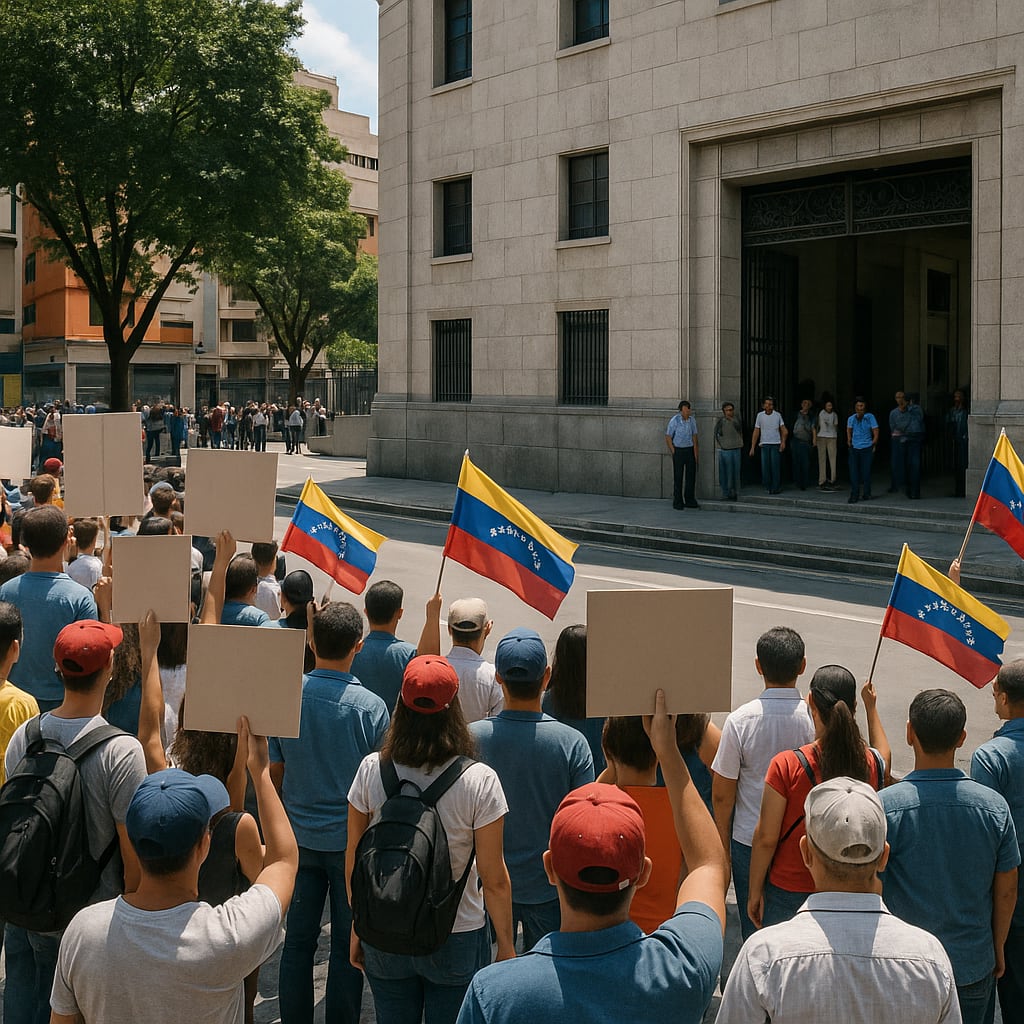
Venezuelans rally for Machado’s return and elections as government frees political prisoners
Narrative Snapshot
Across outlets based in Canada, Hong Kong, Germany, and Qatar, coverage centers on public mobilization around Maria Corina Machado’s safe return and demands for presidential elections. Reports emphasize on-the-ground energy and symbolism: South China Morning Post describes activists in Caracas wearing the sky blue of Machado’s Vente Venezuela party and moving in convoys of motorcycles and cars, while Deutsche Welle and the Toronto Star/Associated Press foreground the calls for fair voting and guarantees of her safety.
The BBC introduces a parallel development not highlighted elsewhere: the government’s release of dozens of political prisoners, reported as occurring days after the country’s interim leader met the US president. That linkage underscores the diplomatic layer shaping the domestic political calendar, a dimension largely absent from the protest-focused accounts.
Clarin shifts attention to opposition organization in-country, reporting Claudia Macero’s return from exile to “inspire confidence and lead changes,” even as Machado continues to face obstacles to re-entry. Al Jazeera’s description of Machado as a Nobel laureate diverges from the other outlets’ characterizations, which identify her as an opposition leader without that honorific, indicating inconsistency in framing her public profile.
What Happened
Supporters of opposition leader Maria Corina Machado rallied in Venezuela to press for her safe return and for presidential elections, with multiple outlets noting crowds in Caracas and elsewhere. South China Morning Post reports that hundreds of activists in the sky blue of Machado’s Vente Venezuela party rode motorcycles and drove through main avenues, honking. Deutsche Welle and the Toronto Star/Associated Press similarly describe public demands for fair elections. Al Jazeera states that Machado has been living in exile and that attempts to return have been foiled multiple times. Clarin reports the return from exile of Claudia Macero, a close ally of Machado, who was greeted in Maiquetía amid continued obstacles to Machado’s own return. In a related development, BBC News reports the government released dozens of political prisoners days after a meeting between Venezuela’s interim leader and the US president.
Why It Matters
The protest demands and reported prisoner releases intersect with questions of legitimacy, rule of law, and electoral credibility in Venezuela. South China Morning Post notes the government has been widely accused of stealing elections, jailing dissidents, and restricting speech, situating current mobilization within a longer-running contest over basic political rights. The BBC’s account of releases tied temporally to a meeting with the US president highlights the diplomatic leverage points likely to influence negotiation outcomes and sequencing.
For policymakers, the combination of street pressure and selective concessions raises immediate choices about engagement strategies, human rights conditionality, and support for credible electoral processes. Decisions by governments and multilateral bodies on observation, verification, and monitoring regimes will shape whether any announced electoral steps command domestic and international confidence. The reported return of some exiled opposition figures, alongside continued barriers for Machado, also signals evolving opposition capacity and the potential for incremental confidence-building or renewed confrontation.
Diverging Narratives
Outlets converge on the fact of coordinated rallies but differ in emphasis and framing. South China Morning Post details the movement’s visibility and explicitly cites widespread accusations against the government regarding past elections and repression, while Deutsche Welle and the Toronto Star/Associated Press keep to concise accounts of demands for fair elections and Machado’s safe return without elaborating on prior allegations. The BBC shifts focus to state actions, reporting the release of dozens of political prisoners and situating it shortly after a meeting between the interim leader and the US president; other outlets do not reference these releases or the US link.
Clarin foregrounds internal opposition dynamics—Claudia Macero’s return to Venezuela to help lead change—contrasting with Machado’s continued difficulties returning. Al Jazeera describes Machado as a Nobel laureate, a characterization not present in the other reports, creating a discrepancy in how her status is presented. Unresolved in the available coverage are the conditions under which Machado could re-enter, the scope of any future releases of detainees, and whether authorities will articulate a credible electoral timetable.
What Happens Next
Key decision points now hinge on state permissions and timelines. First is whether authorities will allow Machado to re-enter safely; signals would include official guarantees, legal or administrative clearances, or public statements removing obstacles cited by Al Jazeera and Clarin. Second is whether and when a presidential election framework is announced; analysts should watch for concrete dates, procedural details, and measures that Deutsche Welle and the Toronto Star/Associated Press identify as necessary for fairness. Third is whether prisoner releases persist following diplomatic engagements, a pattern implied by the BBC’s sequencing of releases after the interim leader’s meeting with the US president. Finally, opposition capacity-building bears monitoring, with Clarin’s report on Macero’s return suggesting potential organizational consolidation inside Venezuela should additional figures follow.