
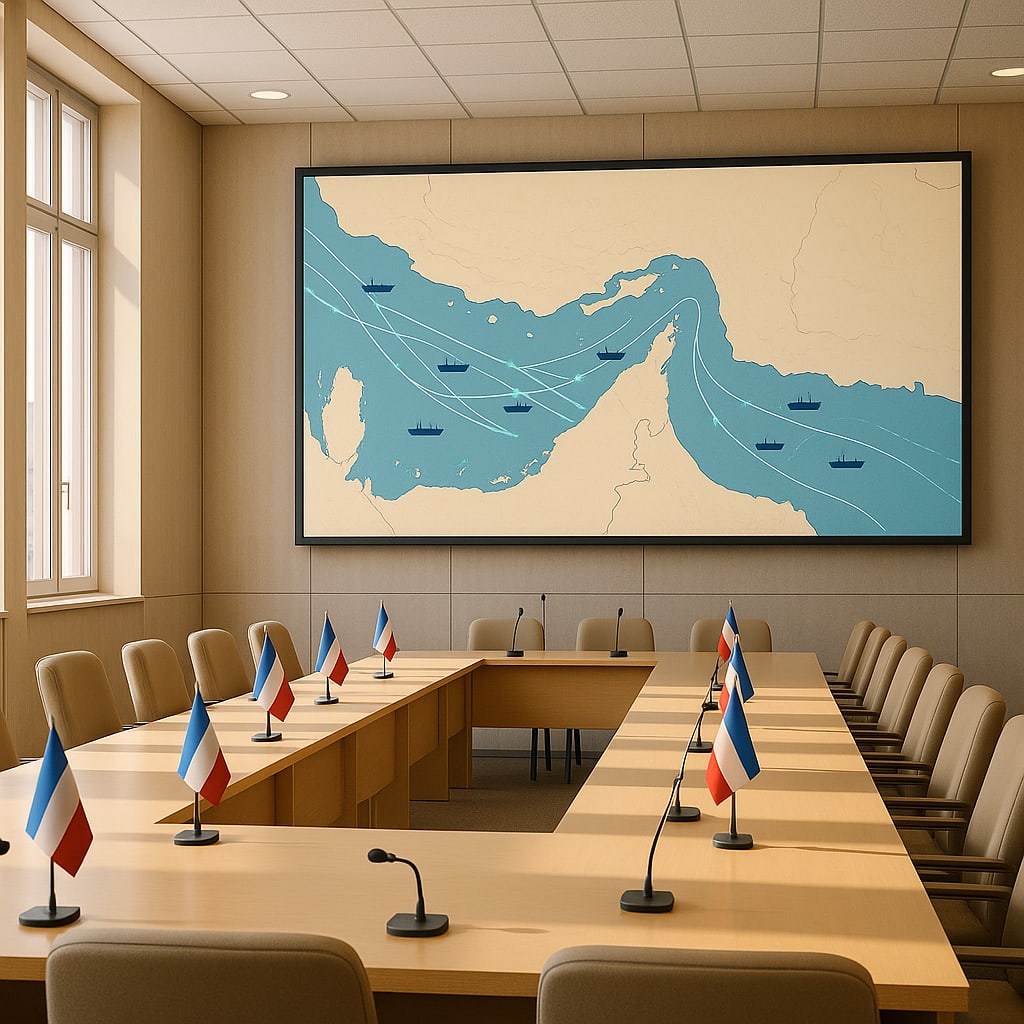
Competing claims and coercive signaling at the Strait of Hormuz draw UN appeal, U.S. pushback, and Iranian vows to expel foreign forces
Narrative Snapshot
Iranian and Iranian-aligned outlets foreground deterrence and expanding operational reach. IRNA amplified an IRGC spokesman’s line that Hormuz “is not open” and has become a hunting ground for U.S. underwater vehicles, while Tehran Times chronicled repeated captures of U.S. uncrewed surface vessels and carried Mojtaba Khamenei’s message that enemies have retreated to the Arabian Sea and will be expelled. TASS and multiple regional outlets reproduced the same leadership narrative. Parallel coverage showcased mobilization and technological claims: RT highlighted civilian training in Tehran under a “popular defense” banner, and IRNA touted advances in missiles and drones and unspecified “surprises.”
U.S.- and UK-based reporting emphasized continuity of traffic and contested Iranian assertions. Middle East Eye cited U.S. Central Command rejecting any notion of Iranian “complete control,” pointing to over a billion barrels of oil transiting recently and framing U.S. activity as both facilitating commercial flow and enforcing a blockade on Iranian maritime trade. Al Jazeera noted Washington’s rejection of a seven-day roadmap to end the war and reopen Hormuz, while also reporting increased oil flows despite Iranian touting of attacks.
Regional actors cast the maritime theater as a security governance problem rather than a single-front contest. The Times of Israel reported the Saudi foreign minister urging the UN to safeguard sea lanes and opposing the use of waterways as leverage, alongside Haaretz’s account of Riyadh’s coalition intercepting Houthi projectiles after a trilateral military huddle with Pakistan and Turkey. Coverage also contained unresolved factual edges: casualty figures from an Iranian anti-ship missile strike on a vessel carrying U.S. Marines varied by outlet, and Italian reporting on Chinese components bound for Iran sat uneasily with concurrent accounts of failed truce efforts.
What Happened
Saudi Foreign Minister Faisal bin Farhan urged the United Nations to protect maritime routes and rejected using vital waterways as pressure tools, according to the Times of Israel. Iran’s signaling escalated: IRNA quoted an IRGC spokesman calling the Strait of Hormuz a “hunting ground” for U.S. underwater vehicles, and Tehran Times and state-linked outlets carried Mojtaba Khamenei’s written assertion that enemies now “do not venture beyond the Arabian Sea” and will be forced out. Middle East Eye reported U.S. Central Command’s rebuttal that Iran lacks control over the strait, citing over a billion barrels of oil transiting recently and ongoing U.S. enforcement of a blockade on Iranian maritime trade. Al Jazeera said Tehran declared full war readiness after Washington rejected a seven‑day roadmap to end fighting and reopen Hormuz. Separate reports said Iran seized two light vessels and arrested 50 people near Qeshm and Minab, and that an earlier Iranian missile strike injured U.S. Marines, with differing counts across outlets. Riyadh’s coalition said it intercepted Houthi missiles and drones after a regional security meeting. Corriere della Sera reported Chinese electronics for drones and missile guidance arrived in Tehran “on the day” a truce was being signed.
Why It Matters
The Strait of Hormuz is simultaneously a military battlespace and a global economic utility. Competing claims of control versus continuity of flow, and parallel practices of seizures and blockades, stress-test norms of navigation, sanctions enforcement, and the threshold for lawful maritime interdiction. Appeals to the UN by a key energy exporter signal pressure for a collective security response that intersects with an existing U.S. kinetic and economic campaign, as reported by Middle East Eye and Al Jazeera. Regional dynamics—Riyadh’s intercepts of Houthi fire and consultations with Pakistan and Turkey—tie Yemen’s projectile threats to Gulf sea-lane protection. Iran’s leadership rhetoric about expelling U.S. forces, paired with advances in missiles and drones and civilian mobilization narratives, raises the salience of asymmetric maritime and littoral capabilities. Reporting on Chinese components, if sustained, would complicate enforcement coalitions and export-control regimes central to managing the conflict’s escalation pathways.
Diverging Narratives
Iranian messaging presents a coercive deterrent posture: Hormuz framed as “not open,” repeated captures of U.S. unmanned systems, and leadership vows to push adversaries beyond and then out of the Arabian Sea, as carried by IRNA, Tehran Times, and state-broadcast quotes relayed by Middle East Eye and The Hindu. U.S. Central Command’s position, reported by Middle East Eye, directly contests “complete control” claims, highlighting transiting volumes and casting U.S. operations as enabling commercial traffic while blockading Iranian maritime trade, a formulation that itself recasts the legal basis of interdiction.
On kinetic costs, casualty accounts diverge. RT, citing NBC, said eight U.S. Marines were injured by an Iranian anti-ship missile strike on a vessel in Hormuz, while Corriere della Sera reported 12 Marines injured in a Pasdaran strike. The Pentagon had not publicly detailed the incident in the RT write-up, leaving attribution and context contested. Diplomatically, Al Jazeera’s account of Washington rejecting a seven-day roadmap to end the war and reopen Hormuz contrasts with Corriere’s assertion that a U.S.-Iran truce was being signed the day Chinese components arrived in Tehran. Saudi coverage and commentary focus on protecting sea lanes and condemning coercive use of waterways, while Iranian outlets justify seizures as enforcement of regulations, with Middle East Eye noting 50 arrests tied to two light vessels off Qeshm and Minab.
What Happens Next
Three decision points emerge from reported positions. First, whether talks to end fighting and reopen Hormuz are revived after Washington’s rejection of a seven-day roadmap, per Al Jazeera; renewed mediator activity or adjusted U.S. messaging would indicate traction, while continued reliance on “pressure tactics” would not. Second, the extent of multilateral maritime security measures: Riyadh’s appeal to the UN and its coalition’s active air defenses against Houthi launches, as reported by The Times of Israel and Haaretz, set the stage for potential UN engagement; watch for UN statements or member-led initiatives. Third, operational tempo and escalation control: IRGC assertions of a “hunting ground,” seizures off Qeshm/Minab, and Iranian promises of new technologies (IRNA, Tehran Times) versus CENTCOM’s escorts and blockade enforcement (Middle East Eye) place a premium on monitoring shipping throughput, further USV/interception claims, and clarified casualty reporting. Corriere’s report on Chinese components makes export-control enforcement and observable transfer patterns a parallel indicator.