
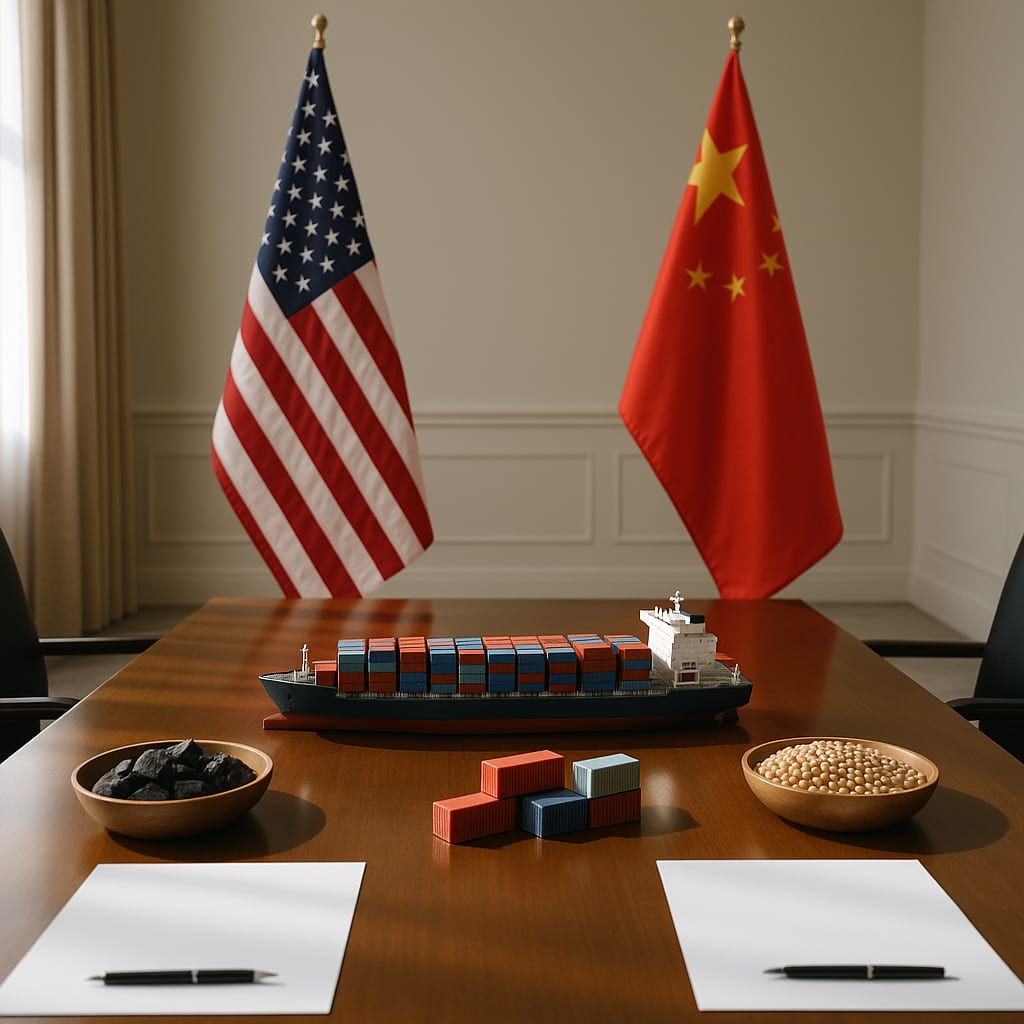
U.S. and China pledge tariff cuts on $60 billion of goods; China to resume U.S. coal imports while soybeans remain excluded
Narrative Snapshot
Across outlets, there is broad agreement that Washington and Beijing released reciprocal, nonsensitive product lists—roughly $30 billion each—for tariff reductions and framed the move as part of a broader effort to stabilize ties after a leaders’ summit in Washington. Reports consistently note the absence of strategic goods and the breadth of covered categories, from consumer electronics and household appliances to agricultural products and cosmetics.
Where coverage diverges is in emphasis and specificity. Hong Kong’s South China Morning Post foregrounds concrete deliverables, reporting China’s commitment to import at least 10 million tonnes of U.S. coal annually for two years and citing a Chinese list of 1,619 U.S. products slated for lower tariffs. Latin American outlets highlight sectoral beneficiaries and limits: Folha de S.Paulo stresses the $60 billion aggregate scope and variety of goods, while Clarín reports that China’s cuts do not extend to soybeans, which remain subject to an additional 10% tariff. U.S., U.K., and Japanese coverage leans into process and uncertainty: the New York Times and The Hindu present the lists as steps to ease tensions ahead of further talks; the Guardian and Japan Times underline that neither the magnitude of individual cuts nor the implementation timeline has been specified.
What is most at stake differs by constituency. Agricultural interests see targeted gains in meat, dairy, corn, wheat, sorghum, and vegetable oils but continue to press on soybeans; the South China Morning Post records U.S. soybean farmers calling the exclusion a “missed opportunity.” Energy and industrial stakeholders will focus on the coal purchase commitment as an immediate, verifiable flow. Strategically, the exclusion of sensitive sectors preserves negotiating leverage, a point reflected in multiple outlets’ characterization of the lists as nonsensitive and in CGTN’s argument that the two sides are seeking to compartmentalize disputes while advancing practical cooperation.
What Happened
After Chinese President Xi Jinping’s state visit to Washington to meet U.S. President Donald Trump, the two governments released reciprocal lists of goods for tariff reductions totaling about $60 billion, with roughly $30 billion in products from each side. The lists span thousands of nonsensitive items, including U.S. agricultural products such as meat, dairy, corn, wheat, sorghum, and vegetable oils, as well as consumer goods like cosmetics, household appliances, toys, and electronics. China said it would lower tariffs on 1,619 U.S. products and committed to import at least 10 million tonnes of U.S. coal in each of the next two years. Soybeans were not included in China’s tariff cuts and remain subject to an additional 10% tariff. Outlets noted that neither government specified the extent of individual tariff reductions or provided a timeline for implementation, and that further negotiations are planned.
Why It Matters
The move signals a managed de-escalation confined to nonsensitive sectors, creating political space for continued talks while leaving leverage in strategic areas intact. Multiple outlets emphasize that the lists exclude strategic goods, indicating that core technology and security-linked trade frictions remain unresolved even as both sides seek to stabilize broader economic ties. The commitments also speak to domestic constituencies: targeted relief for specific U.S. farm products and a quantified coal purchase for U.S. energy producers provide tangible deliverables, while the continued tariff on soybeans underscores calibrated, not across-the-board, accommodation.
Process-wise, the announcements reflect a return to structured bargaining tied to summitry. The Hindu anchors the outcome to Xi’s first U.S. state visit since 2015, and the New York Times and Japan Times note that the measures are framed as steps ahead of further negotiations. CGTN’s commentary characterizes this as compartmentalization—separating contested issues from practical cooperation—suggesting an emerging template for managing competitive interdependence without attempting a sweeping settlement.
Diverging Narratives
Outlets converge on the $60 billion combined scope and the nonsensitive character of the lists but diverge in the weight they assign to substance versus signaling. The South China Morning Post underscores quantifiable outcomes, citing China’s plan to cut tariffs on 1,619 U.S. items and to resume sizable U.S. coal imports, thereby offering measurable benchmarks. By contrast, the Guardian and Japan Times stress indeterminacy, highlighting the lack of clarity on the size of the cuts and on when they will take effect, which tempers expectations about immediate market impact.
Agriculture is a focal point for competing readings of who benefits. Folha de S.Paulo and Clarín describe broad sectoral coverage likely to aid consumers and exporters, while Clarín’s follow-up and the South China Morning Post’s reporting on farmer reactions draw attention to soybean exclusion and a remaining 10% additional tariff, framing the package as partial relief that leaves a key constituency dissatisfied. The New York Times and The Hindu emphasize the lists as confidence-building measures ahead of further negotiations, whereas CGTN presents them as evidence of a deliberate strategy to isolate intractable disputes from areas where cooperation is feasible. Together, the accounts depict a consensus on limited de-escalation, paired with different judgments about its immediacy, depth, and beneficiaries.
What Happens Next
Three decision points will shape the trajectory. First is implementation specificity. The Guardian and Japan Times note missing details on the extent and timing of cuts; analysts should watch for formal tariff schedule updates or regulatory notices from both governments that set rates and effective dates, which will determine real trade effects. Second is product scope in subsequent adjustments. The South China Morning Post and Clarín report soybean exclusion and ongoing farmer discontent; any Chinese move to lower soybean tariffs or announce purchase commitments would recalibrate agricultural politics and trade flows, while continued exclusion would maintain pressure. Third is follow-through on quantified purchases. The South China Morning Post reports China’s plan to import at least 10 million tonnes of U.S. coal annually for two years; customs data and import licensing will show whether this materializes. Across all fronts, the New York Times’ reference to further negotiations indicates additional lists or mechanisms remain possible, with strategic goods staying off-limits unless future talks broaden the remit.