
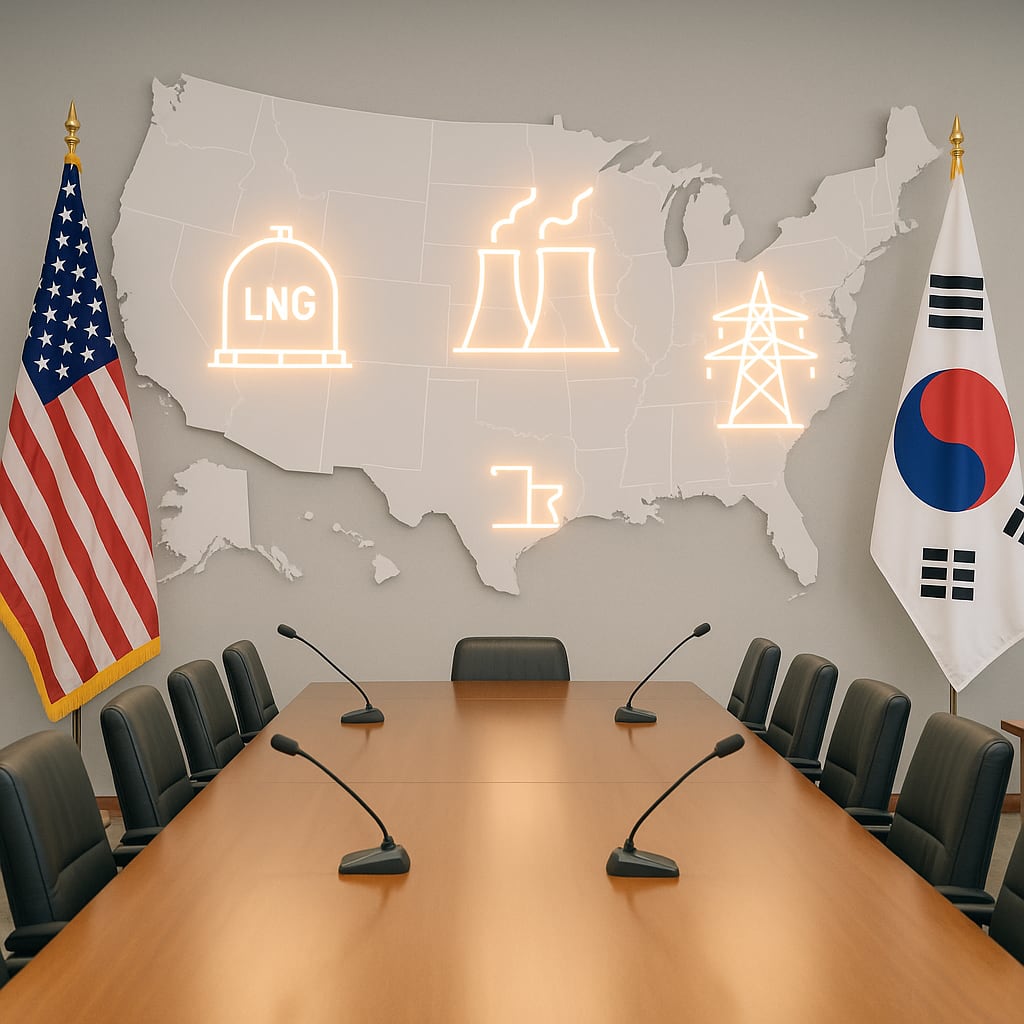
Trump unveils up to $200 billion in South Korean energy investments in the United States, including Alaska LNG and new nuclear projects
Narrative Snapshot
Across outlets, coverage converges on the scale and composition of the package and its political timing, while diverging on how firm the commitments are and how they should be interpreted. International and U.S. outlets broadly agree the White House touted up to $200 billion in South Korean-backed energy projects featuring an Alaska liquefied natural gas export project, multiple nuclear power plants, and a large power facility in Texas. Reporting from Qatar and Hong Kong places the announcement squarely in pre-midterm campaign messaging, while Canadian and French outlets detail the sectoral mix, with the Toronto Star localizing the Alaska component to a high-stakes Senate race.
The sharpest differences lie in the status and credibility of the pledges. South Korean pushback, highlighted by the South China Morning Post and Deutsche Welle, underscores that key elements—especially Alaska LNG—are contingent or still under review. By contrast, a U.S.–Korea framework to advance Westinghouse reactor deployment is presented as a defined channel with an “up to $120 billion” investment commitment, suggesting uneven maturity across the package. Argentine coverage surfaces environmental and economic viability critiques of the fossil-heavy components, injecting policy risk into a narrative otherwise framed by industrial strategy and alliance cooperation.
A separate Fox News report on a $15 billion steel plant announcement in Iowa situates the Korea-related rollout within a broader sequence of high-visibility industrial project unveilings the administration is using to argue momentum in heavy manufacturing. That parallel track reinforces the political communication lens some outlets apply, even as others focus on the cross-border energy and nuclear technology dimensions.
What Happened
The White House said President Donald Trump would outline a package of South Korean investments in U.S. energy projects totaling up to $200 billion, spanning an Alaska LNG pipeline and export project, multiple nuclear power plants, and a major power facility in Texas. Outlets cited specific components: roughly $54 billion for the Alaska LNG initiative long backed by Alaska Senator Dan Sullivan; plans for eight large-scale nuclear plants; and a Texas power-generation project described either as 6 gigawatts or a $22.3 billion natural gas–fired plant supported by Seoul. A companion announcement highlighted a U.S.–Korea framework to deploy Westinghouse nuclear technology, committing up to $120 billion in Korean investment for new U.S. reactors. Following Trump’s remarks, South Korean officials clarified that elements of the package were not finalized; Deutsche Welle reported Seoul would proceed with the Alaska LNG component only if certain conditions are met, and Argentine coverage said the Alaska pipeline remains under review.
Why It Matters
The episode tests how far U.S.–South Korea industrial cooperation can extend into capital-intensive energy and nuclear builds, and how such cooperation is structured. A stated framework to deploy Westinghouse reactors with up to $120 billion in Korean investment points to deeper alignment on nuclear supply chains and technology deployment, with implications for reactor vendor ecosystems and regional energy security. At the same time, Seoul’s public caveats highlight that large, cross-border infrastructure requires clear terms and sequencing, and that allied coordination can be strained by unilateral political timing. Reporting that differences over the allies’ trade agreement terms sit in the background indicates linkages between investment packages and broader economic negotiations. The fossil-heavy profile of the Alaska LNG and gas-fired Texas projects also brings environmental and economic feasibility critiques into play, which could shape permitting, financing, and coalition management around the package’s non-nuclear elements.
Diverging Narratives
Two lines of reporting create a tension between political announcement and policy execution. U.S., Canadian, French, Japanese, and Indian outlets describe a sweeping package with specified sectors and headline figures—$200 billion overall, $54 billion for Alaska LNG, up to $120 billion for nuclear via a Westinghouse-focused framework, and a Texas facility characterized either by capacity or cost. Coverage from Al Jazeera and the South China Morning Post emphasizes the electoral calendar, positioning the announcement as part of a pre-midterm effort to showcase Republican economic stewardship.
By contrast, South Korean clarifications reported by the South China Morning Post and Deutsche Welle stress that the deal is “far from finalised” and conditioned, with the Alaska LNG project proceeding only if certain requirements are met. Argentine reporting adds that while some investments have been formalized, the Alaska pipeline remains under review and the broader plan faces environmental impact and economic viability concerns, underscoring differentiated risk across components. Even within the agreed portfolio, outlets vary on specifics—the number of nuclear units, the scale of the Texas project—signaling that many details are still in flux. A contemporaneous $15 billion steel plant announcement in Iowa, covered by Fox News, reinforces the communications dimension without altering the unresolved substance of the Korea-linked energy package.
What Happens Next
Implementation hinges on formalization. South Korean officials’ statements that the package is not finalized and that Alaska LNG is conditional set a clear benchmark: watch for binding agreements beyond announcements, including project-specific contracts or financing arrangements for LNG and gas-fired generation. The Alaska component’s status—described as under review—will be an early indicator of whether contingent pledges convert to commitments. For nuclear, the reported U.S.–Korea framework tied to Westinghouse provides a channel; site selection, unit count, and financial structuring will signal whether the “up to $120 billion” materializes into scheduled builds. Divergences over trade agreement terms reported from Seoul’s perspective suggest another decision point; movement there may shape scope and sequencing across the package. Given the political framing noted by several outlets, analysts should track whether the administration pairs further project unveilings with concrete deal documentation as a test of follow-through versus headline signaling.