
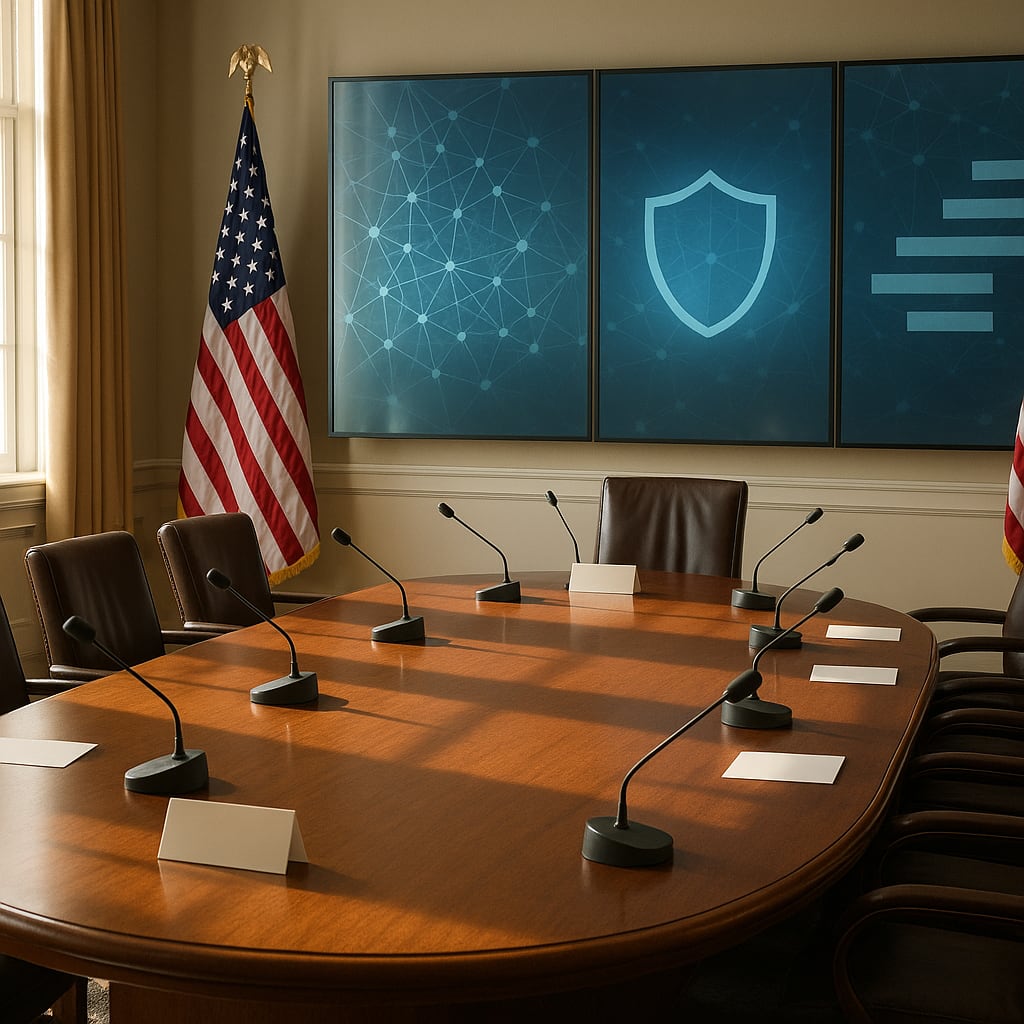
Trump unveils voluntary AI self-policing accord with major tech firms, vows not to “stifle” development
Narrative Snapshot
Across North American outlets, coverage centers on the White House’s choice of a voluntary model and Trump’s pledge not to “stifle” AI, with Canadian reports highlighting a self-policing pact and the U.S. framing the effort as “super intelligence” at the president’s urging. European coverage stresses the “morally binding” nature of the commitments and Trump’s rhetoric that AI is “bigger than the industrial revolution,” while an Italian account points to a White House text outlining four tiers of controls and checks. A British report dwells on the accord’s presentation, noting a misspelling under the president’s signature.
Latin American and Middle Eastern reporting probes operational and political ballast: the Argentine account says the pact includes internal and external audits, could be codified into law, and even touches siting tensions around data centers; Al Jazeera situates the accord amid mounting calls for stricter regulation. U.S. analysis also links the initiative to an earlier round of voluntary commitments under President Biden, asking whether self-policing suffices given high-profile safeguard failures. Asian coverage situates the move alongside U.S.–China dynamics: a Chinese policy adviser argued Washington and Beijing cannot decouple on AI, and separate reporting says Trump and Xi discussed “Super Intelligence” during the Chinese leader’s Washington visit.
What Happened
President Donald Trump convened leading technology chiefs at the White House and announced a voluntary accord under which companies would “self-police” artificial intelligence, while emphasizing the government would not limit AI’s development. Trump characterized AI as “bigger than the industrial revolution,” and, according to the New York Times, pressed to rebrand the field as “super intelligence.” Reports identify signatories as Google, Anthropic, Meta, OpenAI, X and NVIDIA, with Microsoft also involved in the talks. European and Italian outlets describe the commitments as “morally binding,” and Corriere della Sera reports a White House text on “Superintelligence” detailing four levels of controls and checks. Clarin adds that the pact includes internal and external audits and could later be turned into law. The Guardian noted a misspelling—“President of the Unites States”—on the accord document.
Why It Matters
The White House is doubling down on a governance-by-commitment model that relies on firms to set and enforce guardrails, a posture the New York Times says echoes voluntary steps taken under President Biden even as examples of safeguard failures have accumulated. If the Argentine reporting holds—internal and external audits with a path to codification—the accord could become a template for legislative uptake, but it currently sits outside statutory enforcement, framed by European outlets as “morally binding.” Internationally, the move unfolds as Washington calibrates AI competition and dialogue with Beijing. A senior Chinese academic argued U.S. and Chinese AI development cannot fully decouple and should avoid a cold war dynamic, while Fox News reports Trump and Xi discussed “Super Intelligence” during the Chinese leader’s visit. The accord’s framing, including the “super intelligence” label, may shape where transnational norms coalesce—or fragment—around safety, audits, and platform accountability.
Diverging Narratives
Supportive accounts emphasize speed and economic upside, foregrounding Trump’s vow not to “stifle” AI and his claim that it rivals the industrial revolution, while highlighting industry’s willingness to adopt safeguards voluntarily. French, German, and Canadian reporting converges on the self-policing frame, with France24 and Corriere della Sera underscoring a “morally binding” character and structured control tiers, a formulation that implies internal discipline without legal compulsion. The New York Times’ day-two analysis questions sufficiency, noting the plan reprises Biden-era voluntary commitments despite mounting evidence of inadequate safeguards, and Al Jazeera situates the accord amid intensifying calls for stricter regulation. Clarin introduces more concrete mechanisms—internal and external audits and a stated possibility of turning the pact into law—plus operational concessions to reduce opposition to data centers, which few other outlets mention. The Guardian focuses on presentational credibility, flagging the misspelling on the document alongside the push to rebrand AI as “super intelligence,” adding an optics dimension to an otherwise policy-heavy story. Asian reporting widens the aperture to geopolitics, reminding readers that U.S.–China interaction on AI remains structurally in play.
What Happens Next
Two decision tracks emerge from the reporting. First is implementation: whether companies operationalize the reported four levels of controls and conduct internal and external audits. Evidence would include public release of control-tier frameworks, third-party assessment protocols, and any White House updates on the “morally binding” commitments described by European outlets and Clarin. Second is codification: Clarin’s note that the pact could become law sets a legislative watch point; signals would be draft bills incorporating audit requirements or formal oversight of the voluntary safeguards that the New York Times says mirror Biden-era commitments. Internationally, analysts should watch whether U.S.–China exchanges on “Super Intelligence,” reported by Fox News and previewed by the South China Morning Post as an agenda item, yield any joint principles or channels that temper decoupling pressures. Domestically, measures to ease community opposition to data centers, mentioned by Clarin, will indicate how industry translates the accord into siting and infrastructure decisions.