
Brazil heads to first-round vote with Lula and Flávio Bolsonaro neck-and-neck, runoff rules in focus
Narrative Snapshot
Across international and Brazilian outlets, there is broad convergence that the presidential contest is extremely tight and structurally set up for a likely runoff if no one crosses the majority threshold of valid votes. German, British, Qatari, Canadian, Italian, Indian, and Chinese state and commercial media all frame the race as a near tie entering the first round, repeatedly emphasizing the two-candidate focus despite a broader field and pointing to the institutional mechanism of a second round later in October should neither contender clear 50 percent of valid ballots.
Where coverage diverges is in emphasis. Brazilian and Argentine outlets expand the aperture to the legislature, with analysis that Congress has been accumulating power relative to the executive and is likely to gain further influence in this cycle; they also flag growth expectations for Flávio Bolsonaro’s Liberal Party. Other reporting concentrates on voter priorities and socioeconomic baselines, noting families’ mix of higher employment and income alongside heavier debt burdens, and foregrounds crime and the economy as salient concerns.
Campaign narratives are framed differently across geographies. Left-leaning Latin American coverage centers programmatic contrasts on labor protections, public investment, deregulation, and privatization, linking them to competing diplomatic postures. Several Asia- and Europe-based outlets situate the vote within a putative regional rightward drift and the attention of U.S. political actors, while French coverage references debate over alleged U.S. interference as part of the campaign’s backdrop. Brazilian and European dispatches also highlight late-stage mobilization in major cities, with São Paulo and Rio de Janeiro presented as decisive theaters.
What Happened
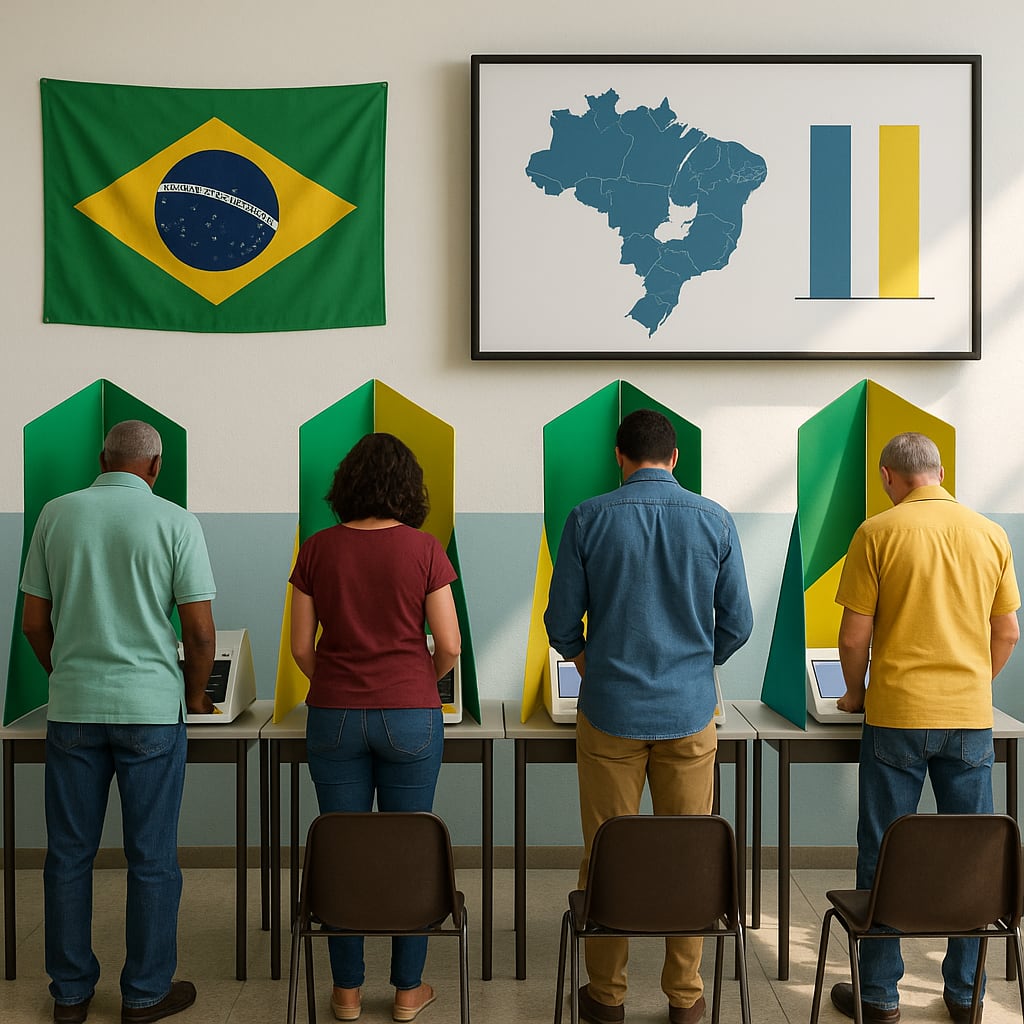
Brazilians were set to vote on October 4 in the first round of a general election that selects the president, governors, the Chamber of Deputies, and two-thirds of the Senate, with roughly 160 million citizens eligible to participate. Thirteen candidates are on the presidential ballot, but coverage consistently identifies President Luiz Inácio Lula da Silva and Senator Flávio Bolsonaro as the frontrunners. Multiple polls, including Datafolha cited in Folha de S.Paulo, indicate a very close race likely to be decided in a second round if no candidate surpasses 50 percent of valid votes, a threshold that excludes blank and null ballots; a runoff would occur on October 25. Campaigning culminated with large Lula-led marches in São Paulo and Rio de Janeiro. Voting also opened for Brazilians in China despite the overlap with the country’s Golden Week holiday, according to Folha de S.Paulo.
Why It Matters
The election will shape Brazil’s policy trajectory under tightening constraints from an assertive legislature. Reporting from Argentina underscores that Congress has been accumulating authority and is expected to increase its influence further, with projections of gains for Bolsonaro’s Liberal Party—an outcome that would condition any presidential agenda through coalition management and bargaining over spending, regulatory policy, and appointments. Al Jazeera’s focus on crime and the economy, together with Folha de S.Paulo’s finding that households have more jobs and income but also higher debt, points to a demanding macro-fiscal environment for the next administration regardless of who wins.
Several outlets frame the vote in regional and international terms. Japan Times and Bangkok Post present it as a test of whether Brazil aligns with a broader rightward turn in the Americas watched closely by U.S. political figures. Telesur English emphasizes divergent economic and diplomatic orientations—state-led social development and multipolar diplomacy versus deregulation, privatization, and conservative-aligned foreign policy—while Le Monde notes the campaign unfolded amid debate about alleged U.S. interference. The result will signal Brazil’s stance within these competing narratives.
Diverging Narratives
Different outlets weight the stakes of the election unevenly. Telesur English situates the contest as a choice between socioeconomic models with clear domestic and foreign policy fault lines—minimum wage increases and public investment versus deregulation and privatization—embedding foreign policy in terms of multipolarism versus conservative alignment. By contrast, the BBC, Deutsche Welle, ANSA, and AP copy published by the Toronto Star largely treat the race as a statistical toss-up, foregrounding process and timing, with limited programmatic detail.
Institutionally focused reporting from Clarin highlights that the legislature’s leverage over the executive is rising and anticipates growth for the Liberal Party, an angle less present in North American and European coverage that centers the presidency. Al Jazeera’s coverage places voter anxieties about crime and the economy at the forefront, while Folha de S.Paulo introduces a mixed socioeconomic baseline—higher employment and income alongside increased indebtedness—without adjudicating which side benefits. On electoral dynamics, Clarin cites last-minute polls narrowing Lula’s advantage to within the margin and expresses concern about abstention, whereas other outlets emphasize the rules governing valid votes and the procedural expectation of a runoff without spotlighting turnout risks. Internationally, Japan Times and Bangkok Post cast the election within a rightward regional trend tied to U.S. political figures, while Le Monde references debate over alleged U.S. interference; most other outlets do not foreground that theme.
What Happens Next
Three decision points will shape the immediate trajectory. First is whether any candidate surpasses 50 percent of valid votes; if not, a runoff on October 25 will follow under rules that exclude blank and null ballots, as noted by The Hindu and Clarin. Indicators to watch include turnout and abstention, which Clarin flags as a concern, and vote distribution in the Southeast, especially São Paulo, the country’s largest electoral college highlighted in coverage of Lula’s mobilizations.
Second is the composition of Congress. Clarin reports that the legislature’s role is expanding and anticipates growth for the Liberal Party. The size and cohesion of blocs emerging from the vote will determine coalition options and the feasibility of advancing or blocking fiscal, regulatory, and social policy proposals.
Third is subnational power. As TASS and CGTN note, gubernatorial races run alongside the presidential vote. Control of key statehouses will influence federal–state coordination and the political networks available to either presidential contender in a potential runoff and subsequent governing.