
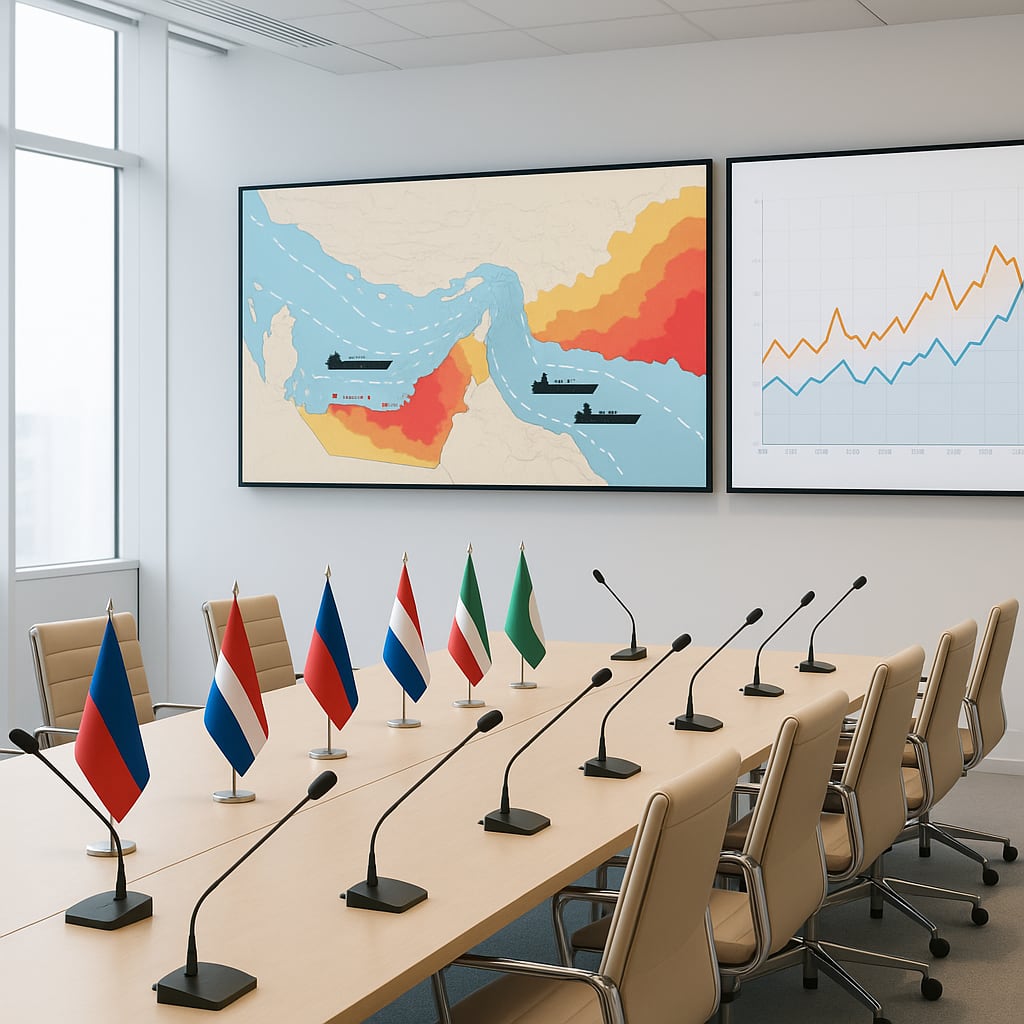
Iran insists Hormuz stay closed until conditions met as Washington touts “ironclad” control and reports cite tanker strikes
Narrative Snapshot
Coverage clusters around two hardline positions delivered through different information ecosystems. Iranian officials, across IRNA, Tehran Times, and statements relayed by The Hindu, ANSA, and Folha de S.Paulo, frame closure as a sovereign security measure tied to explicit “seven conditions” in an Islamabad memorandum and broader claims that no regional infrastructure is secure if Iran’s own security and oil exports are denied. By contrast, US Defense Secretary Pete Hegseth is quoted by Middle East Eye as asserting an “ironclad” blockade and control of the Strait, with throughput “almost at prewar levels.”
Chinese state outlet CGTN, citing Iran’s Fars and an open-source account, highlights a kinetic environment by reporting IRGC strikes on at least seven “violating” tankers over five days, including named Kuwaiti and Emirati vessels. That account sits alongside a Middle East Eye opinion arguing that insurer risk aversion has sharply curtailed traffic, underscoring a non-kinetic constraint on navigation. Iranian outlets simultaneously elevate maritime power as a pillar of resilience and contend US forces have pulled back from Gulf waters, suggesting a shift in deterrence dynamics and signaling leverage beyond the strait itself.
What Happened
Iran’s parliament speaker Mohammad Bagher Ghalibaf said the Strait of Hormuz will remain closed until seven conditions in an Islamabad memorandum are fulfilled, with IRNA stressing Tehran will not base security policy on US statements or tweets. The Hindu and ANSA reported the same position, with Ghalibaf quoted as saying Iran will “fight and negotiate” but will not accept unilateral demands; Folha de S.Paulo linked the conditions to a provisional arrangement with the United States in June. Earlier, Ghalibaf warned via TASS and The Hindu that if Iran cannot sell oil, no regional oil exports would be secure. In parallel, Middle East Eye reported US Defense Secretary Pete Hegseth calling a US “blockade” of Hormuz ironclad. CGTN, citing Fars and an independent observer, reported the IRGC hit at least seven “violating” tankers in five days. Iranian outlets highlighted maritime capabilities and claimed US forces had moved farther from regional waters.
Why It Matters
The standoff exposes how control of a critical chokepoint intersects with sanctions enforcement, regional deterrence, and commercial risk. Iranian officials explicitly link navigation to conditions in an Islamabad memorandum and to the ability to export oil, challenging assumptions that freedom of navigation can be insulated from broader coercive bargaining. US statements of command of the waterway, set against reports of tanker strikes and Iranian claims of force repositioning, test the credibility and cost of maritime security guarantees. The emphasis by Iran’s presidency and senior commanders on “regional responsibility” reframes Gulf security as a regional public good under strain.
For decision-makers, this touches energy security, insurance and reinsurance viability for passage, and the leverage embedded in conditional reopening. It also interacts with nonproliferation signaling—Hegseth’s line on preventing an Iranian nuclear weapon—and the resilience of informal understandings, such as the June provisional framework referenced by Folha de S.Paulo and the Islamabad memorandum cited by IRNA.
Diverging Narratives
Two incompatible depictions of the waterway emerge. Middle East Eye quotes Hegseth asserting that Iran “doesn’t control it, we do,” and that throughput is near “prewar levels,” while CGTN, citing Fars and MenchOsint, reports repeated IRGC strikes on “violating” tankers and names vessels from Kuwait and the UAE as affected. An opinion piece in Middle East Eye further contends that insurers have been unwilling to underwrite transit, claiming only two commercial crossings on 22 September; that perspective highlights market restraint rather than naval presence as the binding constraint. Iranian state media and allied outlets center the “seven conditions” as the operative reopening mechanism but do not enumerate them, leaving external audiences without visibility into benchmarks for de-escalation.
Tehran Times reports an IRGC claim that US forces have moved more than 500 kilometers from regional waters, casting Washington as deterred, whereas Hegseth presents the US posture as dominant and effective. Ghalibaf’s warnings via TASS and The Hindu that no regional exports would be secure if Iran’s exports are blocked position closure and insecurity as reciprocal, not unilateral. Across these accounts, the operational status of the strait—open under protection, closed pending conditions, or open but hazardous—differs by source, with limited shared, independently verified metrics in the provided reporting.
What Happens Next
Key decision points are defined by stated conditions and risk tolerance. First, whether the “seven conditions” in the Islamabad memorandum are detailed and addressed: IRNA ties reopening explicitly to their fulfillment, while ANSA notes US proposals exist; public articulation or partial sequencing of these items would signal a negotiable path. Second, navigational risk on the water: CGTN’s reporting of IRGC strikes suggests continued interdiction of “violating” vessels, while Hegseth’s assurance of high throughput claims safe passage; further documented incidents or sustained, named transits will clarify which dynamic dominates. Third, force posture: Tehran Times’ claim of US pullback versus any visible reinforcement will indicate whose deterrence narrative holds. Finally, commercial behavior matters; the Middle East Eye opinion’s assertion of insurer reluctance points to market gating of transit—changes in underwriting or reported crossing counts would show whether security assurances translate into restored flows.