
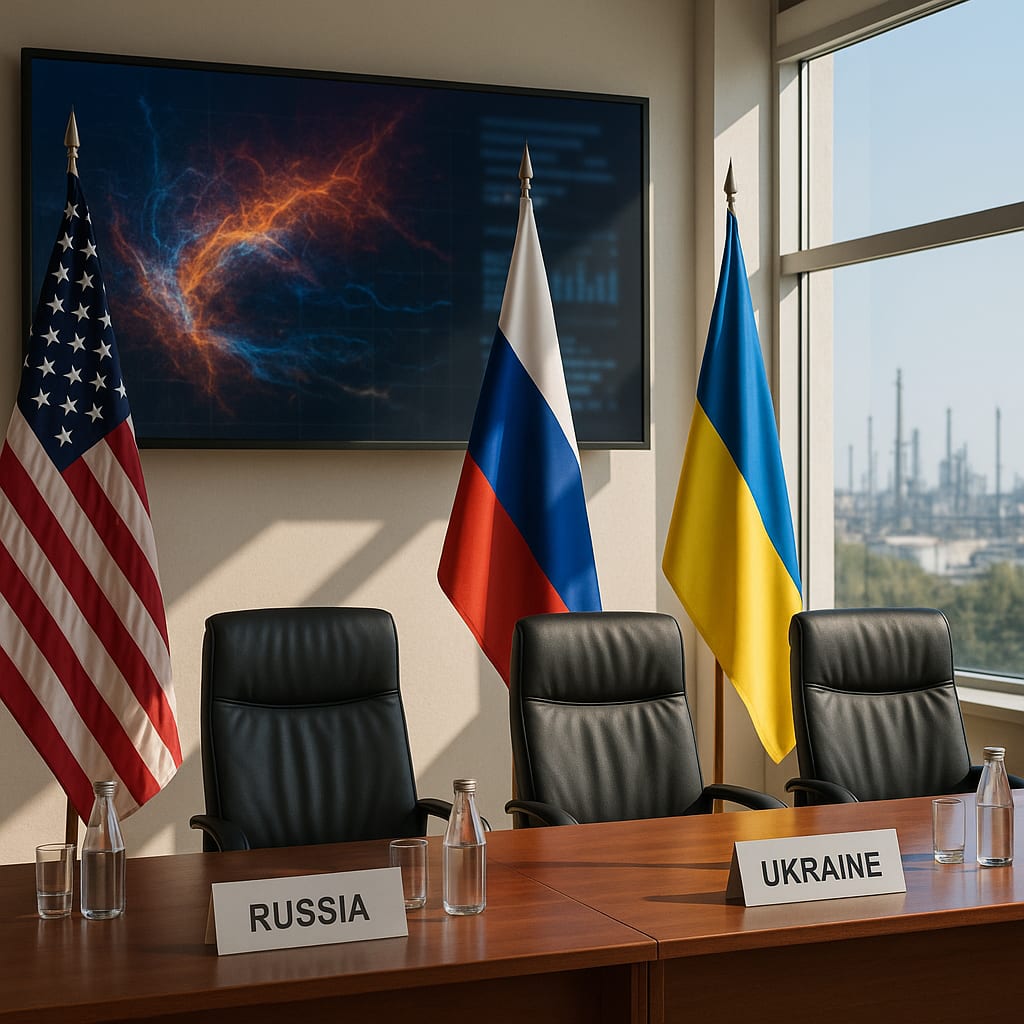
Reports link U.S.–Russia Ukraine talks to potential Lukoil asset sale, as Kyiv accepts U.S.-proposed technical meeting
Narrative Snapshot
Across U.S., Ukrainian, and Indian outlets, there is alignment that negotiations now include a large energy component and a U.S.-facilitated technical meeting that Ukraine says it is ready to attend. The Hindu advances the commercial specifics, citing a deal tied to Lukoil’s global assets that would need clearance from both Washington and the Kremlin, while U.S. and Ukrainian reporting centers on the fact of discussions rather than deal structure.
Russian state outlets frame the diplomatic track as continuous and tied to economic relief through lower energy prices. That contrasts with parallel messaging from Moscow-aligned media portraying Western policy as escalatory—via UK sanctions and EU defense-industrial initiatives—rather than geared to diplomacy.
Coverage around Jared Kushner diverges on ethics. Middle East Eye relays a CNN-based critique of his financial stakes in an Israeli company linked to defense firms, while Fox News highlights Kushner’s rebuttal emphasizing CNN’s own caveat that it found no indication his diplomatic actions directly affected the investments reviewed. Kyiv- and Latin America–based reports emphasize Ukraine’s willingness to engage at a technical level and a potential late-October timetable, foregrounding process and venue rather than the energy angle.
What Happened
The New York Times reported that Vladimir Putin raised a sale of Russian energy assets in talks with Jared Kushner and Steve Witkoff, inserting a major commercial element into U.S.–Russia discussions (NYT, Oct. 3). The Hindu said the contemplated transaction involves Lukoil’s oil fields, refineries, and gas stations worldwide and would require approval from both the U.S. government and the Kremlin (The Hindu, Oct. 3). Ukrainian outlets noted the reporting and separately covered Kyiv’s stance: President Volodymyr Zelensky said Ukraine is ready for U.S.-proposed, trilateral technical talks, potentially in the UAE by the end of October, and that “the ball is now in Russia’s court” (Ukrinform, Oct. 4; Kyiv Independent, Oct. 4; Al Jazeera, Oct. 4; Clarin, Oct. 4). TASS quoted the U.S. energy secretary saying President Trump is in constant dialogue to end the war and lower energy prices (TASS, Oct. 4). Middle East Eye relayed CNN-based conflict-of-interest concerns about Kushner’s investments; Fox News reported Kushner’s rebuttal (MEE, Oct. 1; Fox News, Oct. 2). Additional context included Putin praising India’s prime minister’s ideas on settlement (The Hindu, Oct. 2), a Russian embassy critique of UK sanctions (TASS, Oct. 1), and EU defense-industrial moves (RT, Sept. 28).
Why It Matters
Binding a prospective commercial transaction to wartime diplomacy touches multiple policy regimes at once. The Hindu’s note that any Lukoil asset sale would require U.S. and Kremlin approvals signals intersections with national security and regulatory oversight on both sides, while Russian messaging links diplomatic progress to energy price relief (The Hindu, Oct. 3; TASS, Oct. 4). Kyiv’s acceptance of U.S.-facilitated technical talks—potentially in the UAE—indicates a channel for procedural engagement even as front-line fighting and sanctions dynamics continue (Ukrinform, Oct. 4; Al Jazeera, Oct. 4).
Simultaneous European hardening—UK sanctions criticized by Moscow and EU defense-industrial expansion—illustrates that any diplomatic-commercial package would unfold alongside intensified defense and coercive measures, not instead of them (TASS, Oct. 1; RT, Sept. 28). Scrutiny of Kushner’s financial ties, and his pushback, underscores the salience of conflict-of-interest norms for the perceived legitimacy of U.S. mediation, particularly in a negotiation where an energy asset sale is reportedly on the table (MEE, Oct. 1; Fox News, Oct. 2).
Diverging Narratives
Accounts differ on emphasis and framing. U.S. and Ukrainian reporting foregrounds the existence of talks and Ukraine’s readiness for a U.S.-proposed technical meeting, with The Hindu adding transactional detail about a Lukoil-linked deal contingent on government approvals (Kyiv Independent, Oct. 4; Al Jazeera, Oct. 4; The Hindu, Oct. 3). Russian state media highlights sustained U.S. engagement and explicitly ties ending the war to lowering energy prices, while separately arguing that UK sanctions and the EU’s defense push signal Western disinterest in a political settlement (TASS, Oct. 4; TASS, Oct. 1; RT, Sept. 28).
On ethics, Middle East Eye amplifies a CNN report flagging potential conflicts arising from Kushner’s stakes in an Israeli company with investments in defense firms, whereas Fox News centers Kushner’s response that CNN found no indication his diplomatic actions directly affected reviewed investments (MEE, Oct. 1; Fox News, Oct. 2). Unresolved elements include the scope and terms of any Lukoil asset sale, how it relates operationally to the diplomatic track beyond being raised in discussions, and whether Russia will accept the proposed technical meeting timeline and venue that Ukraine says it can attend (NYT, Oct. 3; Ukrinform, Oct. 4; Clarin, Oct. 4).
What Happens Next
Key decision points are clustered around process, approvals, and optics. First is whether Moscow accepts the U.S.-proposed technical meeting that Kyiv says it is ready to attend in the UAE or another U.S.-proposed venue by end-October; Ukrainian officials portray the next move as Russia’s (Ukrinform, Oct. 4; Kyiv Independent, Oct. 4; Al Jazeera, Oct. 4). Second is whether discussions over Lukoil assets progress toward the dual approvals The Hindu says would be necessary, an indicator of whether the commercial track is advancing alongside diplomacy (The Hindu, Oct. 3). Third is how ethics scrutiny evolves: further media or official attention to Kushner’s investments versus continued emphasis on CNN’s caveat reported by Fox will shape perceptions of U.S. envoy credibility (MEE, Oct. 1; Fox News, Oct. 2). Analysts should also watch Russian statements linking diplomacy to energy prices and European policy moves on sanctions and defense industry for signals of broader negotiating context (TASS, Oct. 4; TASS, Oct. 1; RT, Sept. 28).