
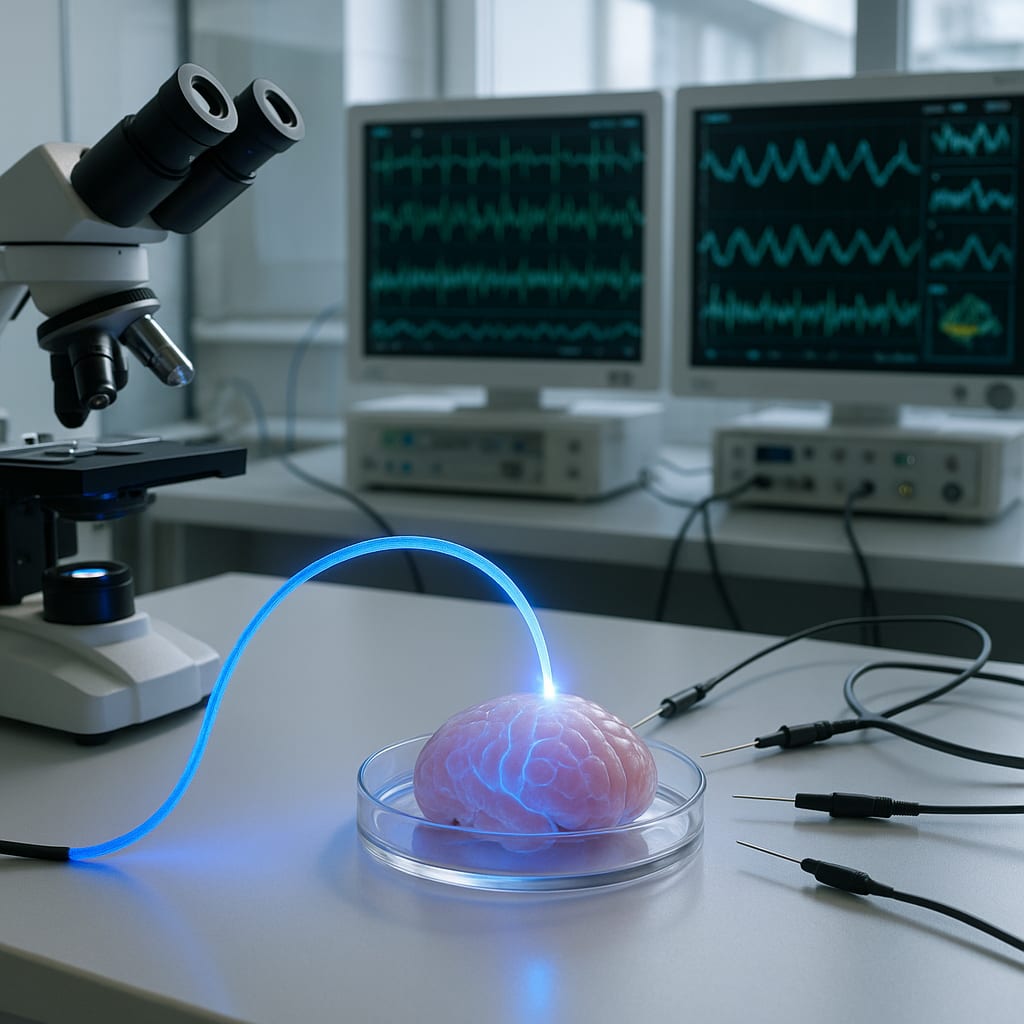
Nobel Prize in Medicine 2026 honors Deisseroth, Hegemann, and Nagel for optogenetics
Narrative Snapshot
Across outlets in Europe, the Americas, and Asia, coverage converges on optogenetics as the centerpiece and credits the trio’s discovery of light-gated ion channels as the enabling breakthrough. European reporting often foregrounds the mechanism and institutional context: Le Monde emphasizes the insertion of specific membrane proteins to switch neurons on or off and the dual basic-and-therapeutic stakes, while the South China Morning Post quotes the committee’s claim that individual nerve cells can be toggled in living brains and notes the prize opened Nobel week in Stockholm. Anglo-American pieces add biographical and institutional detail, with the Guardian listing the laureates’ affiliations and the BBC highlighting Karl Deisseroth’s role as a psychiatrist and neurologist.
Several outlets extend the lens to prospective clinical impact. Deutsche Welle and France 24 describe optogenetics as a tool with implications for treating blindness, depression, addiction, and dementia, and Telesur English reports progress toward vision restoration alongside mapping circuits for pain, social behavior, and circadian rhythms. Latin American reporting complements this with accessible framing of the technique’s reach into movement, memory, emotions, and diseases such as Parkinson’s and epilepsy, with Clarín also offering a profile interview with Georg Nagel. At stake, as La Repubblica’s interview with an optogenetics expert suggests, is the translation horizon: optimism about human application tempered by acknowledgment of difficulties to overcome before routine clinical use.
What Happened
The Nobel Assembly at the Karolinska Institute in Stockholm announced on Monday, October 5, 2026, that Karl Deisseroth, Peter Hegemann, and Georg Nagel won the Nobel Prize in Physiology or Medicine for discoveries concerning light-gated ion channels and optogenetics. The committee lauded work that makes it possible to switch the activity of individual nerve cells on or off in living brains, a foundation of modern optogenetics reported across outlets from Folha de S.Paulo to the New York Times, CBC News, and TASS. France 24 notes the award carries 12 million Swedish kronor and the South China Morning Post adds the announcement opened Nobel week. Reporting highlights the laureates’ backgrounds and affiliations, including Deisseroth’s roles at Stanford and HHMI and Hegemann and Nagel’s German university posts, detailed by the Guardian and Deutsche Welle.
Why It Matters
Multiple outlets tie this recognition to a wider shift in neurotechnology from circuit mapping to therapeutic avenues. Deutsche Welle, France 24, and the Bangkok Post describe optogenetics as unlocking potential breakthroughs for blindness, depression, addiction, and dementia, while Clarín and Telesur English extend that horizon to Parkinson’s, epilepsy, and modulation of behaviors and physiological states. Le Monde frames a dual mandate—unraveling fundamental brain function and developing innovative treatments—placing the field at the intersection of basic neuroscience and clinical translation.
For decision-makers, this codifies optogenetics as a strategic research domain spanning psychiatry, neurology, and ophthalmology. Telesur English’s reporting of progress toward sight restoration and La Repubblica’s interview noting obstacles before human application signal the need for pathway planning: investment in translational infrastructure, interdisciplinary teams, and trial design for gene-and-light-based interventions. The trans-Atlantic character of the laureates’ institutions, highlighted by the Guardian and Deutsche Welle, underscores the cross-border collaboration likely to shape funding priorities and clinical pathways.
Diverging Narratives
Emphases vary by outlet. Mechanistic accounts from Le Monde, ANSA, and the South China Morning Post spotlight how optogenetics works and the committee’s rationale. Clinical-forward narratives from Deutsche Welle, France 24, and the Bangkok Post stress therapeutic prospects, naming conditions from blindness to depression and dementia. BBC and Telesur English frame the advance through cognition and behavior, describing how nerve cells shape feelings, memories, pain, social behavior, thirst, and attention, thus anchoring the technology’s explanatory power for complex functions. Latin American coverage by Clarín blends lay explanation of capabilities with disease applications and includes a human-interest profile of Nagel.
Temporal and institutional framing also differs: the South China Morning Post and Al Jazeera situate the announcement within Nobel week’s broader calendar, while France 24 details the purse. The Guardian enumerates affiliations, emphasizing established elite research ecosystems. A counterweight to translational enthusiasm appears in La Repubblica’s interview with an Italian optogenetics researcher, who highlights difficulties that must be overcome before broader human use, signaling caution on timelines and pathways from lab to clinic despite reports of progress in restoring sight.
What Happens Next
Two decision points emerge from the coverage. First is the degree of push toward clinical translation. Telesur English reports progress in applying optogenetics to restore vision, while Deutsche Welle and the Bangkok Post outline targets in psychiatric and neurological disease. Movement toward trials in ophthalmology or neuropsychiatry would indicate a translational track gaining priority; a continued emphasis on circuit mapping, as highlighted by BBC, Clarín, and Telesur English, would suggest consolidation of optogenetics as primarily a research tool for now.
Second is how actors navigate the hurdles flagged in La Repubblica’s interview about eventual human use. Signals to watch include institutional announcements of translational programs, cross-disciplinary consortia anchored at the laureates’ noted institutions, and funding calls that explicitly link optogenetic mechanisms, described by Le Monde and the South China Morning Post, to disease endpoints cited by Deutsche Welle and France 24. The balance of reporting on vision-restoration progress versus caution about obstacles will indicate the field’s near-term trajectory.